How Large Can Human Civilization Become? Three Orders of Magnitude from Earth to Matrioshka Brains

SFIA's three-path analysis estimates humanity's theoretical scale ceiling, from Earth to 10^52 digital minds in a Matrioshka Brain.
This article traces SFIA's three-round estimation of human civilization's theoretical scale. Round one finds Earth's real bottleneck is heat and governance, not area; the solar system could support trillions. Round two shows planet-colonization of the observable universe yields roughly 3×10^31 people — yet still captures less than one-billionth of stellar output. Round three introduces Dyson swarms and the modified Kardashev scale: a single Dyson swarm supports ~4×10^22 biological humans at 10kW each, while a Matrioshka Brain running at 30K could host ~10^33 digital minds. As scale grows, civilization inevitably fragments from unified empire into a diverse forest of cultures — a consequence of physics, not politics.
How large can human civilization ultimately grow? The question seems simple, but the answer depends on how you define "large": population, inhabited planets, available energy, distance of expansion, or the total lived experience of all conscious beings? Science popularization channel SFIA (Science & Futurism with Isaac Arthur) tackled this question in its 900th episode. The show estimates civilization's potential scale along three paths: expanding outward, scaling up energy and engineering, and transforming the mind itself. Each path yields an upper bound that far exceeds anything typical science fiction imagines.
This article traces the data and logic behind these three rounds of estimation, and examines which conclusions hold up and which deserve more scrutiny.
Round One: Baseline Humanity on Earth and in the Solar System
Earth's Upper Limit Isn't About Floor Space
Earth currently supports about 8 billion people. The show argues that with better agriculture, desalination, nuclear and solar energy, vertical farming, and biotechnology, supporting 10 to 20 billion people is entirely feasible. The real question is whether we can maintain livability, stability, freedom, and prosperity at that scale.
The show uses a set of "scale sanity checks" to demonstrate that surface area is far from the bottleneck. Earth's total surface (including oceans) is roughly 510 million square kilometers:
- At modern urban density of 10,000 people per km², that's about 5 trillion people;
- At high-rise density of 100,000 people per km², about 50 trillion;
- At arcology or deep underground city density of 1 million per km², about 500 trillion.
The show emphasizes these numbers aren't recommendations — they're just scale calibration. When people say "Earth is full at 10 billion," they mean existing infrastructure, political systems, agriculture, and ecological arrangements are already strained, not that there's physically no room. For ordinary people, a comfortable upper limit is set jointly by food, water, waste heat, governance, ecology, and psychology. As the show puts it: "Civilization is not a warehouse packed with mammals."
The Fragility of a Single Planet
No matter how elegantly Earth is developed, it still has only one biosphere, one climate system, and one gravity well. An asteroid, an engineered plague, or one very bad century could interrupt the entire human story. So the first truly meaningful expansion isn't building taller skyscrapers — it's leaving Earth.
The Solar System as Space Opera
The classic picture looks something like this: the Moon hosts mining towns and crater-based telescopes; Mars has dome cities undergoing gradual terraforming; Venus has floating cities in its upper atmosphere; Mercury becomes an industrial world; Ceres serves as a hub port; the moons of Jupiter and Saturn become research outposts and icy-ocean worlds.
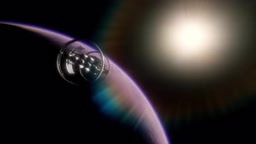
The show's estimate is cautious: the solar system has "many worlds but few front porches." Most bodies threaten life with vacuum, radiation, extreme cold, extreme heat, crushing pressure, or toxicity. Even so, if people are willing to live under domes, underground, or in rotating habitats, populations could reach hundreds of billions or even trillions. 1,000 settled worlds with 1 billion people each gives 1 trillion; 1 million settlements with 1 billion each gives 1 quadrillion (10^15).
The key takeaway from this round: planets are not the primary resource — they're just the resource humans most naturally identify with. Planets are massive objects with deep gravity wells, most of their material buried underground, contributing little beyond gravity and the occasional earthquake.
Round Two: Interstellar Expansion and a Galactic Family Tree
No Faster-Than-Light Travel, No Unified Empire
Traveling at 10% the speed of light, crossing the Milky Way takes about 1 million years; at 1% light speed, about 10 million years. The show notes that millions of years are not impossible for a civilization — they're just impossible for an empire that runs on electoral cycles.
Without faster-than-light communication, interstellar humanity won't be "one conversation" — it will be echoes, descendants, dialects, and legends. After a colony ship reaches Tau Ceti, Earth won't receive confirmation for over a decade or even a century, by which point both societies will have already changed. They'll share ancestors, linguistic roots, and ancient literature, but they won't belong to the same polity — just different branches of the same tree.
The 10% and 1% light-speed figures the show assumes fall into the "relativistic sub-light" category — they don't violate any known laws of physics, but the engineering challenges are enormous. For reference, Voyager 1, the fastest spacecraft humanity has ever launched, travels at roughly 0.006% the speed of light; at that speed it would take about 15 billion years to cross the galaxy. Reaching 1% light speed requires kinetic energy equivalent to roughly 0.005 times the spacecraft's rest mass — and when you account for fuel mass ratios (the Tsiolkovsky rocket equation), chemical propulsion is completely out of the question. Nuclear pulse propulsion, laser sails, and antimatter drives are the most-discussed candidates, each facing engineering challenges of many orders of magnitude. The show's deeper point is this: even if such speeds were technically achievable, information still travels at the speed of light — meaning no single political entity could maintain effective governance over a colony hundreds of light-years away. One-way communication lag alone would be measured in centuries. That's not a political choice; it's a physical constraint.
The Planet-Counting Numbers
- 1 million worlds at 1 billion people each: 10^15;
- 1 billion readily terraformable worlds at 10 billion people each: 10^19 (10 million trillion);
- The author's personal estimate of roughly 1 trillion Earth-like, Mars-like, and Venus-like planets in the galaxy, each hosting 10 billion people: 10^22, about a trillion times today's population.

Beyond the Milky Way
The Andromeda Galaxy is about 2.5 million light-years away — at 10% light speed, tens of millions of years away. The show proposes that intergalactic expansion could use the sparse stars and rogue planets between galaxies to gradually "percolate" along galaxy groups and cosmic filaments. With the industrial capacity of an entire galaxy behind you, fleet speeds might approach 90% light speed, eventually reaching galaxies up to about 12 billion light-years away — a region containing roughly 30 billion galaxies.
Using the planet-colonization model: 30 billion galaxies, each with 1 trillion planets, each hosting 1 billion people, gives a total of roughly 3×10^31. The show uses a Futurama-style bureaucratic calculation here — the "25-star General" joke — to make the point: if 1% of the population is in military service, with one one-star general per 10,000 soldiers and each additional star representing command over three times as many people, the supreme commander's shoulder would carry about 50 stars. And if each galaxy sends just one senator, the super-cluster congress would have 30 billion members.
All these absurd numbers make one thing clear: even covering the entire reachable universe, the planet-colonization model is extraordinarily inefficient. Less than one-billionth of the light the Sun emits actually reaches Earth.
Round Three: Actually Using Space Well — From Ecumenopolis to Kardashev Level 4
The Ecumenopolis Bottleneck Is Heat
In science fiction, planet-cities like Coruscant and Trantor tend to badly underestimate their own populations. Trantor's 40 billion people is only five times today's Earth. Earth's surface is about 500 quadrillion square meters — give each person 1,000 square meters (including farmland, roads, schools, hospitals, and other public facilities), and a single layer could hold about 500 billion people.
But the show's real constraint is heat. The human body itself runs at about 100 watts; factor in food, infrastructure, industry, transportation, and computing, and per-capita energy use is more like 10,000 watts. A trillion people is manageable; 10 trillion requires off-planet support; a quadrillion people creates a planetary-scale heat management crisis. As the show puts it, Earth would transform from a home into "a planet-sized heat sink with a flag stuck in it."
The Terran Swarm: Earth's Orbital Suburbs
Once you have orbital rings, space elevators, and lunar industry, there's no reason to pack everything onto the surface. The Terran Swarm refers to a network of habitats, farms, factories, power collectors, and radiators in Earth's orbital space. The advantages include: artificial 1g gravity through rotation, direct access to sunlight, easier heat rejection into space, and no need to haul raw materials up from the bottom of a gravity well.
Earth intercepts roughly 1.74×10^17 watts of sunlight. If an orbital swarm's collecting area expands to about 50,000 times Earth's cross-section, it could capture roughly 8.7×10^21 watts. At 10,000 watts per person, that's approaching 10^18 people; even at a luxurious 1 megawatt per person, that's still hundreds of quadrillions. The surface population could be dramatically reduced, with Earth returning to the role of "the old city."
The "Terran Swarm" concept in futurist literature usually appears as "Earth swarm" or "near-Earth orbital habitat belt," closely related to rotating space habitat concepts like O'Neill Cylinders. Physicist Gerard O'Neill systematically argued for the feasibility of rotating habitats in his 1976 book The High Frontier: centrifugal acceleration from rotation simulates gravity, large mirror arrays collect sunlight, and radiator panels shed heat into space. Compared to planetary surfaces, orbital habitats offer two key energy advantages: they can collect solar energy around the clock without atmospheric interference or planetary rotation, and their radiators can be oriented freely toward deep space, making waste heat rejection far easier. The Terran Swarm concept scales this up — from individual habitats to a dense infrastructure network throughout Earth's orbital space, with total light-collecting area far exceeding Earth's own cross-section. This bypasses the surface heat-rejection bottleneck and serves as the critical intermediate step in the show's multi-order-of-magnitude estimates.
Dyson Swarms and the Modified Kardashev Index
The show is emphatic: a Dyson swarm is not a solid shell. A solid shell would be structurally unstable. A Dyson swarm is a collection of vast numbers of independent orbital structures — more like a diffuse infrastructure mist than a rigid sphere, without the collision cascade risk (Kessler Syndrome) you'd find in low Earth orbit.
The show uses the modified Sagan-style Kardashev scale (MSS), measured in megawatts: K1 ≈ 10^10 MW, K2 ≈ 10^20 MW, K3 ≈ 10^30 MW, K4 ≈ 10^40 MW. Each 0.1 increment represents a tenfold increase in power.
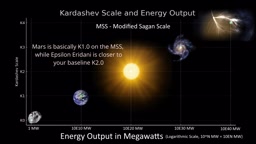
The Sun outputs roughly 4×10^26 watts — a standard K2.0. At 10,000 watts per person, that supports about 4×10^22 people; at 1 megawatt per person, about 4×10^20. A mature Dyson swarm would already surpass the classic "million-world empire" — even the "billion-world empire." The show calls this one of the most important scale corrections in futurism: stars are the main resource, not planets.
The Milky Way's total output is roughly 10^30 to 10^31 MW (K3.0 to K3.1), corresponding to 10^30 to 10^33 people. The Virgo Supercluster is roughly K3.9; the Laniakea Supercluster approximately K4; even the entire observable universe is only about K4.7. A K4 civilization doesn't build individual megastructures — it budgets by the galaxy. In a universe dominated by dark energy, distant galaxies are permanently receding beyond reach, so expansion is simultaneously a race to preserve matter.
The Kardashev Scale was proposed by Soviet astronomer Nikolai Kardashev in 1964, originally to assess the likely radio signal strength of extraterrestrial civilizations, later evolving into a general framework for measuring the scale of a civilization's energy mastery. The original definition has three levels: K1 controls planetary-scale energy (roughly 10^16 to 10^17 watts); K2 controls the full output of a star (roughly 4×10^26 watts); K3 controls an entire galaxy (roughly 10^37 watts). The original scale's weakness is its enormous gaps — K1 to K2 spans a factor of 10 billion, making it impossible to describe intermediate states. Carl Sagan later proposed a continuous version using 10^6 watts as a baseline, with K increasing by 0.1 for each tenfold power increase — what the show calls the Modified Sagan Scale (MSS). By this standard, today's human civilization is about K0.7; Earth's total intercepted sunlight is about K1.7; a complete Dyson swarm is about K2.0; and the galaxy's total output is about K3.0 to K3.1. The framework's central insight is this: it reframes civilizational development as a thermodynamic problem — the upper bound on civilization's scale is fundamentally determined by how much energy it can capture, convert, and use, not by territory, population, or military force.
Round Four: Post-Humans, Mind Uploading, and Matrioshka Brains
Modifying Ourselves Is Easier Than Terraforming Planets
The third upward leap starts with humanity itself. Genetic engineering, cybernetic augmentation, radiation resistance, low-gravity adaptation, extended lifespans, hibernation — the show sums up this direction in one line: "The easiest way to terraform the universe might be to terraform ourselves." Rather than turning Mars into Earth, cultivate humans who are adapted to Mars. Humanity would thereby evolve from a species into a lineage.
After Uploading, How Do You Count Population?
If a mind can be copied, paused, accelerated, merged, or forked, demographics loses its conventional meaning: are ten copies of someone ten citizens? If copies merge, has someone died? Are a trillion people running at one-thousandth speed a smaller civilization, or just a more patient one? The show argues that as long as simulated minds are real, their joys and sorrows are just as genuine as ours — just as Shakespeare is still Shakespeare whether printed on paper or displayed on a screen.
The Thermodynamic Logic of Matrioshka Brains
A Matrioshka Brain is a variant of the Dyson swarm composed of multiple nested layers. Inner layers absorb sunlight and perform computation, radiating waste heat outward; outer layers capture this lower-temperature radiation and compute with it. If each successive layer is four times farther out than the previous one, it has sixteen times the area — radiating at roughly half the temperature for the same power, which means each unit of energy can perform roughly twice as much computation.

The show uses the Landauer limit to estimate a lower bound. Assuming simulating one human brain requires about 10^15 operations per second, and at 30K the minimum energy per bit operation is about 3×10^-22 joules, the theoretical energy cost of one human-equivalent simulation is about 3×10^-7 watts — roughly one-third of a microwatt. A biological brain uses 20 watts.
| Scale | Power | At 20W biological brain | At 30K Landauer limit | With 6-order-of-magnitude loss |
|---|---|---|---|---|
| K1 World Brain | ~10^16 W | 5×10^14 | ~3×10^22 | ~3×10^16 |
| K2 Matrioshka Brain | ~4×10^26 W | 2×10^25 | ~10^33 | ~10^27 |
| K3 Galactic Brain | 10^36–10^37 W | 5×10^34–5×10^35 | 3×10^42–3×10^43 | 10^36–10^37 |
| K4 Supercluster Brain | ~10^46 W | 5×10^44 | ~3×10^52 | ~10^47 |
The gap that digitization opens is enormous: for the same energy budget, cold-running digital minds outnumber biological humans by roughly 7 to 8 orders of magnitude. This is why the show treats AI and mind uploading as the single largest variable in civilizational scale.
Landauer's principle was proposed by physicist Rolf Landauer in 1961. It states that erasing one bit of information must release a minimum amount of heat equal to kT·ln2, where k is the Boltzmann constant and T is the thermodynamic temperature of the system. This principle directly links information processing to the Second Law of Thermodynamics: computation inevitably generates entropy, and lowering the ambient temperature is the only physical way to reduce energy cost per operation. At room temperature (300K), the minimum energy for a single bit erasure is about 3×10^-21 joules; at 30K, this drops to about 3×10^-22 joules — one order of magnitude lower. The Matrioshka Brain exploits precisely this principle: the outer layers operate in ever-cooler radiation environments, so the same energy budget supports progressively more computation. It's worth noting that Landauer's limit is a theoretical floor — real computing systems, due to memory access, signal transmission, error correction, and other overhead, operate many orders of magnitude above this limit. The show's assumption of roughly 10^15 operations per second per human brain is also deeply contested — there's considerable disagreement in both neuroscience and computer science about this figure.
The Limitations of These Estimates
Several caveats are worth keeping in mind. The figure of 10^15 operations per second is a rough and disputed estimate, and "operations" don't map cleanly onto "bit erasures." The Landauer limit is a theoretical floor; real systems carry additional overhead for storage, wiring, error correction, and redundancy — the show itself recommends multiplying by a factor of a thousand to a million. Furthermore, these calculations only account for energy, and assume minds run in real time. Given that current computing is nowhere near physical limits, these numbers should be treated as directional indicators, not predictions.
The Larger the Civilization, the Less It Looks Like "One" Civilization
The show's final answer is not a single number. Human civilization could be 10 billion people thriving on Earth, trillions in a planet-city, quadrillions in a Terran Swarm, 10^22 biological people or 10^33 digital minds around a single star, 10^43 minds in a galaxy, or 10^52 minds across a supercluster.
The larger the scale, the harder it is to remain unified. A small civilization can have a capital. A planetary civilization can share media. An interstellar civilization shares traditions and archives. A galactic civilization has only branches. The descendants of a cosmic civilization might recognize each other only through mathematics, bloodlines, or ancient stories about "a pale blue dot beside a yellow star." The show sees this not as failure: the largest human civilization may not be an empire at all, but a billion civilizations descended from humanity — some biological, some digital, some familiar, some alien.
As the show closes: the question isn't only how large human civilization can grow, but how much future we are willing to create.
Related articles

The Other Side of the Agricultural Revolution: How Disease Helped Farmers Defeat Hunter-Gatherers
Historian Kyle Harper explains how agricultural societies defeated hunter-gatherers: not only through population growth from superior energy extraction per unit of land, but also through pathogens bred by settled life that caused extra mortality during expansion—a dual replacement mechanism.

Why Is AI-Generated Language So Hard to Understand?
Why is AI-generated language fluent yet hard to understand? Based on a Hacker News discussion, this article analyzes the cognitive load of AI text from three angles—imbalanced semantic density, lack of common ground, and side effects of alignment training—and offers practical advice for getting along with AI language.

Progressive Disclosure Makes Agents 2.3x Faster: A New Approach to Context Engineering
A Hacker News discussion proposes using progressive disclosure to optimize AI agent context, achieving a 2.3x speedup. This article analyzes the three performance costs of context bloat and introduces practical approaches such as layered tool catalogs, on-demand retrieval, and history compression, along with implementation considerations.