How MCP Connectors Enable LLMs to Handle the Hardcore Math of Environmental Emissions Compliance

MCP connectors give LLMs pre-validated deterministic tools for EPA stack testing math, eliminating hallucination risk in emissions compliance.
Using industrial emissions compliance as a lens, this article argues why LLMs as probabilistic engines cannot independently handle rigid mathematical workflows like EPA Method 5. The Stack Testing Protocol Designer encapsulates sampling strategy, traverse point calculation, test duration, and compliance validation as four deterministic MCP tools — letting AI agents call pre-validated logic instead of deriving isokinetic formulas themselves. The article further argues that deploying such connectors to production requires robust security governance, which Vinkius provides via V8 sandbox execution, eight-layer policies including SSRF and DLP protection, and single-token access built on the MCPFusion framework.
Industrial emissions monitoring compliance has never been a simple matter of following rules — it's precision mathematics under physical constraints. Take EPA stack testing methods as an example: a single decimal point error when calculating traverse points or sampling heights can invalidate an entire test, resulting not only in costly retesting but potential legal liability.
The problem is that when you hand this kind of highly mathematical, rigidity-driven workflow to a large language model (LLM), the conventional approach is to dump a pile of regulatory PDF manuals into the model and pray it doesn't botch the decimal points. This approach is doomed to fail, because LLMs are fundamentally probabilistic engines being asked to perform deterministic calculations. Bridging that gap requires more than prompt engineering — it requires exposing the mathematical logic to the model as structured tools through the Model Context Protocol (MCP).
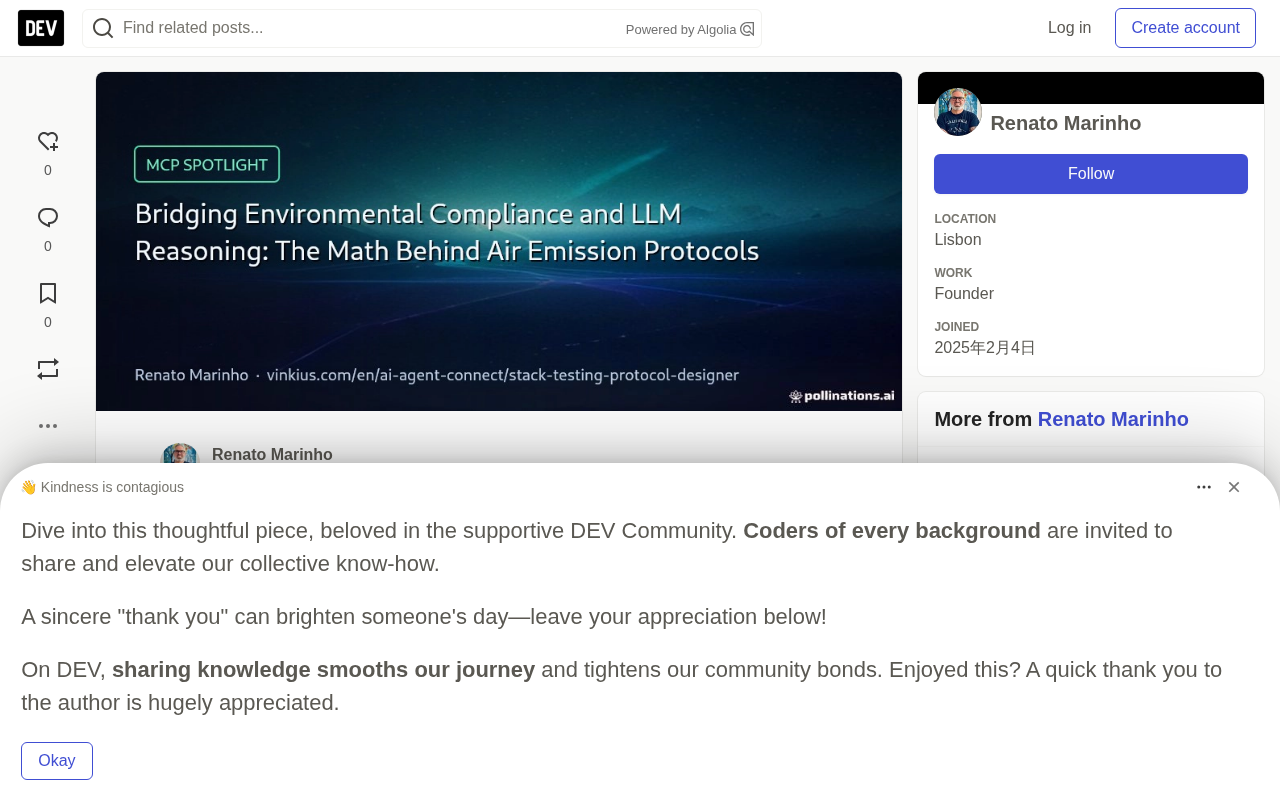
From Prompt Engineering to Deterministic Tools
Asking an AI agent directly to "design an EPA Method 5 protocol" runs into a core problem: the agent has no direct access to the geometric constants required for isokinetic sampling. Isokinetic sampling demands that the gas velocity at the sampling probe inlet match the velocity of the gas stream inside the stack. If this ratio drifts too far, the collected sample is no longer representative.
A compelling case study is the Stack Testing Protocol Designer. On the surface it looks like a calculator for environmental engineers, but in essence it represents a class of "Logic Connectors" — tools that give agents actual operational capability to solve concrete physical problems.
It encapsulates four key functions as discrete tools:
get_sampling_strategy: Solves for vertical positioning based on upstream and downstream turbulence conditions.calculate_traverse_points: Determines how many measurement points are needed across the stack diameter to satisfy regulatory requirements for cross-sectional representativeness.determine_test_duration: Calculates test duration based on target mass collection rate and flow velocity.validate_protocol_compliance: Performs a final compliance check against known EPA method identifiers.
The key insight is this: you're not teaching the AI how to do arithmetic — you're giving it a set of pre-validated "instruments" so it can measure correctly. This fundamentally eliminates the hallucination risk that LLMs carry in deterministic tasks.
The Model Context Protocol (MCP) is an open standard proposed by Anthropic in late 2024, designed to give LLMs a unified way to invoke external tools, databases, and services. Its core idea is to expose each tool's input/output schema to the model in a structured way, enabling the model to interact with external logic via function calling rather than inferring results purely through text generation. Similar in spirit to earlier frameworks like ReAct or OpenAI's Function Calling, MCP's distinguishing characteristic is its emphasis on "tools as contracts" — each tool's behavior, parameter types, and return value format are agreed upon at the protocol layer in advance. The model only decides when to call and what parameters to pass; the actual computation is entirely handled by external code. This architectural separation is especially critical in engineering contexts with strict numerical precision requirements: deterministic math never passes through the model's weights, and therefore is unaffected by sampling temperature or the distribution of training data.
The Real Complexity That Physical Constraints Impose
A common failure mode when general-purpose agents handle technical work is ignoring spatial geometry. Consider this scenario: a 2-meter diameter stack with significant upstream disturbance (say, at 5 meters upstream). A standard LLM might produce a height recommendation that "sounds reasonable" based on textual descriptions in its training data. But by calling get_sampling_strategy, the agent is engaging with logic that genuinely understands laminar flow requirements and the relationship to distance from disturbance sources.
This precision holds equally for particulate matter (PM) testing. Calculating traverse points for PM10 in a 1.5-meter diameter stack involves specific aerodynamic considerations. Rather than having the model guess, the agent calls calculate_traverse_points to ensure the number of points N will maintain isokinetic conditions throughout the sampling run. Deterministic tool calls replace probabilistic text generation — and that's precisely the value of MCP in professional domain applications.
Isokinetic Sampling is the central physical constraint in EPA stack testing methods. When the probe inlet velocity doesn't match the flue gas velocity, "over-isokinetic" or "sub-isokinetic" bias occurs: if probe velocity is too low, larger particles enter the probe in excess due to inertia, inflating the reported PM concentration; if too high, the opposite happens. EPA Method 5 requires the isokinetic ratio to be maintained between 90% and 110% — test data outside this range is not recognized for regulatory purposes. Achieving isokinetic sampling requires real-time measurement of stack static pressure, velocity pressure, temperature, and gas molecular weight, then calculating probe suction flow rate accordingly. This is an iterative calculation involving Bernoulli's equation and the ideal gas law, where rounding errors in any intermediate step accumulate and can affect the final compliance determination. This is precisely why encapsulating such calculations as pre-validated tools — rather than having LLMs derive them on the fly — is of decisive importance in engineering practice.
Why Connectivity Capability Cannot Exist Without Governance
When we talk about deploying these kinds of connectors to production environments — whether they're interacting with sensitive environmental databases or triggering field equipment scheduling — we inevitably hit a wall: security and reliability.
Building this from scratch means spending most of your time managing OAuth callbacks and hardening each endpoint individually. Nobody wants to maintain a custom authentication flow for every niche industry tool they find on GitHub. That's the exact pain point that motivated the creation of Vinkius.
Vinkius positions itself as a "connection layer," not yet another script repository. Built on the open-source TypeScript framework MCPFusion, it ensures every connector follows a consistent behavioral contract. More importantly, when you connect this Stack Testing connector to Claude or Cursor through Vinkius, you get enterprise-grade isolation capabilities out of the box:
- Sandboxed execution: Every tool call runs inside an isolated V8 sandbox, preventing malicious scripts or unexpected inputs from compromising the host system — analogous to how modern browsers handle untrusted code.
- Governance policies: Eight layers of protection including DLP (data loss prevention) and SSRF protection. If an agent attempts to use an environmental calculation tool as a pivot point to scan internal networks, the request is immediately terminated.
- Single-token access: No need to manage fragmented credentials across multiple providers — just one secure connection token passed directly to the MCP client.
The goal isn't just to make things "work" — it's to ensure that granting AI agents write access or specialized mathematical capabilities doesn't create an uncontrolled expansion of the attack surface.
SSRF (Server-Side Request Forgery) is an attack vector that's easy to overlook in AI tool integration scenarios. When an agent is given the ability to call external URLs or internal APIs, maliciously crafted inputs can trick the server into making requests to internal network addresses (such as 169.254.169.254 cloud metadata endpoints or internal databases), bypassing network boundary controls. In industrial settings, this risk is especially pronounced — connectors often need to access SCADA systems, equipment scheduling interfaces, or environmental databases, and if abused, the impact can extend beyond IT systems into physical operations. DLP (Data Loss Prevention) addresses a different class of risk: preventing agents from inadvertently passing sensitive information to unauthorized external endpoints while processing context that contains trade secrets or regulated data (such as emissions values or facility coordinates). Together, these form the baseline defense for outbound traffic in tool-call governance.
Toward a Unified Agent Gateway
A logical extension of this direction is feeding these computational outputs back into a broader quality management ecosystem — analogous to how teams integrate TestRail or Zephyr Scale in software lifecycle management. Even in heavy industry, the shift toward a unified agent gateway is becoming increasingly inevitable.
AI agents only matter when they genuinely reach real systems. Combining LLMs' probabilistic reasoning capabilities with pre-validated deterministic tools, backed by rigorous security governance — this is perhaps the pragmatic path forward for AI adoption in professional domains.
Related articles
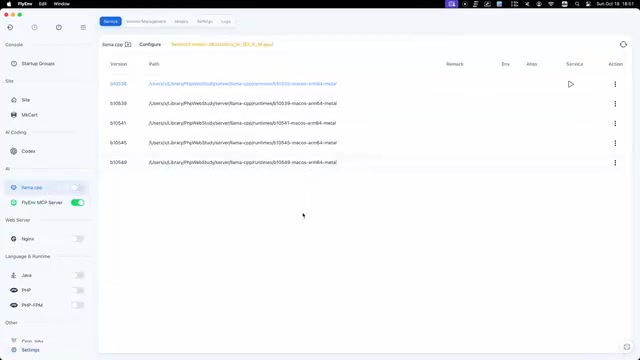
FlyEnv Plugin Review: Visually Running llama.cpp and Managing GGUF Models
FlyEnv launches the official llama.cpp plugin with side-by-side Metal runtime management, public GGUF repository indexing with file type labels, and visual configuration of context, threads, and GPU layers—saving templates and speculative decoding with each model for one-click local LLM inference.
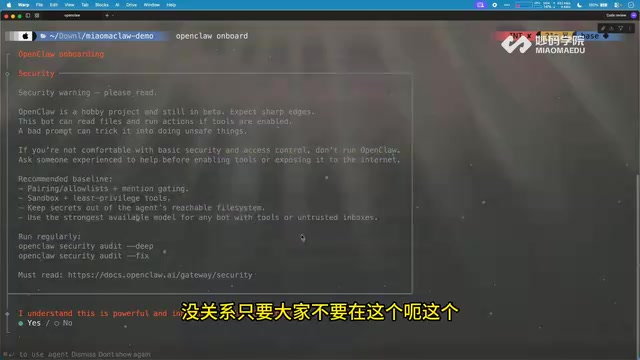
How Can Frontend Developers Advance into AI Agent Development? Deconstructing System-Level Agent Architecture from OpenClaw
Starting from the OpenClaw demo in a Bilibili open class, this article breaks down the three-layer architecture and universal formula of system-level AI agents, and analyzes the path for frontend developers to enter agent development based on TypeScript, including plugin-based design and security/memory layer challenges, with an interview answer framework.
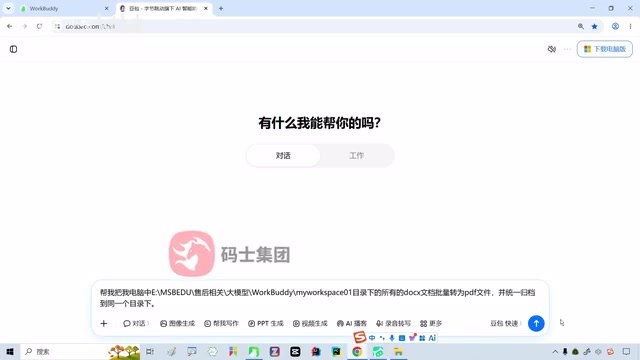
WorkBuddy in Action: How AI Agents Automate Batch File Conversion and Archiving
Bilibili creator Teacher Shanyao tests WorkBuddy vs. Doubao on batch file conversion, showing how AI Agents move from "giving solutions" to "direct execution," with a full workflow and credit cost reference.