How Much Are Workshop Papers Really Worth? A Researcher's Honest Reality Check
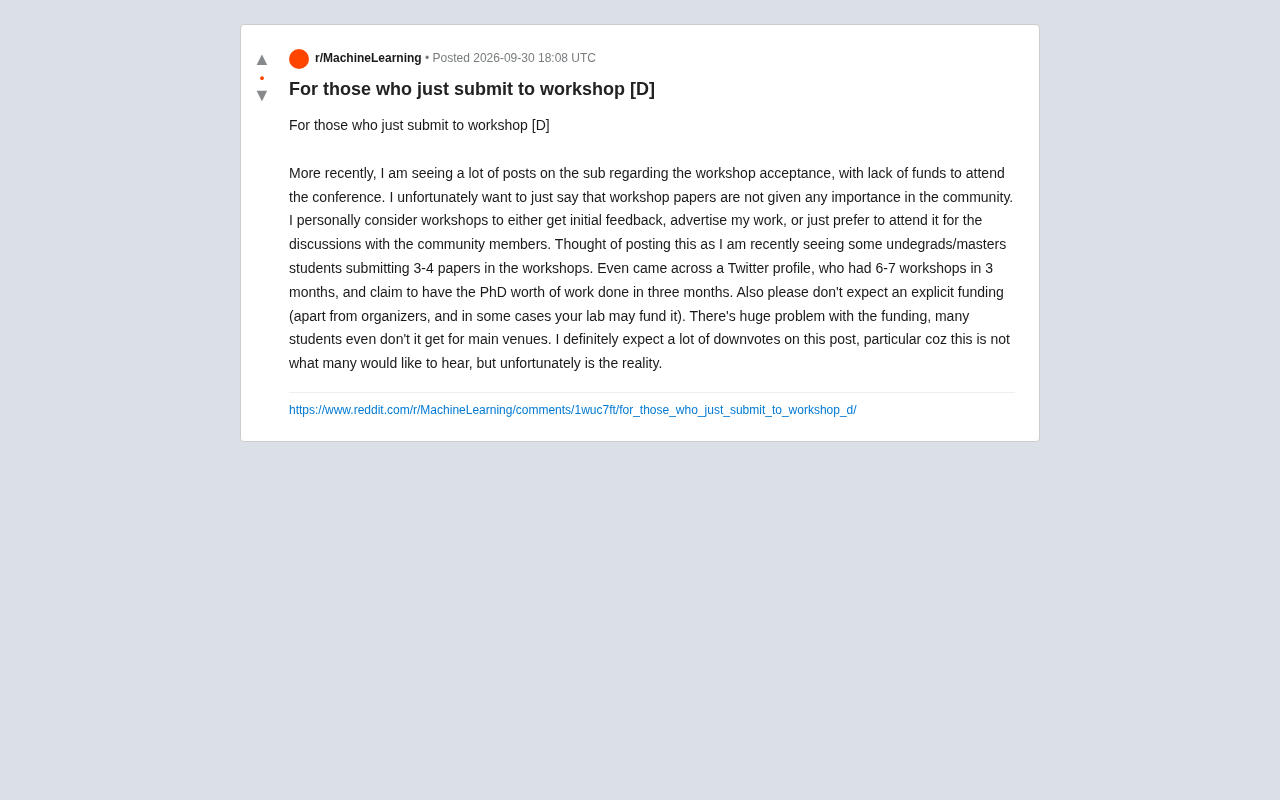
Workshop papers are for discussion, not prestige — a candid reality check for early-career researchers.
A Reddit post in the machine learning community argues that workshop papers carry limited academic weight, serving better as platforms for early feedback and community exchange than as hard proof of research ability. The post highlights two widespread pitfalls: early-career researchers stacking workshop submissions to ease competition anxiety, mistaking volume for depth; and the structural funding gap that makes attending even main conferences difficult for many students. The author advises treating workshops as spaces for experimentation, planning realistically for travel costs, and focusing energy on substantive original research rather than chasing paper counts.
Recently, discussions around "getting a workshop paper accepted but having no money to attend" have been popping up more frequently in the machine learning community. A Reddit user on r/MachineLearning posted a candid, if potentially unpopular, take on the matter: workshop papers don't carry much weight in academic circles. The post sparked a broader conversation about how academia evaluates research, the mindset of early-career researchers, and the harsh realities of research funding.

What Workshop Papers Actually Are
The original poster made their position clear: workshops are more of a venue for getting early feedback, promoting your work, and engaging in community discussion — not a hard metric of research ability.
This cuts to a commonly misunderstood aspect of the academic publishing ecosystem. Main venue papers typically go through rigorous peer review, with acceptance rates often sitting at 20–30% or lower, signaling that the work's completeness and originality have been formally recognized. Workshops, by design, serve a different purpose — they encourage exploratory and preliminary work, apply more relaxed review standards, and aim to foster exchange within specific subfields.
In other words, the value of a workshop paper lies in "joining the conversation," not in receiving an authoritative stamp of approval. Treating it as a major career milestone is a fundamental misreading of what workshops are for.
In machine learning, top main-track venues include NeurIPS, ICML, ICLR, and CVPR, with acceptance rates typically between 15–30%. Each submission goes through multiple rounds of review by 3–5 reviewers, along with written author-reviewer discussions. Workshops are co-located with these main conferences, usually running for half a day to a full day, and focus on specific sub-topics (e.g., "Explainability in Graph Neural Networks" or "Few-Shot Learning"). Their submission and review cycles are shorter, and acceptance criteria emphasize topical relevance and discussion value over strict technical completeness. This distinction is well-understood within the field, but for undergraduates or career-changers just entering research, the surface similarity between the two tracks — both bearing the same conference name — can easily cause confusion.
The Warning Behind "PhD-Level Output in Three Months"
One of the most thought-provoking observations in the post was this: the author noticed many undergraduates and master's students submitting 3–4 papers to multiple workshops at once. They even came across a Twitter account that had accumulated 6–7 workshop papers in three months, claiming to have done "the equivalent of a PhD's worth of work."
This phenomenon reflects a kind of quantity anxiety. In highly competitive application and job-market environments, early-career researchers can easily conflate paper count with demonstrated ability. But churning out a large number of workshop papers in a short time typically means each individual piece lacks depth.
Experienced reviewers, advisors, and hiring committees care about originality, rigor, and impact — not a simple tally of publications. One solid main-conference paper can be far more convincing than ten hastily assembled workshop submissions. The poster's warning is, at its core, a challenge to the illusion that volume equals value.
The Structural Problem of Research Funding
Another grounded point in the post is the funding issue. The author is frank: don't count on workshops providing clear travel grants — outside of occasional support from organizers, or cases where your lab is willing to foot the bill, funding gaps are the norm.
Even more pointed is the observation that many students struggle to secure funding to attend main conferences, let alone workshops. This exposes a long-standing structural problem in academia: the financial barrier between getting published and actually showing up. For researchers from resource-limited institutions or developing regions, even an accepted paper may not be enough — steep registration fees, airfare, and accommodation costs can still make attendance impossible.
This reality is a reminder that researchers should honestly assess the feasibility of attending before submitting, so they don't end up in the awkward position of being accepted but unable to go — and so they don't hold unrealistic expectations about what a workshop acceptance will deliver.
Take NeurIPS 2024 as an example: main conference registration alone runs roughly $1,900–$2,200, and when you add international flights and hotel costs, total attendance expenses can exceed several months' salary for researchers from institutions in South Asia, Africa, or Latin America. While major conferences offer DEI grants (Diversity, Equity & Inclusion Grants) and travel fellowships, these are limited in number and highly competitive to obtain. Some workshops offer token registration discounts to accepted authors, but coverage is far from enough to address the overall funding gap. This structural inequality has been widely discussed in the field and is one of the key drivers behind the continued development of hybrid virtual attendance models — such as the virtual participation option NeurIPS introduced starting in 2020.
How to Think Rationally About Academic Publishing
Although the original poster anticipated heavy downvotes, the perspective they offer is worth considering for anyone early in their academic career.
A few takeaways worth holding onto: treat workshops as a platform for exchange and experimentation, not as résumé decoration; prioritize depth of research over quantity of papers; and plan realistically for funding before you submit. Academic growth is a long game — short-term number-padding doesn't necessarily translate into long-term scholarly credibility.
Of course, this is one researcher's personal view from within a community, and researchers at different stages and in different fields may weigh things differently. But it offers at least one clear, grounded voice: cut through the noise, and get back to what research is actually about.
Related articles

Apple HomeView Hands-On Review: Is the $300 Smart Home Hub Worth It?
Apple HomeView hands-on: a $300 smart home hub with facial recognition for quick account switching, but no App Store or voice recognition. Is the wall-mounted version worth it? Should you buy the first generation?

Meta Muse Wonder Launch: What It Means for Meta's Return to the Frontier AI Race
Meta releases Muse Wonder and WonderFull, benchmarks reach the frontier, community feedback is polarized. An in-depth look at Meta's return to the frontier AI race, its personal agent strategy, and Zuckerberg's different path.

Apple Home Smart Home Lineup Leaked: LG and Schneider Team Up, UWB Door Lock on Board
Apple Home ecosystem gains new LG and Schneider devices: UWB smart lock with proximity unlock, 2.5K dual-camera doorbell, privacy indoor camera, and AirPods-like seamless pairing.