How Much Does It Cost to Raise a Child? 2026 American Family Survey Reveals a Truth Beyond Income

Survey shows perceived financial improvement predicts fertility intentions better than income level.
The 2026 American Family Survey shows the dividing line for fertility intentions is not actual income but the perception of financial improvement: 44% of childless adults under 50 whose finances improved over the past year definitely want children, versus only 24% of those whose finances worsened. Fertility intentions are similar (~30%) for those earning under $50,000 and six figures, as higher earners have longer 'ready' checklists. About one-third of childless adults under 40 who want children can't determine when they'll be financially ready. The article calls for reexamining 'ready' and lasting support like homebuying aid, permanent childcare subsidies, and national paid family leave, rather than one-time payments or temporary tax breaks.
Income Level Isn't the Key? The Perception of Financial Improvement Is the Dividing Line for Fertility Intentions
For decades, Americans have been told that responsible parents should have everything in order before having children—financial stability, a established career, secure housing. But the reality is that even people with good jobs and retirement savings can't be certain what the future holds, and many can't even afford a down payment on a house.
So how much do you actually need to earn to feel ready to have a child? According to the 2026 American Family Survey reported by Vox, the answer seems to depend more on whether your financial situation is improving than on your actual salary level. The survey found that among childless adults under 50 whose finances had improved over the past year, 44% said they definitely want children; among those whose finances had worsened, that figure was only 24%.
This finding challenges the intuition that "income determines fertility." After all, if money were the only obstacle, higher earners should be more willing to have children. But the data shows that income has very little impact.
Income Gap Has Minimal Effect: 30% of Low-Income People Still Want Children
The survey further revealed the weak connection between income and fertility intentions. According to data cited by Vox, about 30% of people earning under $50,000 a year definitely want children—roughly the same proportion as those earning six figures.
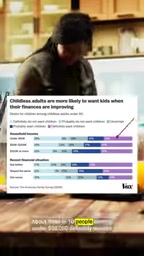
This doesn't mean money is irrelevant. In fact, most adults under 40 say financial stability is "extremely important" before having children. But interestingly, higher earners have longer "wish lists"—they want to accomplish more things before having children. This may explain why income itself doesn't significantly boost fertility intentions: as income rises, so do people's standards for what "ready" means.
The 2026 American Family Survey is an annual national survey conducted jointly by Brigham Young University (BYU) and Deseret News since 2015, tracking long-term changes in American family structure, marriage, parenting, and economic conditions. Based on a nationally representative sample, the survey focuses on a different theme each year and is frequently cited by media, think tanks, and policy researchers for its data stability and academic rigor. The 2026 survey focused on the relationship between fertility intentions and financial perceptions, and it is the data source for the related Vox report. Understanding this context helps gauge the weight of the conclusions: it reflects cross-sectional correlation rather than strict causal inference, and since the sample consists of American adults, extrapolating the conclusions to other countries requires caution.
Fertility Hesitation Under Financial Uncertainty: One-Third Don't Know When They'll Be Ready
The survey also found that about one-third of childless adults under 40 who want children cannot determine when or whether they will ever be financially ready to start a family.

This data reveals the profound impact of financial uncertainty on family planning. While the survey doesn't prove that financial uncertainty directly causes people to not want children, it does show that many people who want children are trapped in a "never ready" dilemma.
Redefining "Ready": Accepting Uncertainty, Policies Need Lasting Support
Facing this reality, Vox points out that people who want children may need to rethink what "ready" means. Perhaps it no longer means checking off every financial milestone, but accepting that we cannot plan for all uncertainties.
But policymakers have a responsibility too. One-time payments or temporary tax breaks can't provide much certainty for prospective parents, and raising children is a long-term responsibility. More lasting support—such as homebuying assistance, permanent childcare subsidies, and national paid family leave—could truly help more people feel secure enough to start a family.

The survey sends a clear signal: fertility decisions are far more complex than simple income numbers. The perception of financial improvement, acceptance of uncertainty, and the improvement of social support systems together shape whether and when people are willing to have children. For policymakers, rather than focusing on short-term incentives, the priority should be building a long-term support system that makes families feel secure.
The national paid family leave mentioned in the article refers to paid parental or caregiving leave legislated at the federal level and covering all workers, distinct from the current unpaid Family and Medical Leave Act (FMLA) in the United States. The U.S. is one of the few developed countries without a national paid maternity leave policy; currently only some states (such as California, New York, and Washington) have implemented paid family leave on their own. Permanent childcare subsidies refer to converting childcare cost assistance from annual appropriations or pilot programs into long-term statutory benefits, in order to reduce uncertainty about family childcare costs. Homebuying assistance typically includes down payment subsidies, low-interest loans, and shared equity programs. What these three types of policies have in common is a commitment to long-term predictability, in contrast to one-time payments or temporary tax breaks—this is precisely the policy logic behind the article's argument that lasting support is more effective.
One-line Summary
The survey shows that the perception of financial improvement predicts fertility intentions better than income level.
Paragraph Summary
The 2026 American Family Survey shows that the dividing line for fertility intentions is not actual income but the perception of financial improvement: among childless adults under 50 whose finances improved over the past year, 44% definitely want children, compared to only 24% of those whose finances worsened. Fertility intentions are roughly the same—about 30%—among those earning under $50,000 and those earning six figures, because higher earners have longer "ready" checklists, with standards rising along with income. About one-third of childless adults under 40 who want children cannot determine when they'll be financially ready, trapped in a "never ready" dilemma. The article suggests reexamining what "ready" means and calls for lasting support such as homebuying assistance, permanent childcare subsidies, and national paid family leave, rather than one-time payments or temporary tax breaks.
Related articles

Pure-Code Video Generation Tested: Which AI Model Actually Follows Instructions?
A Bilibili creator tested three AI models' pure-code video generation with unified prompts and three revisions each: Xiaonaomao has a high ceiling but lacks stability, GPT 6.2 Extra models well but only follows half the instructions, and OPAS 5.5 remains the benchmark.

GPT-6 Six-Tier Hands-On Test: Astra Ultra Dominates but Bills Double
GPT-6 six-tier test: Astra Ultra sweeps 3:0 in 3D tasks thanks to sub-agents and runs 14% faster, but hidden backend bills make its real cost 2.6x single-threaded.

GPT-6.2 Astra vs Fable 5.2: Huge Cost-Efficiency Gap Across 12 Real-World Tests
Bilibili creator tests GPT-6.2 Astra vs Fable 5.2 across 12 real tasks: Fable wins 7-5 but costs 7.2x more and takes nearly 5x longer. Token efficiency emerges as the key selection metric.