How Much Runway Does LangChain's Business Model Have Left? The Existential Challenge Facing LangSmith

Cloud-native observability tools are eroding the moat that LangChain's LangSmith depends on for monetization.
LangChain's commercialization is heavily reliant on its observability and evaluation tool LangSmith, but as cloud-native solutions like AWS Omni and Agentcore offer comparable tracing, evaluation, and annotation capabilities, this single revenue pillar faces structural pressure. For enterprise customers deeply embedded in the AWS ecosystem, the zero migration cost, unified billing, and compliance integration of native tools create a powerful substitution pull that LangSmith's feature advantages struggle to offset. This battle echoes the classic clash between independent tool vendors and hyperscale cloud platforms seen in databases and monitoring. Independent vendors' counterplay lies in cross-cloud neutrality, vertical depth, and faster iteration — but to sustain long-term growth, LangChain must develop new revenue verticals beyond LangSmith.
LangChain's Monetization Problem Comes Into Focus
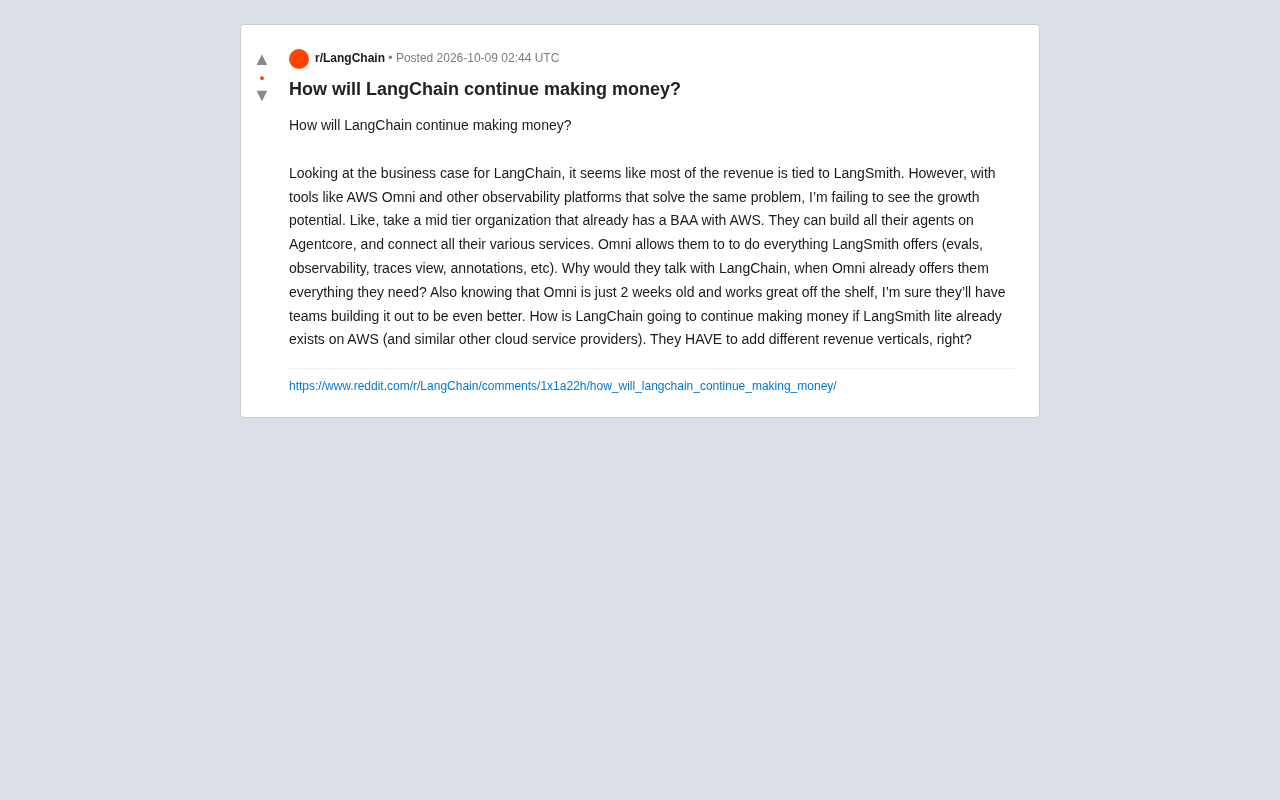
As the ecosystem of AI agent development frameworks matures, questions about LangChain's commercial sustainability are heating up. A Reddit user recently posed a pointed question to the community: with cloud providers rolling out their own observability tools, how much room for growth remains for LangSmith — the core product LangChain depends on for revenue?
This question cuts to a pain point shared by many open-source framework companies: the framework itself is free, so monetization has to rely on value-added services. But when those value-added services go head-to-head against the native capabilities of hyperscale cloud platforms, it's worth taking a hard look at just how deep an independent vendor's moat really is.
How Much Revenue Does LangSmith Actually Carry?
Looking at LangChain's current business structure, the majority of its revenue is tied to LangSmith. LangSmith offers a fairly comprehensive feature set: evals, observability, traces view, annotations, and more — covering the full monitoring lifecycle of LLM applications from development to production.
This toolchain genuinely solved real pain points in the early days of AI agent development. When your application consists of multiple LLM calls, tool calls, and complex reasoning chains, debugging without visual tracing and evaluation capabilities is nearly impossible. LangSmith filled that gap, and naturally became the primary engine of LangChain's commercialization.
The problem is that once this kind of capability is no longer scarce, a revenue structure dependent on a single product line becomes vulnerable.
The observability capabilities LangSmith provides are essentially a solution to the "black box" problem in LLM applications. Traditional debugging tools rely on deterministic input-output relationships, whereas LLM call chains involve probabilistic outputs, multi-step reasoning, tool calling, and vector retrieval — non-deterministic processes where a single request can trigger a dozen sub-calls. Traditional APM tools can't effectively capture information at the semantic level. Through deep integration with the LangChain framework, LangSmith automatically records inputs and outputs, latency, token consumption, and model parameters at every node, and provides both human annotation and automated evaluation (evals) pipelines. The latter lets developers define evaluation criteria and run batch test sets to measure the impact of prompt changes or model upgrades. This "develop-evaluate-iterate" feedback loop is the core value proposition that sets LangSmith apart from general-purpose monitoring tools — and the fundamental justification for charging enterprise customers.
Cloud Providers Enter the Ring and Reshape the Competitive Landscape
The key variable mentioned in the original post is AWS's observability solution (Omni) and agent-building platforms like Agentcore. The original poster laid out a highly compelling scenario:
Imagine a mid-sized organization that has already signed a Business Associate Agreement (BAA) with AWS, with all infrastructure running on AWS. It can now build all its agents directly on Agentcore, connect to existing services, and use Omni to handle evaluation, tracing, and annotation — everything it previously needed LangSmith for.
"Why would they talk with LangChain, when Omni already offers them everything they need?"
The weight of this challenge lies in how it strikes at the real logic of enterprise procurement: when a "good enough" feature is already bundled into an existing cloud bill and permission structure, the marginal cost and integration friction of bringing in a third-party tool often tips the decision toward the native solution. The poster also noted that while Omni had only launched two weeks prior, it "works well out of the box" and has a dedicated team behind it continuously iterating.
The Business Associate Agreement (BAA) is a critical piece of context for understanding enterprise cloud procurement decisions. A BAA is a compliance agreement signed between a cloud provider and a customer, primarily found in regulated industries like healthcare and finance. It specifies the cloud vendor's responsibilities when handling protected data (such as PHI under HIPAA). For enterprises that have already signed an AWS BAA, their workloads are effectively "anchored" to the AWS ecosystem from a compliance standpoint. Bringing in a third-party SaaS tool typically requires renegotiating data processing agreements, conducting security assessments, and going through additional procurement approvals — hidden costs that significantly raise the threshold for switching. This is why the poster used an organization with a signed BAA as the archetypal scenario: for these customers, the competitive advantage of AWS-native tools comes not just from features, but from the elimination of compliance friction.
Independent Tools vs. Cloud-Native: The Moat Wars
At its core, this contest is a classic showdown between independent developer tool vendors and hyperscale cloud platforms. Similar storylines have played out repeatedly in databases, monitoring, CI/CD, and beyond.
Cloud providers' advantages are obvious:
- Distribution: Features are integrated directly into the console, with zero migration cost for users
- Billing consolidation: Unified billing with no separate procurement process required
- Data gravity: Data and workloads are already in the cloud, making native tools the path of least resistance
The independent vendor's room to fight back lies in:
- Cross-cloud neutrality: No lock-in to a single cloud platform; support for hybrid and multi-cloud deployments
- Vertical depth: Doing specific things better than the "good enough" native solution
- Iteration velocity: Focused on a single product, meaning faster feature development that's more tightly aligned with developer needs
The original poster described the threat as "LangSmith lite already existing in AWS" — cloud providers don't need to be the best, they just need to be "good enough and hassle-free" to eat away at a large portion of the middle market.
Historical precedents from the database and monitoring spaces are instructive here. MongoDB, Elastic, and other open-source database companies all faced market disruption when cloud providers launched compatible managed services (e.g., Amazon DocumentDB, Amazon OpenSearch). Some were forced to change their open-source licenses (e.g., SSPL) to prevent cloud providers from directly hosting their software. Datadog, in the monitoring space, offers a different playbook: faced with competition from AWS CloudWatch and Azure Monitor, Datadog maintained a differentiated position and continued to grow by investing deeply in multi-cloud unified visibility, richer correlation analytics, and developer experience. These cases point to a shared conclusion: cloud providers' nativization strategies typically capture the standard needs of the "middle market" quickly, while independent vendors survive in the segment of users with higher requirements for depth, flexibility, and cross-platform consistency.
LangChain Needs a New Growth Curve
The conclusion of the original post is fairly direct: LangChain must develop different revenue verticals. In other words, walking on the single leg of LangSmith is unlikely to be sustainable long-term against the cloud providers' overwhelming distribution advantages.
Following industry logic, possible paths forward for an independent framework company include: going deeper into enterprise-grade features (such as governance, security, and compliance), building a collaboration and orchestration layer that developers can't easily replicate with cloud-native tools, or establishing a differentiated position through deep compatibility with multi-cloud environments. But all of these require sustained investment, and the outcome is far from certain.
It's worth noting that this discussion is primarily based on observations and reasoning from a single Reddit user — not an official financial disclosure or strategic statement from LangChain. Specific descriptions in the post about Omni's feature completeness and launch timing also reflect the poster's personal experience and have not been cross-verified by multiple sources.
That said, the value of this question doesn't lie in providing a definitive answer. Rather, it serves as a reminder to the entire AI tooling ecosystem: when foundational capabilities get absorbed into cloud providers' native offerings, every open-source framework that depends on value-added services for monetization needs to seriously rethink where its moat is actually built.
Related articles

Free Unlimited Claude Code Solution: Agnes AI + CC Switch Setup Guide
No paid subscription needed — pair the free AI platform Agnes AI with the open-source tool CC Switch to provide a backend for Claude Code, enabling unlimited free calls to text, image, and video models. This guide covers the full setup, test results, and usage boundaries.

A Complete Zero-Cost Guide to Getting Started with Claude Code for Beginners in China
A beginner's guide to Claude Code for users in China: two installation methods (command line and IDE plugin), full configuration steps for replacing the official API with the free domestic LongCat model, and a hands-on demo of building a small tool with natural language, plus tips.

When the NSA Gets Involved: The AI Supply Chain Crisis Behind Open-Source CVEs and API Key Hijacking
Multiple open-source projects disclosed severe CVEs in one day, PHP flaws alarmed the FBI, and Railway and OpenCode were breached with API keys stolen. This article breaks down the vulnerability window, AI-accelerated exploitation, and the AI supply chain crisis behind the API key black market, with a developer defense checklist.