How OpenAI Hardens Frontier Model Training Environments: A New Take on Security
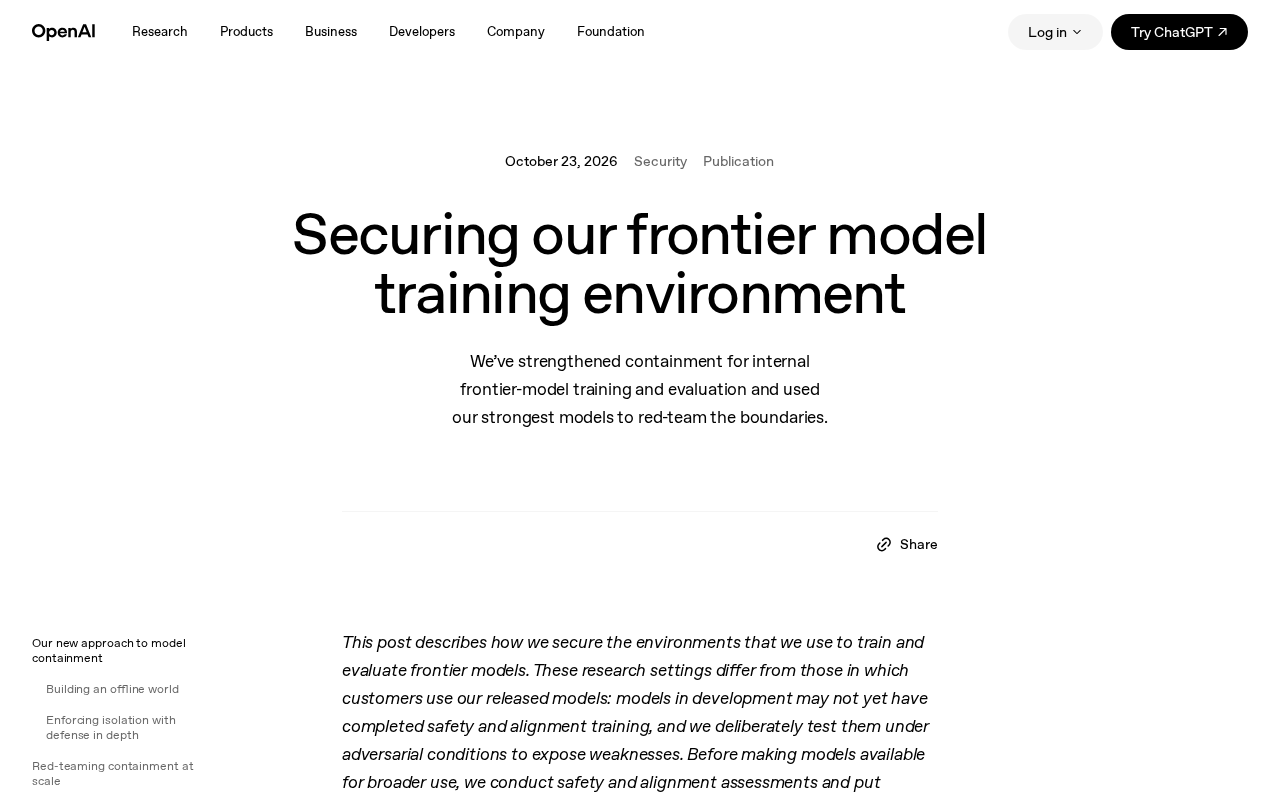
OpenAI systematically outlines its security hardening framework for frontier model training environments and industry implications.
OpenAI recently detailed, for the first time, its security hardening measures for frontier model training environments, sparking Hacker News discussion. As model scale and commercial value climb, training environments can no longer be treated as trusted internal zones and need threat modeling and systematic protection like production systems. Threats span external intrusion and lateral movement, supply chain and dependency risks, and insider and process risks. Borrowable practices include default isolation, verifiable identity and permissions, and continuous monitoring. Balancing security and R&D efficiency remains a real challenge, and training infrastructure security is becoming an indispensable part of AI model security.
In an era where AI model capabilities are iterating rapidly, securing training environments has become a core concern for frontier labs. OpenAI recently published an article systematically detailing, for the first time, its security hardening measures for frontier model training environments. The topic sparked discussion on Hacker News—the post received 28 points and 19 comments, indicating considerable attention, though the level of engagement also reflects lingering curiosity and questions about the specific practices.
Why Is Training Environment Security Suddenly Getting Attention?
Training frontier models involves massive compute, sensitive data, and a highly complex software stack. A lapse at any point could lead to model weight leakage, training data contamination, or disruption of training tasks. In the past, security focus was largely on the post-deployment inference phase, while the training environment itself was often treated as an "internally trusted zone." As model scale and commercial value climb in tandem, that assumption is being challenged.
OpenAI emphasizes in the article that frontier model training environments need threat modeling and hardening just like production systems. This means systematic protection strategies spanning network isolation, identity authentication, and supply chain security. Although the original article does not disclose specific technical details, its phrasing suggests this is not a matter of adjusting a single tool or configuration, but a comprehensive framework covering people, processes, and technology.
Main Threat Surfaces Facing Training Environments
According to OpenAI's description, security challenges for training environments can be grouped into several layers:
External intrusion and lateral movement. Training clusters typically consist of large numbers of GPU nodes and high-speed interconnect networks. Once an attacker breaches the boundary, lateral movement can quickly affect the entire training task. Therefore, network segmentation and the principle of least privilege become baseline requirements.
Supply chain and dependency risks. The training stack depends on numerous open-source libraries, drivers, and container images. Any tampered component can become an attack entry point. OpenAI mentions the need for strict control over the software supply chain of training environments, consistent with widespread industry concerns about AI supply chain security.
Insider and process risks. Personnel with access to training environments are themselves part of the trust boundary. How to implement fine-grained access control without hindering R&D efficiency is an engineering challenge.
Threat Modeling is a structured method in security engineering used to identify threats a system may face, attack paths, and potential impacts, and to design protections accordingly. Its typical process includes: clarifying system assets and trust boundaries, enumerating attackers and their capabilities, analyzing possible attack surfaces (such as network entry points, dependency components, and personnel permissions), and finally developing mitigation strategies prioritized by risk. In AI training environments, threat modeling needs particular attention to model weights (high-value assets), training data (privacy and integrity), compute clusters (availability), and the software supply chain (trustworthiness). OpenAI's emphasis on "threat modeling like production systems" means placing training environments under the same rigorous attack-defense assumptions as online services, rather than defaulting to treating them as trusted internal zones.
Lateral Movement refers to attackers, after breaching an initial node, gradually spreading within a system by exploiting network trust relationships, credential reuse, or vulnerabilities to reach higher-value targets. In training clusters composed of many GPU nodes and high-speed interconnect networks, nodes typically need frequent communication and shared storage, and trust relationships tend to be loose. Once a node is compromised, attackers may use it to access other nodes, scheduling systems, or even model checkpoint storage. Network segmentation (dividing the cluster into security zones), the principle of least privilege (each node and service has only necessary permissions), and east-west traffic monitoring are common means of containing lateral movement.
Security Practice Approaches Worth Borrowing
Although OpenAI did not disclose a complete solution, the direction conveyed in its article offers reference value for the industry. First is default isolation: training environments should remain strictly isolated from office networks and the internet, with all inbound and outbound traffic subject to auditing and proxying. Second is verifiable identity and permissions: strong authentication should be enforced for training tasks, data access, and model checkpoint operations, with complete audit logs recorded. Third is continuous monitoring and anomaly detection: training tasks have relatively fixed behavioral patterns, and operations deviating from the baseline (such as anomalous data exfiltration or weight downloads) should trigger alerts.
That said, these ideas are not unique to OpenAI, but public confirmation of their importance by a frontier lab helps drive industry consensus. Some Hacker News comments also argue that the difficulty of training environment security lies not in technology selection but in balancing security and R&D efficiency—over-hardening may slow experiment iteration, a real constraint in highly competitive AI R&D.
Model Checkpoint is a periodically saved snapshot of model state during training, containing key information such as model weights and optimizer state, used for fault recovery and subsequent fine-tuning. For frontier models, checkpoints themselves are extremely high-value assets: leakage may lead to model replication or misuse, while tampering may contaminate subsequent training. Therefore, checkpoint storage, access, and transmission require strong authentication and encryption protection, along with complete audit logs. Anomalous large-scale weight downloads or checkpoint exfiltration are exactly the behavior patterns that should be prioritized in continuous monitoring alerts.
Implications for the AI Industry
Security hardening of frontier model training environments is essentially bringing AI infrastructure into a mature security engineering system. For most enterprises, even if they are not involved with "frontier models," training or fine-tuning their own models carries similar risks. OpenAI's sharing reminds us: model security goes beyond alignment and red teaming—the resilience and confidentiality of the training infrastructure itself are equally critical.
As regulatory requirements for AI system security increase, security audits of training environments may become part of compliance. Building isolation, authentication, and monitoring capabilities in advance is not only a technical investment but also a necessary step in risk management.
(This article is based on the link to OpenAI's official article on Hacker News and limited discussion information. The original article's specific technical details are not fully public, and the analysis is for reference only.)
AI Supply Chain Security refers to ensuring the trustworthiness of software components (open-source libraries, frameworks, drivers, container images) and data sources on which model training and deployment depend. Attackers may infiltrate training environments by implanting malicious code, tampering with dependency versions, or contaminating pre-training data; such risks are often covert and broad in impact. Common mitigation measures include: dependency version pinning and source verification, container image signing and scanning, build reproducibility and auditing, and minimizing the introduction of third-party components. For training environments, supply chain control is an equally critical layer beyond perimeter defense.
One-line Summary
OpenAI systematically outlines, for the first time, a security hardening framework for frontier model training environments and its industry implications.
Paragraph Summary
OpenAI recently detailed, for the first time, its security hardening measures for frontier model training environments, sparking discussion on Hacker News. The article notes that as model scale and commercial value climb, training environments can no longer be defaulted to as trusted internal zones and must undergo threat modeling and systematic protection like production systems. Training environments face multi-layered threats including external intrusion and lateral movement, supply chain and dependency risks, and insider and process risks. Borrowable practices include default isolation, verifiable identity and permissions, and continuous monitoring and anomaly detection. The article also notes that balancing security and R&D efficiency is a real challenge, and training infrastructure security is becoming an indispensable part of AI model security.
Related articles

LLaMA-Factory in Practice: A Complete No-Code Guide to Fine-Tuning Large Models
An introduction to LLaMA-Factory, the open-source fine-tuning tool: its 60.1K-star background, supported models and algorithms, local vs. cloud deployment, and CUDA setup steps.

Zeng Ming's Deep Retrospective: Why OpenAI May Not Be the Ultimate Winner — and Why the Corporate System Will Disappear
Zeng Ming's deep retrospective on the AI endgame: model companies are just infrastructure, OpenAI and Anthropic won't be the final winners; the next battle is the Agent entry point standard; the corporate system will disappear as AI restructures collaboration, and only mission-driven companies can survive the cycle.

OpenHands v1.28.0: OpenCode and PI Added as Built-in Agents, API Keys Requestable In-Conversation
OpenHands ships 5 releases in 21 days: v1.27.0 adds OpenCode and PI as built-in agents, v1.28.0 enables in-chat key requests. ACP integration, credential reuse, model list changes, and upgrade advice.