How Outdated Is Your AI? Training Cutoff Dates Compared Across 20 Major Models
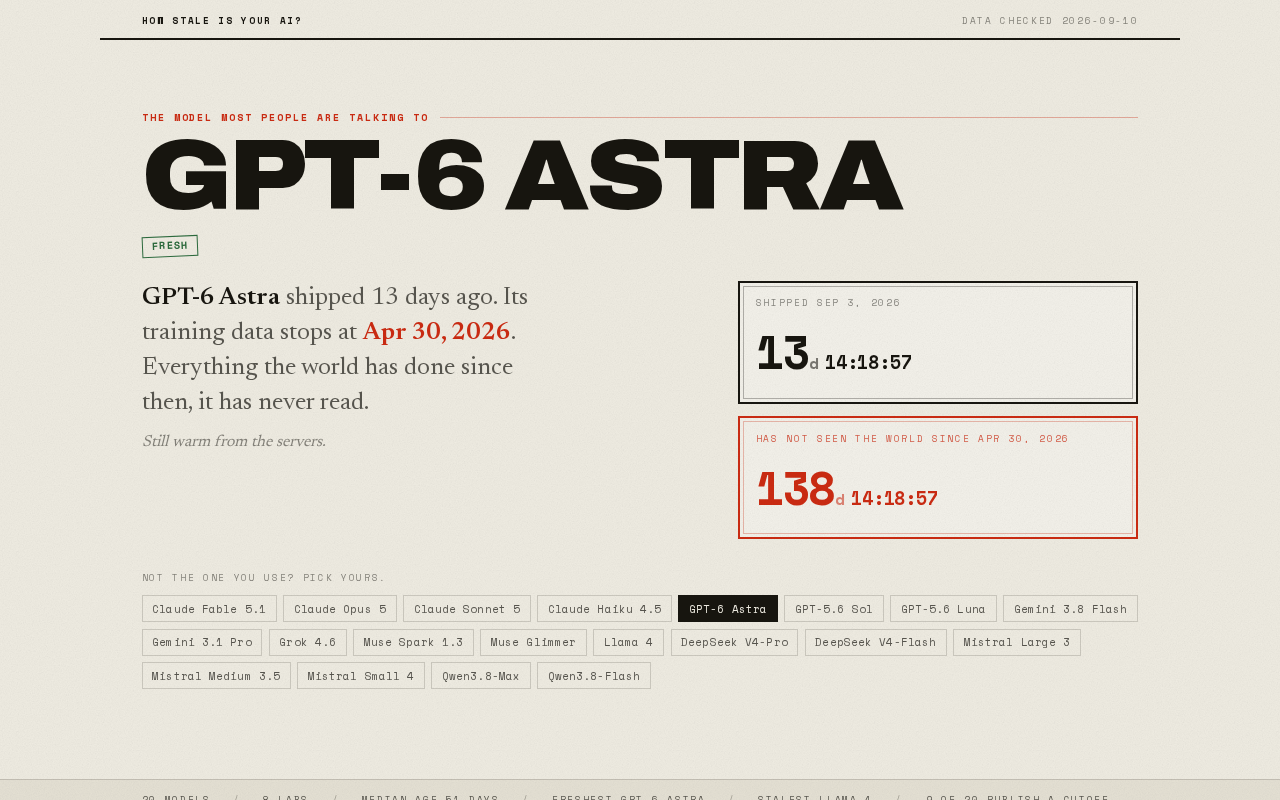
An open-source project maps training cutoff dates for 20 AI models, exposing a key but overlooked factor in model selection.
Most users evaluate AI models based on parameter count, reasoning ability, or benchmarks — but overlook a critical dimension: how current the model's knowledge actually is. A project called "How Stale Is Your AI?" compares release dates and training cutoff dates for 20 major models, making the gap between the two instantly visible. For time-sensitive use cases like AI-assisted coding, this matters: outdated training data can lead models to suggest deprecated APIs. Web search and RAG are the primary tools for compensating, and the project calls for knowledge freshness to become a standard criterion in AI model selection.
A Blind Spot in AI Evaluation: Knowledge Freshness
When evaluating large language models, we tend to focus on parameter count, reasoning ability, or benchmark scores — yet we often overlook a critical dimension: how current a model's knowledge actually is. A project that sparked discussion on Hacker News (Show HN: How Stale Is Your AI?) puts this blind spot front and center, systematically compiling the release dates and training data cutoff dates for 20 mainstream AI models.
The training cutoff refers to the latest point in time covered by a model's training data. Any events, technologies, or knowledge that emerged after this date are effectively invisible to the model when it operates without internet access. This means that even a newly released model may have internal knowledge that already lags behind reality by months — or even longer.
Release Date ≠ Knowledge Freshness
One of the most valuable aspects of this project is how it separates two concepts that are often conflated: release age and training cutoff. Many users assume that a newly released model has the most up-to-date knowledge — but in practice, there's often a significant gap between the two.
The journey from data collection and cleaning to training and public release involves a lengthy engineering pipeline. A model released today may have training data that only extends to six months or even a year ago. For use cases that depend on timely information — such as checking the latest software versions, library API changes, or recent industry developments — this time gap directly affects the accuracy of responses.
This lag between training and deployment is commonly referred to as training-to-deployment lag in the industry. It arises from multiple factors: data collection and cleaning alone can take months, training large-scale models takes additional weeks to months, and the process is followed by alignment fine-tuning (e.g., RLHF), safety evaluations, red-teaming, and infrastructure deployment. GPT-4, for example, has a training data cutoff of April 2023, yet it has been in commercial use across release cycles that span well beyond that point. Furthermore, many models remain in active deployment long after their initial release — meaning the release age keeps growing while the training cutoff stays fixed. The gap between a model's knowledge and current reality only widens over time, never narrows.
Why Developers Should Care About Training Cutoffs
For developers using AI-assisted coding, training cutoff dates are especially important. Technology stacks evolve rapidly — a framework can introduce breaking changes within just a few months. If a model's knowledge is anchored to an older version, the code suggestions it provides may reference deprecated APIs or outdated best practices.
This is precisely why more and more AI tools are integrating capabilities like web search and RAG (Retrieval-Augmented Generation) — fundamentally, to compensate for the staleness of static training data. Understanding a model's knowledge boundaries helps you judge when you can trust its output directly, and when you need additional verification or external information.
RAG (Retrieval-Augmented Generation) is currently one of the most widely adopted approaches for addressing knowledge freshness. The core idea is straightforward: before the model generates a response, relevant and up-to-date text snippets are retrieved from an external knowledge base — such as enterprise documents, real-time databases, or the internet — and provided to the model as context. This allows the model to produce responses grounded in fresh external information, even if its own parametric knowledge is outdated. Web search is a simplified implementation of this concept, where the model directly queries a search engine for real-time results. The key distinction between the two lies in the controllability of the knowledge source: RAG typically targets domain-specific private data, while web search draws from the public internet. Understanding this mechanism helps you assess the claims of AI tools that advertise "real-time information access" — specifically, which technical path they're using and where their reliability boundaries lie.
Building a Habit of Evaluating Model Freshness
The value of this project isn't in delivering an authoritative, day-by-day ranking — it's in reminding the broader community that knowledge freshness should be a standard criterion in model selection.
In practice, a few simple habits can help: for questions involving the latest technologies or recent events, prioritize models with more recent training cutoffs or those with web access; for time-insensitive tasks like text editing or logical reasoning, you can weight a model's overall capabilities more heavily. Factoring training cutoff dates alongside release dates into your decision-making leads to more rational and reliable use of AI tools.
It's worth noting that the project has seen limited traction on Hacker News so far (5 upvotes, 1 comment), and functions more as a practical utility share than a major community event. But the question it raises — the shelf life of AI knowledge — is something every AI user should take seriously.
Summary
As large language models become embedded in everyday workflows, we can't just ask whether a model can do something — we also need to ask whether it knows the latest. The training cutoff, a parameter that often gets a single line in official documentation, actually defines an invisible boundary on a model's capabilities. Tools like this one, which bring together freshness data on 20 models in a single view, offer the community a pragmatic reference point for making more informed decisions.
Related articles
AI Agent Learning Roadmap: A Four-Stage Guide for Complete Beginners
A four-stage AI Agent learning roadmap for beginners: from core concepts and model deployment to RAG, LangChain, LoRA, and interview-ready projects.
Free Access to Mystery Model & DeepSeek V4 via Cline: Complete Setup Tutorial
Learn how to use DeepSeek V4 and the mystery "Niumai" model for free on Cline — covering IDE extension and CLI installation, account setup, and model selection.
Cline + VS Code in Practice: Generate a To-Do App from a Single Prompt
Cline is an autonomous coding agent inside VS Code. This hands-on guide shows how to generate a to-do app from one prompt and compares Claude, Ollama, and Groq integrations.