How to Become an Agentic AI Job Candidate Through Real-World Projects

Build multi-agent systems, automated workflows, and memory-enabled agents to stand out in the Agentic AI job market.
This article offers actionable guidance for AI developers who have learned LangChain, RAG, and Agents but aren't sure what to build next. It argues that basic chatbots and simple RAG apps no longer demonstrate competitive ability, and that hiring managers want to see projects tackling real complexity — including multi-agent collaboration, tool-calling automation workflows, and memory-equipped self-improving assistants. Engineering skills like observability, evaluation, and deployment are equally essential. The core advice: master the underlying principles of agent planning, tool use, and memory rather than chasing every new framework, and present your work publicly through GitHub and writing.
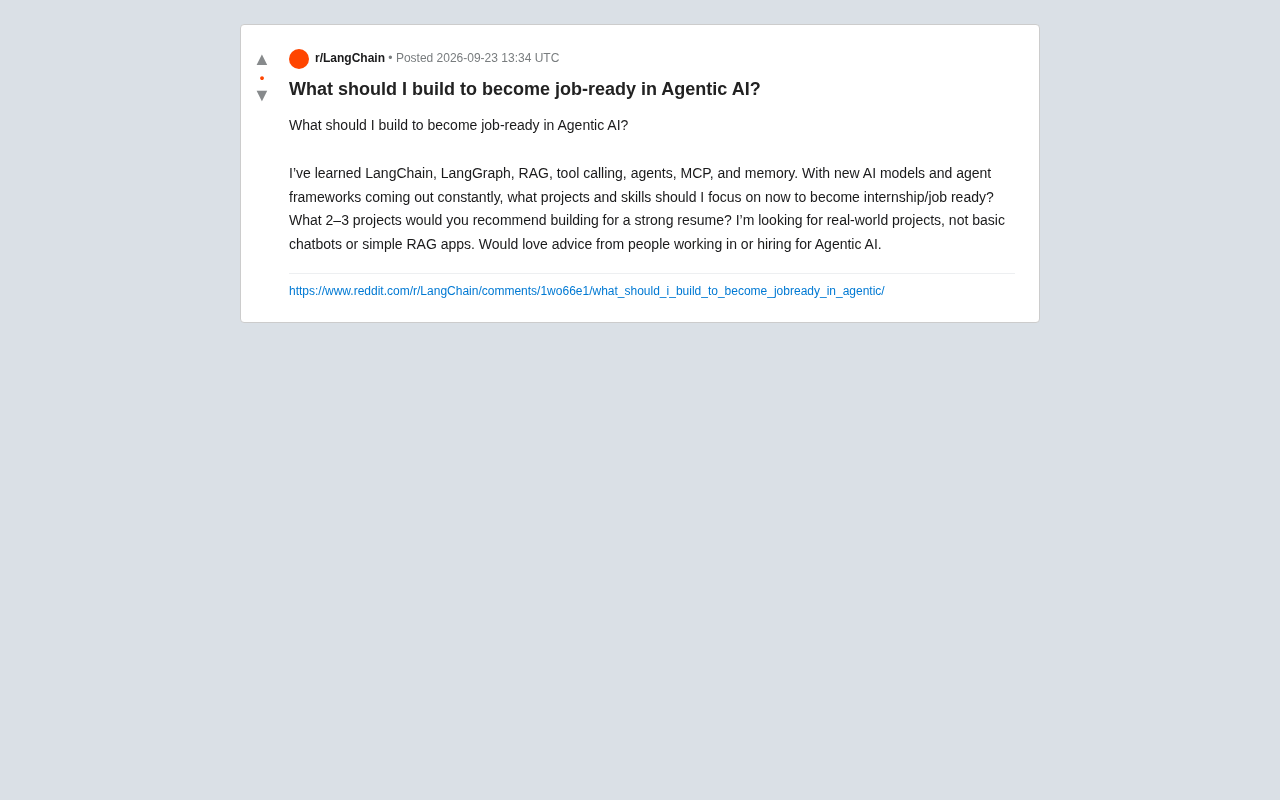
In today's AI job market, knowing the tech stack is just the price of admission. What truly makes a résumé stand out is a portfolio of solid, hands-on projects. A question posted by a Reddit developer resonated with many: after learning LangChain, LangGraph, RAG, tool calling, Agents, MCP, and memory mechanisms, he was still unsure what to build to actually meet the bar for an internship or full-time role — especially with new models and Agent frameworks emerging constantly.
This question reflects a shared anxiety among practitioners in the Agentic AI space today: the technology evolves too fast, and basic chatbots or simple RAG applications can no longer demonstrate real capability. Drawing on this common dilemma, this article outlines the project directions and core skills that Agentic AI job seekers should focus on.
Why Basic Projects Are No Longer Competitive
The person asking explicitly said he didn't want to build "basic chatbots or simple RAG apps" — and that's a sharp observation. As open-source frameworks have matured, the barrier to building a question-answering RAG system has dropped dramatically. A few dozen lines of code and a vector database are all it takes. What hiring managers see is the ceiling of your ability, not the project itself.
What truly differentiates candidates is the ability to handle real-world complexity: multi-step task orchestration, error recovery, state management, multi-agent collaboration, and reliability in production environments. It's only when a project begins to grapple with these engineering challenges that the real value of Agentic AI becomes apparent.
Three Types of Real-World Projects to Focus On
1. Multi-Agent Collaborative Systems
Single agents have limited reach, and real business scenarios typically require multiple agents working in concert. Consider building a system that simulates team collaboration — for example, an automated research assistant where one agent handles information retrieval, another handles analysis and summarization, another verifies facts, and a coordinator agent integrates the final output.
This type of project showcases LangGraph's state graph orchestration capabilities and demonstrates your understanding of inter-agent communication, task allocation, and conflict resolution. Compared to single-agent systems, multi-agent architectures are closer to actual enterprise needs and do a much better job of exposing and testing engineering design skills.
LangGraph is a framework in the LangChain ecosystem specifically designed for building stateful, multi-step Agent workflows. Its core abstraction is a directed acyclic graph (DAG): nodes represent agents or processing steps, and edges represent state transition logic. Unlike linear chain-style calls, LangGraph supports conditional branching, loops, and parallel execution — making it naturally suited for task routing and error retries in multi-agent scenarios. In a multi-agent system, the "Orchestrator" agent decomposes tasks and schedules sub-agents, and LangGraph's state graph provides a structured way to manage shared state and message passing between those agents, eliminating the chaos of manually maintaining complex scheduling logic.
2. Automated Workflows with Tool Calling
The developer already has experience with tool calling and MCP (Model Context Protocol) — exactly the foundation needed for building practical automated workflows. Pick a concrete business use case — automated customer support handling, a code review assistant, or a data analysis pipeline — and have the agent actually call external APIs, interact with databases, and execute code.
The key is to make the project do real things, not just operate at the conversation level. An agent that can automatically pull data, generate a report, and send an email is far more convincing than a chatbot that can only chat. Incorporating MCP also demonstrates familiarity with standardized tool interfaces, which is a hot topic in the industry right now.
MCP (Model Context Protocol) is an open protocol proposed by Anthropic in late 2024, designed to standardize the interface between large language models and external tools and data sources. Before this, every Agent framework had its own tool-calling format, making it difficult to reuse tools across frameworks. MCP defines a unified specification for "tool description + invocation + response," allowing the same tool service (such as database queries or file operations) to be integrated into different LLM applications — similar to how REST APIs standardized web development. Incorporating MCP into a project not only shows you're keeping up with emerging industry standards, but also means the tool modules you build have better reusability and interoperability, which is especially important for enterprise-grade applications.
3. Agents with Long-Term Memory and Self-Improvement
Memory mechanisms are among the skills the developer mentioned — and they're also the key to taking Agentic AI from "one-off Q&A" to "continuous service." Consider building a personal assistant with both short- and long-term memory that can remember user preferences and interaction history, and continuously refine its responses over time.
Going further, you can try introducing reflection and self-evaluation mechanisms, allowing the agent to analyze failures and adjust its strategy accordingly. This type of project is more challenging, but it sits squarely on the frontier of both current research and industry exploration — and can significantly demonstrate your technical depth.
Agent memory mechanisms are typically divided into four categories: short-term memory (the context window of the current conversation), long-term memory (persistently stored user preferences and historical events, usually backed by vector databases or key-value stores), episodic memory (complete records of specific tasks or sessions), and procedural memory (operational rules and skills the agent has learned). The "Reflection" mechanism involves having the agent critically review its own behavior after a task, generate improvement suggestions, and write them back to memory — an idea originating from Shinn et al.'s 2023 paper Reflexion. Building an agent with these capabilities requires careful design of storage architecture and trigger timing, and is an area actively explored by both the academic and engineering communities.
Beyond the Project: Engineering Skills Matter Just as Much
For developers anxious about the constant churn of new models and frameworks, a practical piece of advice is: don't blindly chase every new framework. The underlying principles are consistent — the core of any agent is always the cycle of planning, tool use, memory, and execution feedback. Once you understand the fundamentals, picking up a new framework is just a matter of time.
Hiring managers care not just about whether you can get a demo working, but whether you can build something usable, maintainable, and deployable. That means paying attention to the following engineering capabilities:
- Observability: Add logging, tracing, and evaluation to your agents so you can pinpoint exactly where things go wrong.
- Evaluation framework: Build test cases to measure agent performance objectively, rather than relying on gut feeling.
- Cost and latency optimization: Real production environments have real constraints on token consumption and response time.
- Deployment: Containerize your project and deploy it to the cloud, with clear documentation and a live demo.
A project that's deployed, comes with evaluation results, and includes technical documentation is worth more than three demos that only run locally.
Observability is far more critical in agent systems than in traditional software, because LLM call chains are long and highly non-deterministic — a single failure could originate from any one of: the prompt, a tool call, context truncation, or model hallucination. Platforms like LangSmith (LangChain's official tracing tool), Langfuse, and Arize Phoenix can record the complete trace of every agent run, including inputs and outputs at each step, token consumption, and latency. Integrating a tracing tool into your portfolio project — and being able to walk through a specific trace to explain "how I identified and fixed an agent running in an uncontrolled loop" — is often far more impressive to experienced engineering interviewers than a generic list of technologies.
How to Turn Projects into Job Search Advantages
Building the projects is only step one — how you present them matters just as much. Maintain clean repositories on GitHub with well-written READMEs that explain your design decisions and technology choices, and share your thinking process and lessons learned on a blog or social media.
This kind of "learning in public" not only builds your portfolio but also attracts attention from people within the industry. In a fast-moving field like Agentic AI, demonstrating the ability to learn continuously and solve problems independently often resonates more deeply with hiring managers than any list of skills.
Conclusion
Looking at the developer's skill set, he already has a solid foundation — what's missing is hands-on experience integrating these technologies into complex, real-world scenarios. Rather than worrying about the churn of frameworks, the better move is to pick two or three high-depth projects — a multi-agent collaboration system, an automated workflow, a memory-equipped intelligent assistant — and build each one deeply, thoroughly, and to the point where it can be deployed and demonstrated. The technology will keep changing, but the ability to solve real problems will always be in short supply.
Related articles

Felix Rieseberg Personal Homepage
Felix Rieseberg's personal homepage sparks attention on Hacker News. This article covers the Slack engineer's technical background, the rise and fall of nativefier, and the value of a developer homepage as a tech calling card.

@ai-sdk/vue 3.0.306 Patch Release Syncs with [email protected] Update
@ai-sdk/vue 3.0.306 released, synced with [email protected]. A routine patch release for the Vercel AI SDK ecosystem with no public API changes; the Vue adapter layer stays version-aligned with the core package.

Gemini 4 Argon API Launches: The Era of Million-Token Output Begins
Google launches Gemini 4 Argon with sparse MoE architecture, up to 1M output tokens, and a 68.90% Vals Index score, available across API, AI Studio, and the Gemini app.