How to Build a Document Parsing Correction UI? One Developer's Product Vision and Community Questions
A developer envisions a correction UI after document parsing to improve reliability with in-place correction, memory, and evals.
The article introduces a Reddit developer building a document Correction UI (CUI) to make inevitable human correction more systematic and data-valuable, given that parsing pipelines cannot be 100% accurate. The CUI includes five modules: in-place review, continuous learning, correction memory (prompt memory instead of fine-tuning), built-in evals, and API-First integration. A future vision is letting users upload their own ground truth datasets. The developer asks the community three questions: whether anyone needs it, how they would use their own datasets, and how they currently handle corrections. The article analyzes three hurdles: value proposition sharpness, correction memory effectiveness, and cold-start trust.
An Overlooked Step: Correction After Parsing
Document parsing and information extraction are among the most densely applied AI scenarios today, but virtually everyone in the field knows: no pipeline achieves 100% accuracy. Invoice amounts, contract clauses, table fields—there are always extraction results that require human review before entering downstream processes.
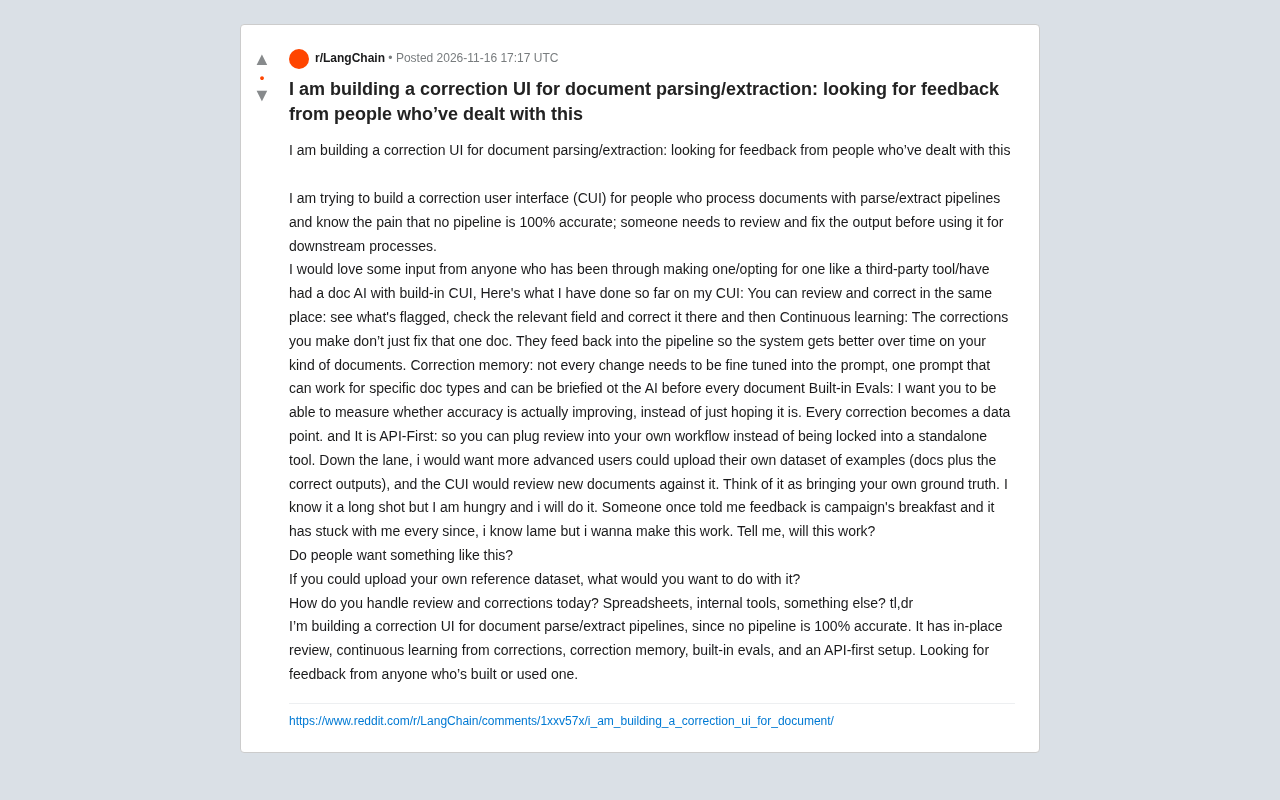
A developer on Reddit is building a dedicated Correction UI (CUI) for this purpose and has posted in the community seeking feedback (see image). His starting point is simple: since correction is inevitable, make correction itself more systematic and more data-valuable.
Existing Design: Five Core Modules
According to the post, the CUI currently consists of five interrelated parts.
In-place Review and Correction
Users can see flagged problem fields in the same interface and correct them on the spot, without switching back and forth between annotation tools, Excel, and the original system. This is the most basic and essential layer—compressing "discovery" and "fixing" into a single action.
A document parsing pipeline typically refers to an automated processing chain from raw documents (PDFs, scans, images, etc.) to structured data, generally including layout analysis, OCR/text recognition, field detection and extraction, and post-processing validation. Each stage introduces errors that propagate downstream, making 100% end-to-end accuracy difficult. The Correction UI (CUI) adds a human intervention layer at the end of this chain; it does not replace automation but catches fields with low confidence or failed rule validation, enabling humans to review and correct at minimal cost. This positioning is important: the CUI complements rather than replaces the pipeline, and its value depends on being faster and more accurate than manual checking from scratch.
Continuous Learning from Corrections
The key is that each human correction not only fixes the current document but also flows back into the pipeline, gradually adapting the system to the characteristics of "your type of documents." This transforms human review from a pure cost item into a continuously accumulating training signal.
Correction Memory
The developer makes a judicious judgment here: not every modification warrants fine-tuning. His approach is to maintain a prompt memory for specific document types, briefing the model with this "memory" before processing each new document. This is lighter-weight than fine-tuning and closer to real engineering constraints.
Fine-tuning refers to continuing training a pre-trained model on domain-specific data to shift its parameters toward that domain, improving performance on specific tasks. Fine-tuning is usually effective but costly: it requires sufficient labeled data, GPU compute, model version maintenance, and retraining with each data update. In contrast, prompt memory does not alter model parameters but stores rules, examples, or preferences distilled from historical corrections as text in an external memory bank, injected as context into prompts before each new document. This approach updates instantly, costs very little, and is highly interpretable—suitable for scenarios with relatively fixed but diverse document types. Its limitations lie in the model's context window and instruction-following capability; as rules accumulate, forgetting or conflicts may occur, and generalization is less stable than fine-tuning.
Built-in Evals
The correction process itself generates data points, which are used to measure whether accuracy is actually improving rather than relying on gut feeling. For data teams that need to justify results to business stakeholders, this layer is often the source of persuasiveness.
Evals (short for evaluations) in AI engineering refers to systematically measuring the output quality of a model or pipeline using a set of samples with ground truth answers, with common metrics including field-level accuracy, recall, and F1 score. Traditionally, a batch of test sets is run offline during development, but document processing faces continuously changing real-world data distributions, making offline evaluation prone to distortion. The built-in evals approach embeds evaluation into the daily correction workflow: each human correction naturally produces a "model output vs. correct output" comparison sample. As these samples accumulate, they reflect accuracy trends in real time. For data teams, this is more convincing than subjective impressions and is key evidence for proving to stakeholders that the system is improving.
API-First
The review step can be embedded into users' existing workflows rather than forcing teams to migrate to yet another standalone tool. This choice directly determines whether the product is a "platform" or a "component."
Future Vision: Bring Your Own Ground Truth
The latter half of the post mentions a longer-term direction: allowing advanced users to upload their own example datasets (documents + correct outputs), which the CUI uses to review new documents against. The developer calls this "bring your own ground truth."
This idea deserves separate discussion. Real labeled data within enterprises is often the scarcest asset. If a correction tool can directly consume this data, it ceases to be just a patch interface and approaches a lightweight continuous evaluation and adaptation platform. Of course, the developer himself admits this is a long shot.
Ground truth refers to labeled data used as the standard answer in machine learning, serving as the benchmark for measuring model performance and the supervision signal for training. In document extraction, ground truth is a document and its corresponding correct structured output. High-quality labeled data within enterprises is often very scarce because labeling requires business experts' time and involves sensitive information that is inconvenient to outsource. Allowing users to upload their own ground truth means the tool can directly judge new document extraction results against the enterprise's own standards, bypassing the mismatch between generic evaluation sets and actual business needs, and giving the correction tool continuous evaluation and lightweight adaptation capabilities. The difficulty lies in the diversity of data formats, inconsistent labeling quality, and how to use this data without leaking sensitive information.
Three Questions He Really Wants Answered
The questions raised in the post are actually more valuable than the feature descriptions:
- Does anyone want this?
- If you could upload your own reference dataset, what would you do with it?
- How do you currently handle review and correction—Excel, internal tools, or something else?
The third question is especially critical. Document correction in many teams still relies on spreadsheets plus manual checking, which is both an opportunity and a high switching cost: migrating to a new tool requires it to be clearly superior to a shared spreadsheet.
Can This Direction Work?
From a product logic perspective, this concept captures a real pain point but must overcome several hurdles.
Is the value proposition sharp enough? "In-place correction + continuous learning + evals + API" is a complete narrative, but users may initially pay for only one of these points. Whether it's saving labor, improving accuracy, or providing an explainable quality metric to stakeholders, priorities need to be clarified.
The effectiveness boundary of correction memory. Replacing fine-tuning with prompt memory is more realistic engineering-wise, but for highly formatted document types, its generalization ability needs validation with real failure cases.
Cold start and trust. Getting teams to entrust their core document processing workflows to a new tool takes time. API-First is a correct choice for lowering the barrier, but the real barrier is whether it can demonstrate higher efficiency than existing workflows from day one.
The developer writes at the end of the post that someone told him "feedback is the breakfast of entrepreneurs," and this has always influenced him. Whether the community can give him the answers he wants remains to be seen, but the very act of raising the question has highlighted a step in the document AI implementation chain that tool vendors have long downplayed.
One-line Summary
A developer envisions a correction UI after document parsing, using in-place correction, memory, and evals to improve real-world reliability.
Paragraph Summary
The article introduces a Reddit developer building a document Correction UI (CUI). Given that document parsing pipelines cannot achieve 100% accuracy, the goal is to make inevitable human correction more systematic and data-valuable. The CUI has five modules: in-place review and correction, continuous learning from corrections, correction memory (using prompt memory instead of fine-tuning), built-in evals, and API-First integration into existing workflows. A longer-term vision is to let users upload their own labeled datasets as ground truth for comparative review. The developer asks the community three questions: whether anyone needs it, how they would use their own datasets, and how they currently handle corrections. The article concludes that three hurdles must be overcome: sharpness of the value proposition, the effectiveness boundary of correction memory, and cold-start trust.
Related articles

David Fincher's New Film Accused of Being AI-Generated? The Truth Behind the Controversy
David Fincher's new film *The Further Misadventures of Cliff Booth* is accused of using AI, with a carriage shot in the trailer sparking controversy. Netflix's acquisition of Ben Affleck's AI company and Fincher's own openness to AI keep suspicions alive. This article sorts out the controversy and the views of all sides.

FCC Clears SpaceX's Space-Based AI Data Centers: A Debate Over Regulatory Boundaries
The FCC approved SpaceX's plan to deploy AI data centers in space but dismissed opponents' key concerns about scientific research impacts as beyond its regulatory authority. This article analyzes the regulatory boundary issues behind the decision, the deeper tensions of space-based AI infrastructure, and its implications for the industry.

Why Are Latinos Nearly Half of the U.S. Border Patrol?
Latinos hold nearly half of the U.S. Border Patrol and about 30% of ICE. Vox's Khalil Green explores their motivations, identity tensions, and why enforcement work ≠ MAGA.