How to Choose a High-Quality AI Agent Development Course: 5 Practical Selection Criteria

Five practical criteria to help career changers and self-learners pick high-quality AI Agent development courses.
A mechanical-engineering-turned-AI developer shares five criteria for evaluating AI Agent courses: whether the curriculum covers a complete pipeline from API calls and Function Calling through RAG to deployment; whether projects are résumé-worthy with real tool integrations and metrics; whether the course addresses production concerns like token costs and tool-call failures; whether content is regularly updated; and whether structured feedback and mentorship are provided.
AI Agent development is becoming one of the hottest directions in the large language model application space — but course quality varies wildly. A Bilibili creator who successfully transitioned from a mechanical engineering background into a large model role shared five criteria for evaluating AI Agent development courses, drawing from his own hard-learned lessons. This article summarizes his key insights to help readers who are selecting courses or making a career switch avoid common pitfalls.
Why So Many People Study but Can't Build Anything
This creator started out in mechanical engineering, and after graduating faced a familiar struggle: limited job openings, fierce competition, and slow career progression. After encountering countless examples of large model applications, AI assistants, and office automation tools, he arrived at a key realization: many seemingly sophisticated AI applications are, at their core, just connecting a model's API and engineering it into a working product.
For someone with an engineering background, skills like logical decomposition and process delivery are transferable — what was missing was a complete pathway for AI application development. But he quickly fell into a trap. He watched countless public videos, picked up concepts like Prompt engineering, Agents, and Function Calling, followed scattered tutorials to write code — building a chat UI one day, connecting a vector database the next, then getting stuck on deployment — and ultimately had nothing complete enough to put on a résumé or demo.

This feeling of "I learned something but can't actually do anything" is exactly what plagues most self-learners. Fragmented learning cannot build complete delivery capability — and complete delivery capability is what the job market actually values.
Criterion 1: Does It Cover a Complete Delivery Pipeline?
The first criterion for judging course quality is whether it covers a complete development pipeline — not just teaching you how to write prompts.
A high-quality Agent course should cover at minimum: requirements decomposition → model selection → API calls → tool calling (Function Calling / Tools) → RAG retrieval → memory and state management → evaluation and monitoring → deployment.
A practical tip: don't just listen to the marketing copy — go directly to the course outline and look for these keywords: Function Calling, Tools, RAG, evaluation and observability, and production deployment. If a course only teaches you to write prompts and have the model "play a certain role," it's more of a prompt engineering course than a real Agent development course.
A few terms in this pipeline are worth explaining. Function Calling / Tools refers to the ability of a large model to actively call external functions or APIs during a conversation — the model doesn't just generate text, it can decide "when to call a calculator" or "when to query a database." This is the core mechanism that distinguishes an Agent from an ordinary chatbot. RAG (Retrieval-Augmented Generation) is an architecture that combines an external knowledge base with a model: when a user asks a question, the system first retrieves relevant passages from a document library, then sends those passages along with the question to the model. This allows the model to answer questions about private knowledge outside its training data while reducing hallucinations. Observability, borrowed from traditional software engineering, refers to tracing, logging, and monitoring an Agent's runtime behavior — making it easier to diagnose issues like "why did the model call the wrong tool" or "which step consumed the most tokens" in a production environment. Together, these three components form the infrastructure that takes an Agent from "runs" to "maintainable."
Criterion 2: Can the Projects Go on Your Résumé?
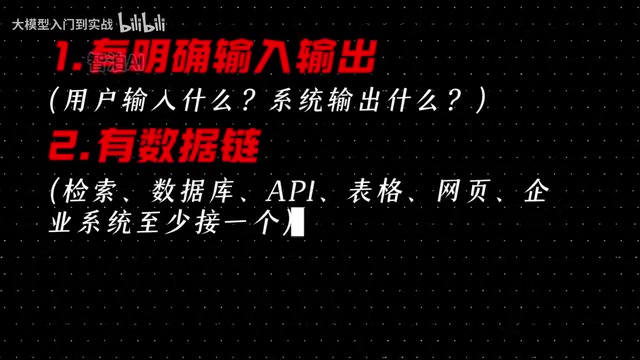
For career changers, projects are the key to getting a foot in the door. The creator argues that a project worth learning should have three characteristics:
- Clear inputs and outputs: what the user provides and what the system returns, with well-defined boundaries.
- Tool integrations: retrieval, databases, APIs, spreadsheets, web pages, or enterprise systems — at least one.
- Metrics or a closed loop: accuracy, hit rate, response latency, cost — even the most basic quantitative indicators.
He offered two examples with real practical value: an enterprise knowledge base Q&A Agent that includes RAG retrieval, access control, citation tracing, and a backend management interface; and a multi-tool office Agent that can read emails, parse spreadsheets, generate weekly reports, and auto-archive files. By contrast, a bot that can only chat, or a purely theoretical course on "what are agents, planning, and reflection," offers limited practical value.
Criterion 3: Does It Offer a Real-World Development Perspective?
The real challenge of Agent development isn't getting something to "run" — it's getting it to "run reliably." This is the part most scattered tutorials overlook.
A solid course should address these real-world production challenges: how to control token costs, how to handle model switching, how to prevent tool-calling failures, and how to ensure data security. You don't need the course to go extremely deep, but it should at least make you aware of where the pitfalls are. Otherwise, your project may fall apart the moment it hits a production environment.
The core logic here is: distinguish between "a demo that can be shown" and "a product that can be deployed." The former just needs a connected flow; the latter requires attention to cost, stability, and security — and that's precisely what differentiates candidates in a job search.
Token cost control is one of the most practically significant aspects of an engineering perspective. Large model APIs typically charge by the token, and in multi-turn conversations or multi-tool calls, context length can accumulate rapidly, making per-task costs far exceed expectations. Common control strategies include truncating conversation history (keeping only the last N turns), using summary-based memory compression, and tiering model selection based on task complexity (e.g., using a smaller model for simple classification and only invoking a flagship model for complex reasoning). "Preventing tool-calling failures" involves a different class of engineering problems: models sometimes generate malformed tool parameters, call nonexistent functions, or fall into infinite loops. Mature Agent frameworks incorporate parameter validation, retry limits, and exception-handling mechanisms — but these details almost never appear in tutorials that only demonstrate the happy path.
Criterion 4: How Often Is the Course Updated?
Large model technology evolves at breakneck speed, and older courses can become outdated almost immediately after you finish them. The creator suggests checking two things:
First, look at whether the course outline includes recent content — new tool-calling approaches, framework updates, or evolved evaluation methods. Second, check whether the assignments and code repositories are actively maintained, rather than abandoned after the initial recording.
This matters especially for fast-moving fields like Agent development. Frameworks and best practices can shift every few months, and outdated teaching content directly undermines the practical value of what you learn.
Criterion 5: Is There Ongoing Support and Feedback?
The final criterion is one career changers most easily overlook, yet it's critically important: a support and feedback mechanism.

The creator's point is direct: career changers usually aren't lacking for videos to watch — what they're missing is someone to pull them out of the pit when they get stuck. Prioritize courses that offer assignment reviews, project Q&A sessions, and community discussion. Bonus points if they also provide résumé advice and guidance on framing your projects. Guided learning is measurably more effective than going it alone.
A Note on Course Promotion
It's worth acknowledging that this content is clearly promotional in nature — the original video repeatedly uses phrases like "get it for free," "grab the resource pack," and "pinned link in the comments," and the personal story (spending over 20,000 RMB on courses, landing a 30K job) cannot be independently verified.
That said, setting aside the marketing elements, the five selection criteria themselves have genuine reference value: complete delivery pipeline, résumé-worthy projects, a real-world development perspective, update frequency, and ongoing support with feedback. This framework applies not only to evaluating paid courses but also as a checklist for self-learners planning their own learning path.
For readers looking to get started with AI Agent development, the real advice is this: whether you choose a course or go the self-study route, keep "can I independently deliver a complete project" as your north star. Build systematically around the core elements — tool integrations, RAG, evaluation, and deployment — rather than getting stuck at the level of concepts and fragmented demos.
Related articles

Bilibili's Hit Dify Tutorial: A Practical Guide to Building 20+ AI Apps from Scratch
A distilled guide to Bilibili's top-rated Dify tutorial: Windows + Docker deployment, MySQL connection, five app types, model integration strategy, and publishing.

Agent Skills Beginner's Guide: From Concepts to Multi-Agent Collaboration in Practice
A comprehensive guide to Agent Skills: core concepts, components, the importance of Description, standardization, beginner learning paths, and multi-agent collaboration.

One Neuron Detects Both Cats and Cars? We Reproduced It and Found a New Explanation
The cat-car neuron reinterpreted: researcher Cammarata argues it distinguishes pointy from round, not cats from cars. We reproduced the experiment and found the new explanation holds on most inputs—but cars are the exception. The interpretability debate continues on language models.