How to Choose an AI Agent Framework? Azure AI, Semantic Kernel, and AutoGen Compared in Practice

A practical comparison of Azure AI Agent Service, Semantic Kernel, and AutoGen for AI Agent development.
This article compares three major AI Agent frameworks—Azure AI Agent Service, Semantic Kernel, and AutoGen—based on the "AI Agents for Beginners" course. It covers what Agent frameworks are, why they're needed, and provides hands-on code examples for each. Azure AI Agent Service suits single-Agent Azure scenarios, Semantic Kernel targets enterprise production, and AutoGen enables cutting-edge research experimentation.
When building AI Agents, choosing the right framework often determines whether a project can be successfully delivered. Based on Lesson 2 of the "AI Agents for Beginners" course, this article systematically covers what Agent frameworks are, why you need them, and how to make the right choice among the many available options.
What Is an AI Agent Framework and Why Do You Need One?
Agent frameworks (Agentic Frameworks) are essentially a class of tools that give developers building AI Agents more granular control over task management. As emphasized in Lesson 1 of the course, an Agent's core mission is to "complete tasks," and a framework's value lies in helping us better organize and orchestrate those tasks.
To understand why Agent frameworks are necessary, we first need to clarify the fundamental difference between AI Agents and traditional LLM calls. An AI Agent is a software system capable of perceiving its environment, making decisions, and executing actions to achieve specific goals. Unlike traditional single-call interactions with large language models, Agents possess the ability to autonomously plan, invoke tools, and manage memory. As the capabilities of foundation models like GPT-4 and Claude have rapidly advanced, developers have found that Prompt Engineering alone can no longer meet the orchestration demands of complex tasks—a systematic architecture is needed to manage Agent lifecycles, tool registration, context passing, and multi-step reasoning chains. This is precisely the technical soil from which Agent frameworks emerged.
Specifically, Agent frameworks solve the following key problems:
- Task allocation: In multi-Agent collaboration scenarios, you need to decide which Agent should handle a specific task. Frameworks help make this decision.
- Context understanding: Agents must have awareness of environmental state and contextual information. For example, if an Agent needs to book a hotel room, it first needs to know which rooms are currently available. Frameworks make context management more controllable.
- Agent collaboration: How multiple Agents work together to complete tasks needs to be defined by the developer. Frameworks create communication spaces and protocols that make inter-Agent collaboration more efficient.
- Performance evaluation: These frameworks also include built-in tools or connectors that help developers observe and evaluate Agent performance in practice.
It's worth noting that Multi-Agent Systems (MAS) are a classic research direction in distributed artificial intelligence, dating back to the 1980s. In the LLM era, the core challenges of multi-Agent collaboration include: how to define communication protocols between Agents (message formats, callback mechanisms), how to avoid task conflicts and deadlocks, how to implement shared memory and state synchronization, and how to maintain system predictability as the number of Agents increases. Frameworks abstract away these underlying details, allowing developers to focus on business logic rather than infrastructure.
In other words, the significance of a framework is elevating "getting Agents to complete tasks" from scattered code logic into a manageable, extensible, and evaluable engineering system.
Horizontal Comparison of Three Major AI Agent Frameworks
There are numerous Agent frameworks on the market. This course focuses on three solutions: Azure AI Agent Service, Semantic Kernel, and AutoGen. Each has a different positioning and clearly distinct use cases.
Azure AI Agent Service: The Best Starting Point for Single Agents
Azure AI Agent Service is currently designed primarily for single-Agent scenarios, supporting both code-based and UI-based construction. Its greatest advantage is deep integration with existing Azure services and capabilities—if your tech stack is already built on Azure, this seamless connection significantly reduces onboarding costs.
From a technical architecture perspective, Azure AI Agent Service is part of Microsoft's Azure AI platform, built on top of Azure OpenAI Service. Its design philosophy is similar to OpenAI's Assistants API, but deeply integrates Azure's enterprise-grade services including identity authentication (Entra ID), data security (Azure Key Vault), and monitoring (Azure Monitor). Its Thread mechanism draws from conversation management concepts—each Thread maintains independent message history and context state, enabling Agents to maintain consistency across multi-turn conversations while supporting concurrent user isolation.
Semantic Kernel: An Agent Framework for Enterprise Production Environments
Semantic Kernel is a framework designed for enterprise-grade production environments. The team behind it places particular emphasis on the developer experience when building AI Agents for production. It supports three languages—C#, Java, and Python—and provides rich connectors for integrating with various model services.
Semantic Kernel was open-sourced by Microsoft in 2023, with its core architecture centered around three concepts: Kernel (a container for services and plugins), Plugin (encapsulating reusable functional modules), and Planner (decomposing user intent into executable steps). The Kernel's design is similar to a dependency injection container, where developers can register different AI services (OpenAI, Azure OpenAI, Hugging Face, etc.), native functions, and Prompt templates. This plugin-based architecture enables enterprises to wrap existing business logic as Plugins, quickly giving Agents the ability to call internal enterprise systems.
For teams that need to actually deploy Agents to production and serve real business needs, Semantic Kernel's stability and enterprise-grade features are significant advantages.
AutoGen: A Testing Ground for Cutting-Edge Agent Research
AutoGen was born out of Microsoft Research, and it's not just a powerful framework—it emphasizes converting the latest Agent research results into runnable code, enabling researchers and developers to quickly test and experiment with cutting-edge ideas.
AutoGen was initially released by Microsoft Research's team in 2023. Its paper "AutoGen: Enabling Next-Gen LLM Applications via Multi-Agent Conversation" proposed a conversation-based multi-Agent programming paradigm. AutoGen's core innovation lies in modeling inter-Agent interactions as Conversation Flows, supporting flexible topological structures—including pairwise conversations, group chats, and hierarchical patterns. The AutoGen 0.4 version released in 2024 underwent a major refactoring, introducing an event-driven architecture and stronger type safety, improving engineering quality while maintaining research flexibility.
If your goal is to explore the latest advances in Agent technology and build experimental prototypes, AutoGen would be the more suitable choice. Interestingly, both Semantic Kernel and AutoGen can reuse Agents built through Azure AI Agent Service—the three are not mutually exclusive.
Framework Selection Advice: Start Small
The course's core recommendation is—start small.
Here's a concrete path you can follow:
- Validate ideas with a single Agent first: Use a service like Azure AI Agent Service to get one Agent running and verify whether the core logic holds.
- Then expand to multi-Agent collaboration: Once a single Agent runs stably, use frameworks that support multi-Agent scenarios (like Semantic Kernel or AutoGen) to combine them.
- Make your final choice based on your goal: If targeting production environments, choose Semantic Kernel; if exploring cutting-edge research, choose AutoGen.
This incremental approach avoids getting bogged down in complex multi-Agent architectures from the start, and lets developers achieve verifiable results at each stage.
Hands-On Code Demos for All Three Agent Frameworks
Listening to explanations isn't enough—hands-on practice is the best way to understand these tools. The course provides three runnable code examples, one for each framework.
Semantic Kernel Code Example
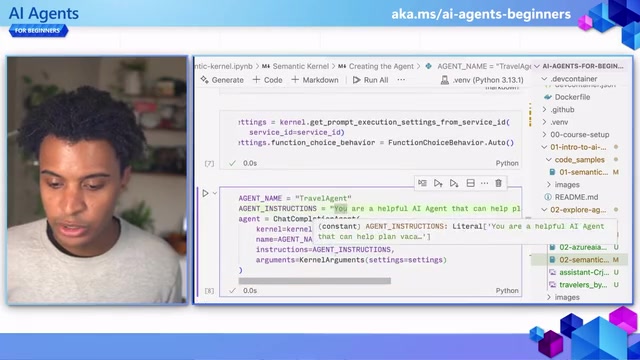
In the Semantic Kernel example, the developer defines a destinations plugin that takes a list of destinations and randomly returns one when the user requests travel planning. The Agent is defined through a Chat Completion Agent, while the Kernel carries all added services, tools, instructions, and additional settings.
This demonstrates Semantic Kernel's core design philosophy: Plugins serve as callable capability units for Agents, with their inputs, outputs, and descriptions declared through function decorators (like @kernel_function in Python). When the Agent receives a user request, the LLM automatically determines whether to call a function based on the Plugin's description information—this is the Function Calling mechanism. The Kernel, as a central dispatcher, routes the LLM's call intent to the corresponding Plugin implementation.
During execution, you can clearly see: the user requests planning a day trip, the system calls the get_random_destination function, returns "New York" as the result, and then the Agent generates a complete itinerary for New York based on this information.
AutoGen Code Example
AutoGen's setup approach is similar but the flow differs slightly. First, you create a client (the underlying model), where you can configure settings like JSON output—this is crucial when working with different functions and system components. Then you define the Agent, including its name, model client, tools (customizable), and system message (equivalent to Agent instructions in Semantic Kernel). In the example, a learning vacation is requested, and the Agent ultimately returns a seven-day Maui itinerary.
A key difference between AutoGen and Semantic Kernel is AutoGen's native support for multi-Agent interaction patterns. In AutoGen, you can easily set up auto-reply rules between Agents, termination conditions, and maximum interaction rounds, enabling collaborative patterns like "one Agent proposes a solution while another reviews and provides feedback"—without manually writing message-passing logic.
Azure AI Agent Service Code Example
Azure AI Agent Service works differently. It dynamically creates Agents at runtime during user interaction and establishes a thread to manage the message exchange between the user and the Agent.
In the example, the user requests generating a bar chart showing different traveler counts and destinations. This uses Azure AI Agent Service's built-in Code Interpreter tool, which allows the Agent to generate code—specifically, Python code to draw the bar chart.
Code Interpreter is a sandboxed code execution environment that allows AI Agents to dynamically generate and run code for data analysis, visualization, file processing, and other tasks. Under the hood, it typically uses containerization technology (like Docker or microVM) to execute Agent-generated code in an isolated environment, ensuring security. The value of Code Interpreter is upgrading LLMs from "can only generate text" to "can perform computation"—Agents can write matplotlib plotting code or pandas data processing logic, run it, and return results (charts, files) directly to the user.
By observing the run status, you can see the complete interaction process of the Agent running various tools, ultimately generating and displaying the image directly.
Summary: How to Choose the Right AI Agent Framework for You
There's no single right answer when choosing an AI Agent framework—the key is matching your target scenario:
- Already using the Azure ecosystem and need to quickly get started with a single Agent → Azure AI Agent Service
- Targeting production environments and need enterprise-grade stability → Semantic Kernel
- Exploring cutting-edge research and rapidly experimenting with new ideas → AutoGen
The most important principle remains "start small"—first get a single Agent truly running, then gradually expand to multi-Agent collaboration. Theory matters, but only by actually running code and adjusting various settings yourself can you truly understand the differences and tradeoffs between different frameworks.
Related articles

Uber Deploys ChatGPT Work Company-Wide: AI in the Workplace Enters the Scaled Implementation Phase
Uber deploys ChatGPT Work to 30,000+ employees, extending it from engineering to all roles. We analyze its expert-engineer pairing, end-to-end automation, and questions of AI control and power concentration—insights for scaling AI in the workplace.

Shift at Midnight Hands-On: When "ID Verification" Becomes Alien Hunting
Shift at Midnight blends ID verification with horror survival in a four-player co-op game. We break down its inspection mechanics and chaotic humor.

Zelensky Recounts the Outbreak of War: I Need Ammunition, Not a Ride
Zelensky recalls the first day of war in a YouTube interview: farewell to family, rejecting Biden's evacuation offer with "I need ammunition, not a ride," and how Bucha shaped his stance on compromise and peace talks.