How to Do Research in the AI Era: Avoid Outsourcing Your Thinking to Machines

Researchers must resist outsourcing deep thinking to AI while leveraging it as an assistant, not a substitute.
As AI tools make research faster, they also risk creating an illusion of understanding and eroding critical thinking. This article examines the cognitive traps of over-reliance on AI in research—including hallucinations, cognitive monoculture, and shallow processing—and offers practical strategies for preserving deep thinking while using AI as a powerful assistant rather than a replacement.
A Researcher's Confession
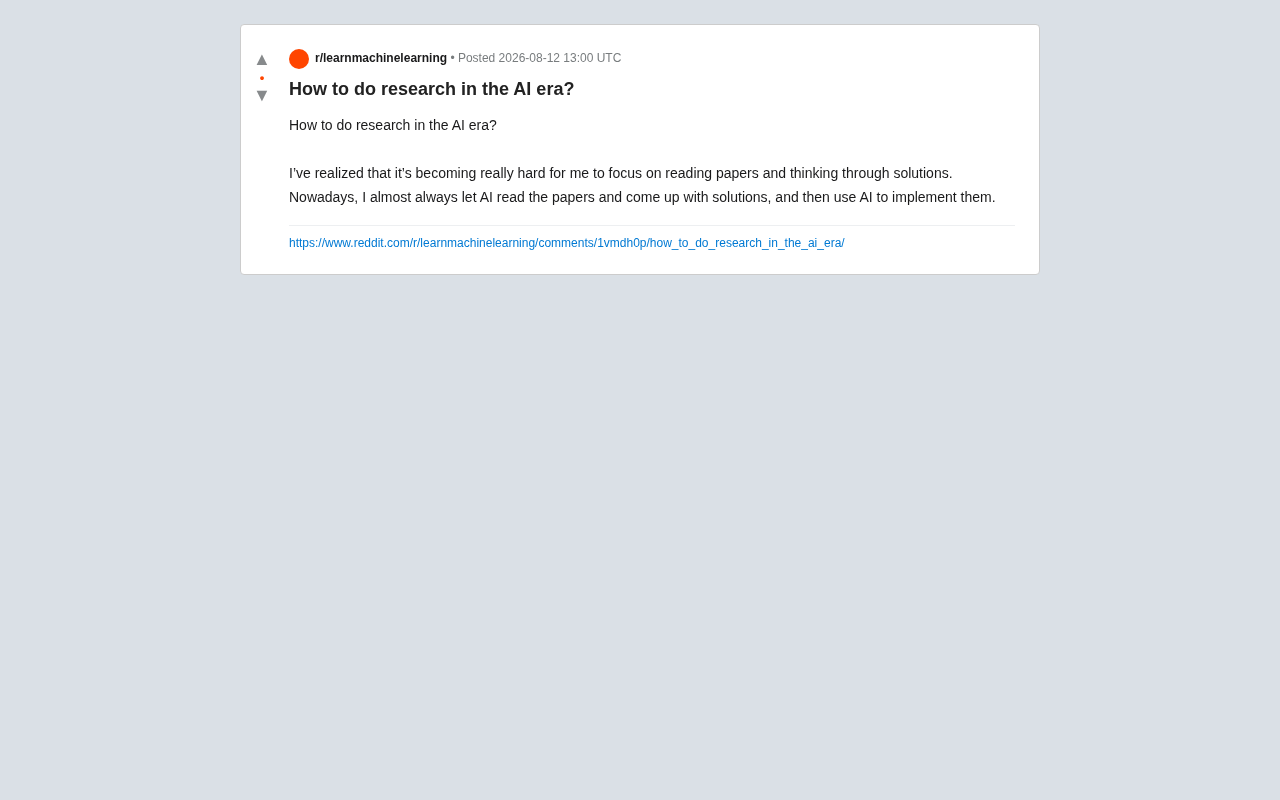
Recently, a researcher posted this dilemma on Reddit: "I find it increasingly difficult to focus on reading papers and independently thinking through solutions. Now, I almost always have AI read papers for me, propose solutions, and then use AI to implement them."
This brief confession captures a shared anxiety among countless researchers, engineers, and students in the AI era. When large language models can summarize a dozens-page paper in seconds, offer seemingly reasonable technical solutions, and even generate runnable code, we can't help but ask: what role is left for human researchers in this process? Are we quietly outsourcing our most precious capacity for thought to machines?
The Temptation and Traps of AI-Assisted Research
The Efficiency Gains Are Real — But So Are the Costs
We must acknowledge that the efficiency gains AI tools bring to the research workflow are tangible. Papers that used to require hours of close reading can now be quickly distilled by AI into core contributions, methodology, and limitations. When venturing into unfamiliar fields, AI can serve as an "introductory tutor," helping researchers rapidly build knowledge frameworks. During the implementation phase, code generation tools dramatically compress the time from idea to prototype.
For modern research that requires cross-disciplinary information integration and processing massive volumes of literature, this acceleration is nearly irresistible. Take bioinformatics as an example: a single research topic might involve hundreds of papers spanning molecular biology, statistics, and computer science, and a traditional fully manual literature review could take months. Refusing to use AI tools, in a sense, means voluntarily surrendering a competitive advantage.
The "Illusion of Understanding" Is Eroding Research Foundations
The problem is that AI's answers often look "good enough" — good enough to make us abandon the impulse to think deeply ourselves. Hidden here is a cognitive psychology trap — the illusion of understanding.
This phenomenon was first systematically described by cognitive scientists Rozenblit and Keil in their 2002 research, who called it the "illusion of explanatory depth." Experiments showed that people consistently overestimate how well they understand how things work. In the AI context, this problem is further amplified: when large language models present information in a fluent, well-structured manner, the human brain misinterprets "readability of information" as "depth of one's own understanding." Neuroscience research shows that true knowledge internalization requires coordinated work between the prefrontal cortex and hippocampus, requiring active encoding and retrieval practice, while passively receiving AI summaries engages little more than shallow processing pathways.
When we read a clear AI-generated summary, our brains produce a sense of satisfaction — "I get it now." But in reality, we've only grasped second-hand conclusions pre-digested by AI, not the deep intuitions built through our own difficult thinking. True research ability comes precisely from those moments of being "stuck" — the struggle of not understanding a derivation or not being able to figure out a hypothesis is the breeding ground for knowledge internalization and creative inspiration.
What Is the Core of Research Ability, Really?
Asking Questions Matters More Than Answering Them
In an era when AI can answer almost all "known questions," the value of research increasingly lies in asking the right questions. AI excels at interpolation and summarization within existing knowledge boundaries, but it struggles to judge which questions are truly important or which directions are worth years of investment.
This kind of "taste" and "judgment" comes from a researcher's long-term immersion in a field and critical thinking. Physicist Richard Feynman famously maintained a mental list of "twelve favorite problems," and whenever he encountered a new discovery or method, he would test whether it could advance any of those problems. This deep problem awareness cannot be formed overnight — it requires researchers to gradually refine it through repeated reading, thinking, and failure. If we can't even be bothered to read papers ourselves, how can we develop the keen instinct to identify real problems?
Critical Verification Is Irreplaceable
AI suffers from the well-known "hallucination" problem. LLM hallucinations refer to the model generating content that appears plausible but is factually incorrect or fabricated. The root cause lies in how LLMs work: they are fundamentally statistical next-token predictors trained on massive text corpora to learn language patterns, but they possess no genuine fact-verification capability or world model. The training objective maximizes linguistic fluency and coherence, not factual accuracy. Even after RLHF (Reinforcement Learning from Human Feedback) alignment, the hallucination problem cannot be fundamentally eliminated — research shows that even GPT-4-level models can have factual error rates of 15-30% in specialized academic domains, especially when precise citations, data, and reasoning chains are required.
AI might confidently present a logically coherent yet completely wrong solution, or cite literature that doesn't even exist. If researchers lose the ability and habit of independent verification, they will accept these errors as truth.
More dangerously, when the entire research community relies on the same few AI models, a collective cognitive blind spot may form — a "cognitive monoculture" effect. This concept borrows from the risk of monoculture in agriculture: when all crops share the same genes, a single disease can destroy the entire yield. In academic research, if everyone draws inspiration and direction from models with the same training data distribution, the intellectual diversity of the research community will drastically decline. AI models' training data reflects past knowledge distributions, naturally inclining them toward "mainstream" answers and "safe" directions. Yet many important breakthroughs in the history of science — such as quantum mechanics' overturning of classical physics, or plate tectonics' displacement of the fixed continent hypothesis — came precisely from challenging mainstream consensus. If everyone is guided toward similar lines of thinking, it actually stifles the diversity and originality that research should embody.
Rebuilding Research Methodology in the AI Era
Treat AI as a "Research Assistant," Not a "Research Substitute"
The proper positioning should be: let AI handle mechanical, verifiable, low-creativity work, while reserving core thinking, judgment, and innovation for yourself.
Specifically:
- Use AI for initial screening, do close reading yourself: Let AI help filter truly relevant papers from a massive literature pool, then personally dive deep into those core papers. During close reading, try not looking at the AI summary first — annotate key passages yourself, write down your own understanding and questions, then compare with the AI's summary to see what you missed and what the AI misread.
- Use AI for drafts, do the critique yourself: Let AI generate preliminary proposals, but scrutinize each assumption, logic chain, and feasibility with a critical eye. Develop the habit of "challenging AI" — actively look for gaps and unconsidered edge cases in AI-proposed solutions.
- Use AI for implementation, do the design yourself: Code can be written by AI, but overall architecture and key design decisions must remain in your control. This means you need to clearly know why you chose this algorithm over that one, why modules are divided this way, and where performance bottlenecks might emerge.
Deliberately Preserve Space for "Slow Thinking"
Nobel laureate in economics Daniel Kahneman systematically articulated the dual-system theory of human cognition in his 2011 book Thinking, Fast and Slow. System 1 (fast thinking) is automatic, intuitive, and nearly effortless — like recognizing faces or simple arithmetic. System 2 (slow thinking) requires attention allocation and is conscious and analytical — like complex logical reasoning or learning new concepts. Kahneman's research revealed that humans naturally tend to rely on System 1 to conserve cognitive resources, activating System 2 only when System 1 encounters problems it cannot handle.
The convenience of AI tools, in a sense, reinforces this cognitive laziness — it gives System 1 a powerful external prosthesis, further reducing the frequency with which System 2 is activated. Yet breakthrough discoveries in scientific research almost invariably depend on deep engagement of System 2. AI excels at providing "fast thinking" instant answers, but true research breakthroughs often come from "slow thinking" — the deep cognitive process requiring prolonged immersion and repeated deliberation.
Researchers need to consciously preserve AI-free "slow thinking" periods: manually working through key derivations, sketching thought maps on paper, engaging in deep debates with peers. These seemingly "inefficient" activities are precisely where a researcher's irreplaceable core competitiveness lies. Consider establishing a fixed weekly "no-AI research day," or when facing core research problems, thinking independently for at least one to two hours before turning to AI.
Conclusion: Tools Evolve, But Thinking Must Not Atrophy
Returning to that Reddit researcher's dilemma, his anxiety is actually a healthy signal — he recognizes that over-reliance on AI may be eroding his core capabilities. This metacognition — the awareness and reflection on one's own cognitive processes — is itself a manifestation of advanced thinking ability and the first line of defense against cognitive atrophy.
AI won't make research stop requiring thought. Quite the opposite — it raises the bar for researchers' judgment, creativity, and critical thinking. In an era where everyone has access to AI assistance, those who truly stand out will be the researchers who haven't let their thinking capacity atrophy, but have instead used AI to amplify their own insights.
Tools evolve, but human thinking must not atrophy. This is perhaps the most fundamental principle for doing research in the AI era.
Related articles

Apple HomeView Hands-On Review: Is the $300 Smart Home Hub Worth It?
Apple HomeView hands-on: a $300 smart home hub with facial recognition for quick account switching, but no App Store or voice recognition. Is the wall-mounted version worth it? Should you buy the first generation?

Meta Muse Wonder Launch: What It Means for Meta's Return to the Frontier AI Race
Meta releases Muse Wonder and WonderFull, benchmarks reach the frontier, community feedback is polarized. An in-depth look at Meta's return to the frontier AI race, its personal agent strategy, and Zuckerberg's different path.

Apple Home Smart Home Lineup Leaked: LG and Schneider Team Up, UWB Door Lock on Board
Apple Home ecosystem gains new LG and Schneider devices: UWB smart lock with proximity unlock, 2.5K dual-camera doorbell, privacy indoor camera, and AirPods-like seamless pairing.