How to Learn AI Agents? A Roadmap That Cuts Your Learning Load in Half
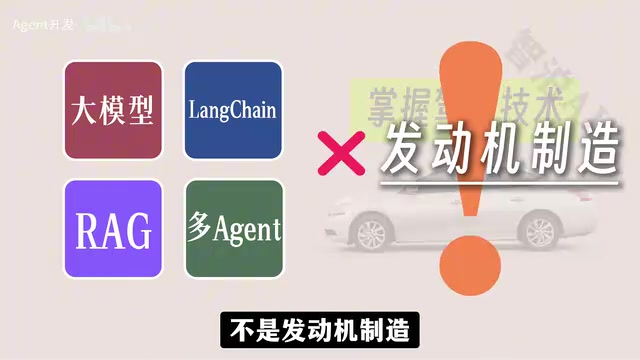
Learning Agents is like learning to drive: locate your learner type, filter knowledge by subtraction, then speed up with projects.
The article presents an Agent learning methodology for application developers. It sorts learners into three types—casual viewers, researchers, and job/project seekers—and notes that much anxiety comes from applying algorithm-researcher standards to application developers. Using the formula "Agent = LLM + memory + tools," it defines boundaries: focus on prompts, APIs, and RAG plus LangChain and tool calling, while merely understanding underlying algorithms. The roadmap has three steps: tier knowledge into must-learn, understand, and skip to halve the load; string everything together with one real project; and use ROI to justify a speed-run over starting from syntax. It ends with a three-question framework for new concepts.
Agent concepts keep multiplying—from RAG to LangChain, from single-agent to multi-agent—and beginners easily fall into the anxiety of "learn every new one as it appears." A popular Agent tutorial on Bilibili offers a counterintuitive answer: learning Agents is like learning to drive. Cars keep getting new models, but what you need to master is driving skill, not engine manufacturing. The core of this methodology isn't teaching you how to derive formulas—it's helping you judge what to learn and what you can confidently skip.
First, locate yourself: which type of learner are you?
The tutorial divides Agent learners into three categories. The first scrolls past the video out of curiosity and leaves after watching. The second wants to study the underlying principles, derive formulas, and do algorithm work. The third—the largest group—wants to use Agents to find a job, build projects, or take on freelance work, but doesn't know where to start. The first two aren't the focus; the third is the audience this roadmap truly serves.
This classification is valuable in itself. The root of many beginners' anxiety is holding an "algorithm researcher" standard against an "application developer." With the wrong direction, the more you learn, the more frustrated you get.
One formula sets the framework: Agent = LLM + memory + tools
The entire roadmap rests on a minimalist formula: Agent = LLM + memory + tools. The tutorial uses a driving analogy—the LLM is the engine, memory is the fuel tank, and tools are what actually make the car run and do work.
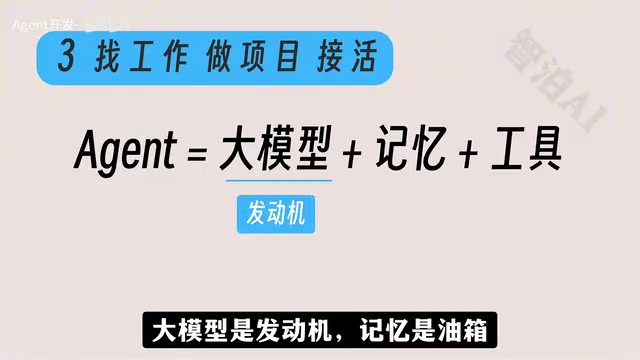
From this, only two areas need to be learned: first, model understanding, including prompts, APIs, and RAG; second, engineering capability, including the LangChain framework and tool calling. Just know the underlying principles well enough to understand what's going on—don't get stuck in mathematical derivations. This is a pragmatic judgment: an application developer's competitive edge lies in putting models to use, not in rebuilding them.
RAG (Retrieval-Augmented Generation) is an engineering pattern in which the LLM first retrieves relevant documents from an external knowledge base before answering, then feeds the retrieved results to the model as context. Its core value is solving two problems: the LLM "doesn't know private data" and "easily fabricates facts." Typical scenarios are enterprise knowledge bases, customer service Q&A, and document assistants. RAG's engineering difficulty mainly falls into two stages: chunking determines how documents are split—chunk size directly affects semantic integrity; retrieval determines what similarity strategy is used to find the most relevant fragments, commonly vector retrieval, keyword retrieval, or a hybrid of both. If chunking and retrieval aren't tuned well, the model can't answer accurately no matter how strong it is—which is exactly why the article later emphasizes "grinding" on them in a project.
LangChain is a development framework that encapsulates LLM calls, prompt templates, tool calling, memory management, and retrieval capabilities into standard components. Its significance is making the formula "Agent = LLM + memory + tools" land in runnable code: memory corresponds to conversation history and state management, tools correspond to function calling and external API integration, and retrieval corresponds to the RAG pipeline. For application developers, LangChain lowers the barrier to chaining multiple capabilities into a workflow, but it also brings problems: overly thick abstraction layers and difficulty locating errors. So a more reasonable approach when learning is to first understand what problem each component solves, then decide whether to use the framework or write a small amount of code by hand—rather than treating the framework as a black box to copy.
Step one: Build a knowledge map and cut the learning load in half
The first step of the concrete roadmap is to divide knowledge points into three tiers: must-learn, understand, and skip. Prompts, RAG, and Agent development are must-learn; multi-agent collaboration is rarely used in production and only needs to be understood; underlying algorithms have little relation to application work and can be skipped entirely.
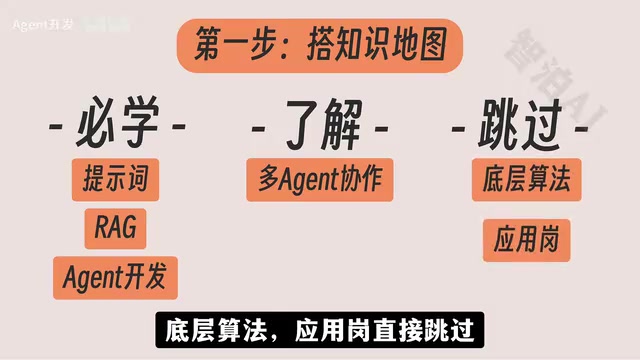
According to the tutorial, this round of filtering can cut the learning load in half. This "subtraction" mindset deserves separate mention—most tutorials do addition, desperate to stuff every new concept into you; but an effective learning plan's first step is precisely to clarify what not to learn.
Multi-agent collaboration refers to having multiple intelligent agents with different roles or tool permissions divide up a task—for example, one handles planning, one handles retrieval, and one handles validation. It's eye-catching in research and demo scenarios but relatively rare in production, for three reasons: longer call chains raise latency and cost; information passed between agents easily becomes distorted, and errors cascade and amplify; debugging and accountability become difficult. By contrast, a single agent with clear tool boundaries is often more stable and controllable. So the tutorial's classification of it as "understand only" is a pragmatic judgment—know what it is and what scenarios it suits, and don't invest heavy effort at the beginner stage.
Step two: Project-driven—one real project strings together all knowledge points
After filtering, use one real project to string together all the knowledge points. The tutorial's example is building an enterprise knowledge base, grinding hard on RAG's chunking and retrieval. The logic is straightforward: getting one project working is far better than learning ten knowledge points in isolation.
The biggest problem with learning knowledge points in isolation is the lack of a feedback loop—you don't know when a knowledge point will be used in a real scenario or what happens if you use it wrong. Project-driven learning forces you to test knowledge in context, binding memory and application together.
Step three: Calculate ROI—the wave won't wait
The third step is calculating return on investment. The tutorial compares two plans: Plan A starts from Python syntax and takes three months just to reach the Agent doorway; Plan B speed-runs in three or four days, directly follows a project, and produces work in a month. The conclusion is that Plan B is better—the wave won't wait.
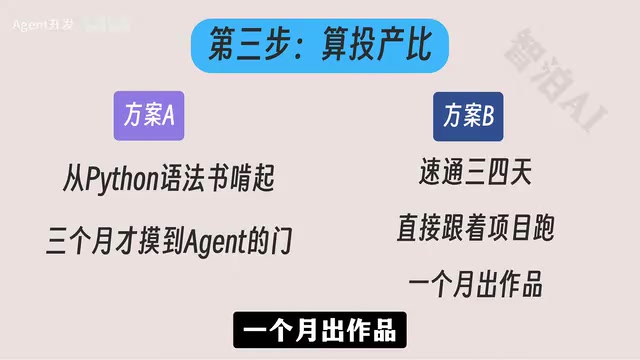
One independent judgment needs to be added here: Plan B's cost is a weak foundation, and you can get stuck when facing complex problems. The tutorial doesn't expand on this, but for the third type of learner, producing work first to build positive feedback and then going back to fill in foundations is usually more sustainable than the reverse. The premise is that you keep asking "why" within the project, rather than just copying code.
When you encounter a new concept, ask three questions first
Finally, the tutorial offers a reusable decision framework. Whenever a new concept becomes hot, ask yourself three questions: First, will it be used in my target project? Second, after learning it, can I produce visible results? Third, is the ROI of time invested versus return high?
These three questions are essentially fighting technical anxiety. Technology changes daily, but the underlying logic of application development is stable—plan your route around your goals, and you won't be led around by buzzwords. This methodology's applicability actually extends beyond Agents; it can be applied to any rapidly iterating tech field.
Full roadmap at a glance
Stringing the above steps together, the roadmap is: Python speed-run → LLM understanding → RAG → Agent hands-on practice → project integration. Each segment has clear output standards rather than a vague "learn it." For people who want to take on freelance work and build projects, the greatest value of this roadmap isn't the list of knowledge points—it's a way of thinking for judging what to learn and what not to learn.
One-line Summary
Learning Agents is like learning to drive: first locate your learner type, use subtraction to filter knowledge, then speed up through project-driven learning.
Paragraph Summary
The article introduces an Agent learning methodology for application developers. It first divides learners into three types—casual viewers, researchers, and those who want jobs and projects—and points out that the third type is the focus, with much anxiety stemming from applying algorithm-researcher standards to application developers. It then uses the minimalist formula "Agent = LLM + memory + tools" to define learning boundaries: focus on model understanding such as prompts, APIs, and RAG, plus engineering capabilities such as LangChain and tool calling, while merely understanding underlying algorithms. The concrete roadmap has three steps: divide knowledge points into must-learn, understand, and skip tiers to cut the learning load in half; use one real project (such as an enterprise knowledge base) to string together all knowledge points; and use ROI to decide to prioritize a speed-run to produce work rather than starting from syntax. Finally, it provides a three-question decision framework for new concepts and summarizes the full roadmap.
Related articles
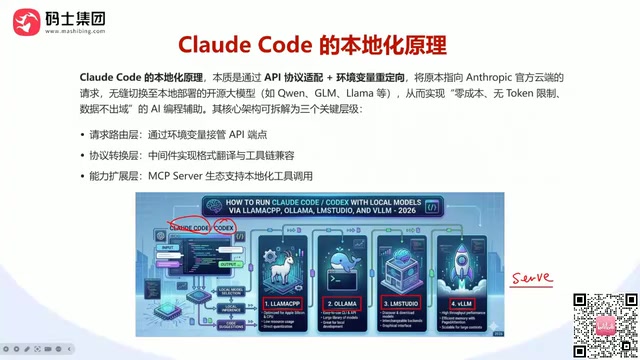
Connecting Claude Code to Local Models: A Four-Layer Architecture Breakdown and GPU Cloud Deployment Guide
Explaining Claude Code's four-layer architecture for connecting to local models: environment variable API endpoint redirection, inference engine service wrapping, protocol conversion, and the MCP tool ecosystem, plus GPU cloud deployment paths and Ollama selection considerations.
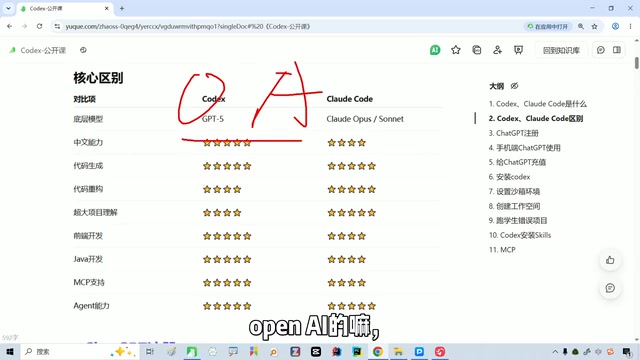
Codex Zero-Basics Hands-On: Local Sandbox and MCP Ecosystem Explained
Bilibili tutorial on zero-basics Codex AI programming: Codex vs Claude Code, ChatGPT registration and mobile setup, local sandbox, Spring MVC debugging, Skills for PPTs, and MCP with Amap—ideal for non-programmers.
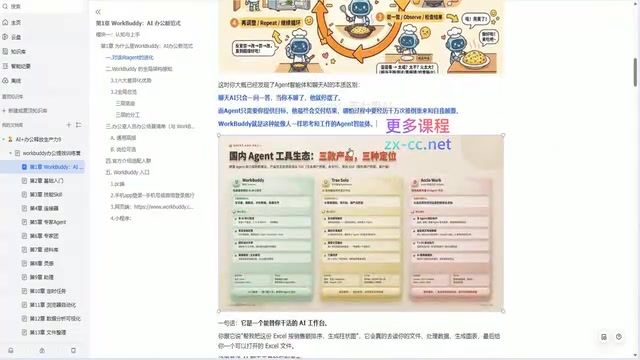
Tencent WorkBuddy Step-by-Step Tutorial: From Installation to AI-Automated Office Work in Practice
Tencent WorkBuddy step-by-step tutorial: explains the AI agent's four-step working mechanism, three-layer architecture, and multi-model advantages, covering document writing, data cleaning, PPT generation, and other office scenarios, and introduces installation and usage of four entry points: PC, mobile, web, and mini program.