Codex Zero-Basics Hands-On: Local Sandbox and MCP Ecosystem Explained
A zero-basics guide to AI agent tools like Codex: setup, practical scenarios, and cost trade-offs.
Based on a Bilibili tutorial, this article outlines a zero-basics entry path for AI programming agents like Codex and Claude Code. It distinguishes large models from agent tools, shares the creator's take that Codex with GPT-5.5 is easiest to use, details ChatGPT registration and mobile Apple ID subscription (Turkey region saves nearly half), and showcases local sandbox parallelism, Spring MVC debugging, Skills for PPTs, and MCP with Amap. Core advice: get a project running first, then dig deeper.
AI programming tools are evolving from "brains that can think" into "agents that can act." In a recent tutorial, a Bilibili creator demonstrated how to use Codex for parallel tasks in a local sandbox, Spring MVC debugging, and even making PPTs with Skills, while comparing the pros and cons of Codex versus Claude Code. Based on that tutorial, this article maps out a zero-basics entry path and the key concepts involved.
From Large Models to Agents: The Essential Difference Between Tools
The creator emphasizes at the outset that tools like Codex and Claude Code should be called "AI agent tools" rather than mere large models. A large model is like a brain that can only think but not act; an agent is like a brain equipped with hands and feet, able to call tools and execute tasks. This distinction is especially important for zero-basics learners—you don't need to know how to write Java or Path code to drive an agent through natural language to complete development tasks.
According to the creator's observations, Codex and Claude Code are currently the most widely used among programmers, forming the first tier. He believes these tools are "a must-have for everyone," worth mastering whether or not you are a programmer.
AI Agent refers to a software system that uses a large language model as its core reasoning engine, capable of autonomously planning tasks, calling external tools (such as code execution environments, browsers, APIs), and iteratively adjusting based on execution results. Unlike conversational large models that only output text, the key capability of an agent lies in its "action loop": perceiving needs → breaking down steps → calling tools → observing results → revising strategy. Programming agents like Codex and Claude Code typically come with built-in tool sets for file reading/writing, terminal command execution, and code retrieval, and allow extension to third-party services through protocols such as MCP, enabling end-to-end tasks from requirements analysis to debugging and deployment in real development environments. Understanding this architecture helps beginners realize that an agent's effectiveness depends not only on the underlying model but also on the richness of its toolchain and task orchestration strategy.
Codex vs Claude Code: The Creator's Practical Conclusions
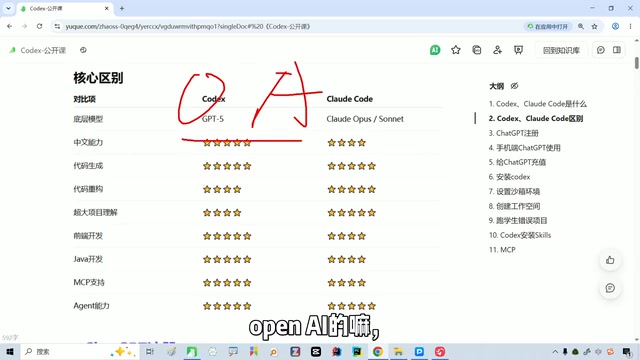
The creator's personal conclusion is that Codex is the easiest to use. The underlying model he configured is GPT-5.5, which he considers to have "better understanding of Chinese," "stronger requirements analysis capability," "strong full-stack front-end and back-end capabilities," and a rapidly growing MCP ecosystem. As OpenAI's most heavily invested product, Codex has clear advantages in user experience—for example, it has a standalone app for convenient daily use.
Regarding Claude Code, the creator notes that its corresponding overseas Claude models are expensive, and many people choose to pair it with DeepSeekAd models to reduce costs, though the results are inferior to overseas models. He admits that "some overseas models are indeed a tiny bit ahead of domestic ones," but predicts the gap will narrow in the future, and tool choice will ultimately come down to cost-effectiveness.
MCP (Model Context Protocol) is a standardized protocol proposed and open-sourced by Anthropic, designed to let large model applications connect to external data sources and tools in a unified way. Developers only need to implement a single MCP server to expose capabilities such as databases, map services, and project management tools to agents that support the protocol, without adapting separately for each model. For Codex, the rapid expansion of the MCP ecosystem means it can connect to external services like Amap, file systems, and Git repositories at low cost, significantly expanding its application boundaries. Compared with traditional Function Calling, MCP emphasizes cross-model and cross-platform interoperability, and is gradually becoming an industry convention for agent tool integration.
The First Hurdle for Zero-Basics Learners: ChatGPT Registration and Network Setup
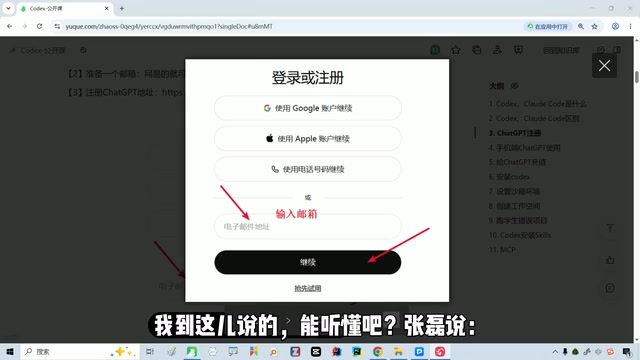
The tutorial spends considerable space explaining ChatGPT account registration, because this is a prerequisite for using Codex with GPT models. The creator breaks the process into several key steps: circumventing network restrictions, preparing an email address, visiting the registration page, email verification, and phone number verification. Phone verification is where most people get stuck—a foreign number is required, which can be obtained through SMS verification platforms by selecting the OpenAI service and topping up.
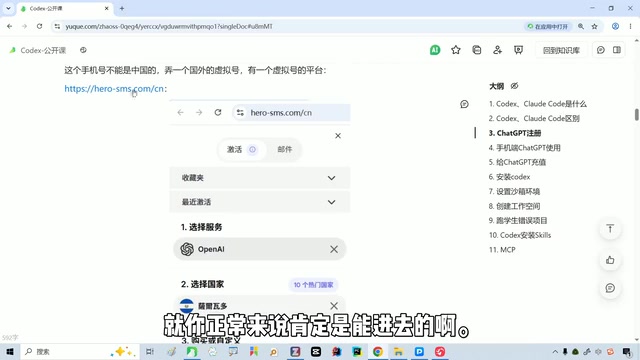
The creator also mentions cost differences: the US region monthly fee is about 160–180 RMB, while the Turkey region is about 80–90 RMB—nearly half the price. His company uniformly uses Turkey accounts.
Mobile Setup: Apple ID Switching and Subscription Payment
After completing web registration, mobile approval requires the ChatGPT app. A mainland China Apple ID cannot download it, so you need to register an Apple ID with a US address and switch regions. The creator reminds that the phone system must be version 16.1 or above, and the phone also needs to circumvent network restrictions.
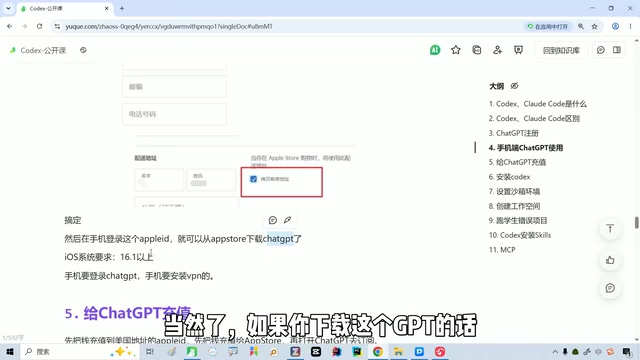
Payment can likewise only be completed on mobile: first top up the US-region Apple ID, then subscribe to ChatGPT in the App Store. The creator shows personal plan options and suggests choosing the basic tier during the learning phase, while company users can consider team plans.
Local Sandbox, Spring MVC Debugging, and Skills in Practice
The tutorial title covers multiple practical scenarios: local sandbox parallel workspaces let the agent execute tasks in isolated environments, Spring MVC debugging demonstrates AI-assisted debugging capabilities, Skills for making PPTs shows toolchain extensibility, and MCP connecting to Amap demonstrates external service integration. Although the original text does not elaborate much on the specific operations for these scenarios, the creator demonstrates Codex's value in real development workflows through actually running projects—from requirements analysis to front-end and back-end integration, the agent can handle a large amount of repetitive work.
For zero-basics learners, the creator's advice is direct: first solve account and network issues, then follow the tutorial to run through a complete project, and ask targeted questions when specific errors arise. This "get it running first, then dig deeper" path is more efficient than systematically learning all prerequisite knowledge.
Local Sandbox is an isolated execution environment in which an agent runs code, installs dependencies, and starts services without affecting the host system, and which also facilitates parallel execution of multiple tasks. Sandboxes are typically implemented through containers (such as Docker), lightweight virtual machines, or permission-restricted processes, providing file system isolation, network access control, and resource limits. For programming agents, sandboxes both ensure security (preventing malicious or erroneous code from damaging the local environment) and support "parallel workspaces"—multiple agent instances can simultaneously handle independent tasks in different sandboxes without interference. This is also the technical foundation that enables Codex to run multiple project scenarios at the same time.
Ecosystem and Cost: A Rational View of Tool Selection
The creator repeatedly mentions cost issues in the tutorial. The ChatGPT subscription fee is not low for individual learners, and the Turkey region option can save nearly half. Pairing Claude Code with domestic models is a cost-reduction approach, but effectiveness is compromised. The rapid development of the MCP ecosystem means Codex can connect to more external tools (such as Amap), expanding its application boundaries.
His judgment is: at the current stage, overseas models do have advantages, but the gap is narrowing, and tool selection will ultimately return to cost-effectiveness. For zero-basics users, rather than agonizing over which model is stronger, it's better to first become proficient with one tool—after all, "at least having a GPT to look things up normally" is also a benefit.
Spring MVC is a classic web framework in the Java ecosystem, using a model-view-controller layered architecture, widely used in enterprise back-end development. Common errors involve dependency injection failures, request mapping conflicts, and view resolution exceptions, and troubleshooting often requires combining stack traces with configuration files. The value of AI agents in debugging scenarios lies in their ability to read project source code, logs, and configuration files, locate the error context, and provide modification suggestions or even directly apply patches. However, the quality of an agent's diagnosis depends on its understanding of framework conventions and project structure, and zero-basics users still need basic error-reading skills to effectively guide the agent in narrowing down the scope of investigation.
One-line Summary
A zero-basics guide to AI agent tools like Codex: registration and setup, practical scenarios, and cost trade-offs.
Paragraph Summary
Based on a Bilibili creator's tutorial, this article maps out a zero-basics entry path for AI programming agents (represented by Codex and Claude Code). It first distinguishes large models from agent tools—the latter can call tools to execute tasks, driven by natural language without programming background. The creator finds Codex with GPT-5.5 the easiest to use, with standout Chinese understanding and full-stack capability, plus a fast-growing MCP ecosystem; Claude Code can pair with domestic models to cut costs but with compromised results. The tutorial details ChatGPT registration (circumventing network restrictions, foreign phone verification), mobile Apple ID switching and subscription payment (Turkey region saves nearly half), and demonstrates local sandbox parallelism, Spring MVC debugging, Skills for PPTs, and MCP connecting to Amap. The core advice: get a project running first, then dig deeper, and tool choice will ultimately come down to cost-effectiveness.
Related articles
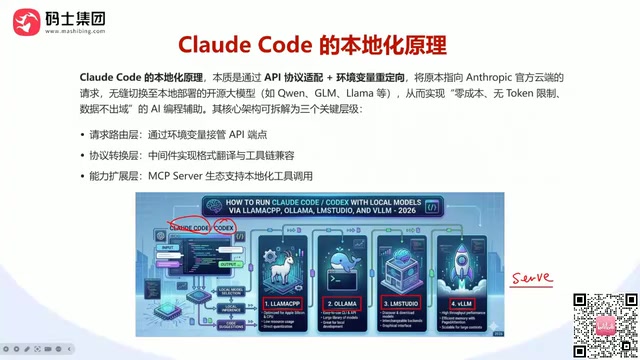
Connecting Claude Code to Local Models: A Four-Layer Architecture Breakdown and GPU Cloud Deployment Guide
Explaining Claude Code's four-layer architecture for connecting to local models: environment variable API endpoint redirection, inference engine service wrapping, protocol conversion, and the MCP tool ecosystem, plus GPU cloud deployment paths and Ollama selection considerations.

How to Learn AI Agents? A Roadmap That Cuts Your Learning Load in Half
Confused by the flood of Agent concepts? A Bilibili tutorial offers a three-step roadmap: build a knowledge map to cut learning load in half, drive learning with real projects, and calculate ROI—plus three questions to ask about any new concept, helping application developers escape tech anxiety.
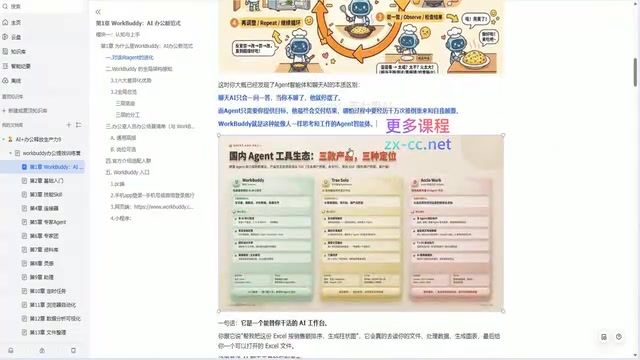
Tencent WorkBuddy Step-by-Step Tutorial: From Installation to AI-Automated Office Work in Practice
Tencent WorkBuddy step-by-step tutorial: explains the AI agent's four-step working mechanism, three-layer architecture, and multi-model advantages, covering document writing, data cleaning, PPT generation, and other office scenarios, and introduces installation and usage of four entry points: PC, mobile, web, and mini program.