How to Quantify the Structural Stability of Insurance Pricing Models? A New Metric, MSSD, Provides the Answer
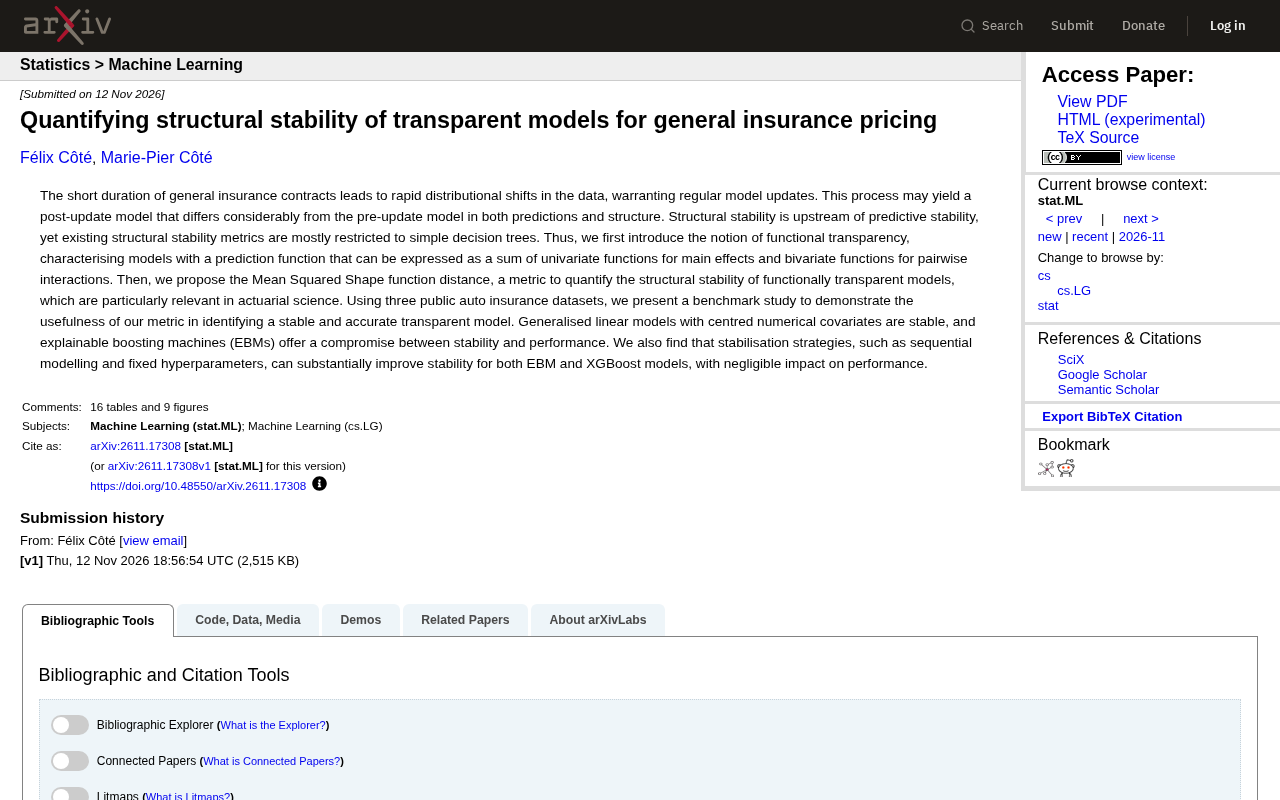
A study proposes functional transparency and the MSSD metric to quantify the structural stability of insurance pricing models.
Insurance pricing models need frequent updates, but updates can significantly change model structure, and structural stability is upstream of predictive stability. Existing metrics are mostly limited to simple decision trees and cannot cover complex actuarial models. Researchers propose functional transparency (prediction function decomposable into main effects and pairwise interactions) and the Mean Squared Shape function distance (MSSD) to quantify structural stability. Benchmarks on three public auto insurance datasets show: GLMs with centered numerical covariates are stable; EBMs balance stability and performance; stabilization strategies like sequential modeling and fixed hyperparameters significantly improve EBM and XGBoost stability with negligible performance loss.
Title
How to Quantify the Structural Stability of Insurance Pricing Models? A New Metric, MSSD, Provides the Answer
Meta Description
Insurance pricing models are updated frequently—how can structural stability be quantified? This article explains the concept of functional transparency and the Mean Squared Shape function distance (MSSD) metric proposed in a recent study, and presents benchmark conclusions on the stability of models such as GLM and EBM across three auto insurance datasets.
Article Content
Insurance pricing models are updated frequently, but the updated model may undergo significant changes in both prediction and structure. Structural stability is an upstream issue relative to predictive stability, yet most existing metrics are limited to simple decision trees. A recent study proposes the concept of functional transparency and the Mean Squared Shape function distance (MSSD) metric to quantify the structural stability of transparent models, and conducts benchmark tests on three public auto insurance datasets.
Why Do Insurance Pricing Models Need to Care About Structural Stability?
General insurance contracts have short terms, and data distributions drift quickly, which requires models to be updated regularly. But the update process may produce a model that differs greatly from the pre-update model in both prediction and structure.
Structural stability is critical because it sits upstream of predictive stability—if the model structure itself is unstable, predictive stability lacks a foundation. However, most existing structural stability metrics apply only to simple decision trees and cannot cover the more complex models commonly used in actuarial science.
This study fills exactly this gap: it provides a general-purpose tool for quantifying structural stability for models with functional transparency.
Functional Transparency: What Makes a Model "Transparent"?
The researchers first define functional transparency: a model is functionally transparent if its prediction function can be expressed as the sum of univariate functions (main effects) and bivariate functions (pairwise interactions).
The key to this definition is that it allows each component of the model to be examined individually—both main effects and interaction effects have explicit functional forms. This transparency is particularly important in actuarial science because regulators and business stakeholders need to understand what the model does, not just its predictions.
Common generalized linear models (GLMs) and explainable boosting machines (EBMs) satisfy this definition, whereas black-box models such as XGBoost do not have functional transparency—but this does not prevent researchers from using stabilization strategies to improve the stability of the latter.
A generalized linear model (GLM) is the most classic interpretable model in insurance pricing, with a prediction function of the form $g(E[Y]) = \beta_0 + \sum_j \beta_j x_j$, mapping the linear predictor to the target mean via a link function. Each covariate contribution in a GLM is a univariate linear term, which naturally satisfies functional transparency, but its ability to model interaction effects is limited, requiring manual specification of interaction terms or the use of nonlinear spline basis expansions.
An explainable boosting machine (EBM) is a modern implementation of a generalized additive model (GAM). It fits univariate shape functions round by round via a boosting algorithm and can optionally fit pairwise interaction terms, with the final prediction being the sum of the shape functions. The advantage of EBM is that it automatically captures nonlinear main effects and a small number of interactions while keeping each component visualizable and interpretable. Unlike GLM, EBM's shape functions are learned from data rather than preset in linear form, so their structural stability depends more on the distribution of the training data and hyperparameter settings.
MSSD: Measuring Structural Change via "Shape Function Distance"
Building on functional transparency, the researchers propose the Mean Squared Shape function distance (MSSD) to quantify the structural stability of transparent models.
The core idea is to compare changes in the shape of each functional component before and after a model update, rather than merely comparing predicted values. This amounts to a "difference comparison" at the structural level, capable of capturing instabilities that predictive metrics may miss.
The value of MSSD lies in turning "choosing a transparent model that is both stable and accurate" from an empirical judgment into a quantifiable decision process.
A shape function is the functional form corresponding to each component in a transparent model—for example, the univariate linear terms in a GLM, the learned univariate splines in an EBM, or the smoothed output of a decision tree ensemble. Each shape function characterizes the contribution pattern of a feature (or feature pair) to the prediction. Structural stability concerns whether these shape functions change drastically after a model update, not merely whether the predicted values change. MSSD quantifies this change by computing the mean squared difference of corresponding shape functions at sample points before and after the update; if the form or magnitude of a shape function changes significantly, the MSSD value increases accordingly. The advantage of this metric is that it can distinguish cases where predicted values are stable but the structure has changed, thereby more sensitively capturing the hidden risks introduced by model updates.
Benchmark: GLM Is Stable, EBM Balances Stability and Performance
The researchers conducted a benchmark study using three public auto insurance datasets to verify the utility of MSSD in identifying stable and accurate transparent models.
Key findings include:
- Generalized linear models (GLMs) with centered numerical covariates perform stably;
- Explainable boosting machines (EBMs) offer a trade-off between stability and performance;
- Stabilization strategies (such as sequential modeling and fixed hyperparameters) can significantly improve the stability of EBM and XGBoost models, with negligible impact on performance.
These conclusions have direct reference value for actuarial practice: if a team needs to maintain structural consistency across model updates, it can approach the problem from both model selection and training strategy—choosing models that are inherently structurally stable (such as centered GLMs), or adopting stabilization training strategies for EBM/XGBoost.
Implications for Actuarial Science and Explainable AI
The significance of this work goes beyond insurance pricing. It provides a framework: first define operational criteria for model transparency, then measure structural stability under these criteria. This line of thinking is valuable for any model scenario that requires regular updates and interpretability (such as risk control and medical scoring).
Of course, MSSD currently applies only to functionally transparent models; for fully black-box models, one still needs to rely on stabilization strategies for indirect improvement. How to quantify structural stability across a broader range of model classes remains an open question.
This article is based on a public research abstract; please refer to the original paper for specific experimental details and data.
One-line Summary
A study proposes functional transparency and the MSSD metric to quantify the structural stability of insurance pricing models.
Paragraph Summary
Insurance pricing models require frequent updates, but updates can lead to significant changes in model structure, and structural stability is an upstream issue relative to predictive stability. Existing metrics are mostly limited to simple decision trees and cannot cover the complex models commonly used in actuarial science. To address this, researchers propose the concept of functional transparency (the prediction function can be decomposed into a sum of main effects and pairwise interactions) and the Mean Squared Shape function distance (MSSD) metric to quantify the structural stability of transparent models. Benchmark tests on three public auto insurance datasets show that: GLMs with centered numerical covariates perform stably; EBMs achieve a trade-off between stability and performance; and stabilization strategies such as sequential modeling and fixed hyperparameters can significantly improve the stability of EBM and XGBoost with negligible performance loss. This work provides a quantifiable structural stability evaluation framework for model scenarios that require regular updates and interpretability.
Related articles

Gemini 4 Neon Review: Benchmark Scores Rival Carbon, API Pricing and Quota Breakdown
Google Gemini 4 Neon is now live, benchmark scores closely tracking Carbon, API pricing 3/15 at twice Hydrogen's rate. This article compiles Bilibili creator testing: Neon can replace 90% of Carbon scenarios, AntiGravity quota consumption is only one-third of Carbon, plus subscription channel restrictions and 2API ban risks.

Gemini 4 Helium Coming Soon? Signals of Google Loosening Subscription Restrictions
Google team member hints releases will continue; community speculates Gemini 4 Helium (Flash Lite) may be next. Subscription ban controversy gets a response as product lead says "Soon," suggesting restrictions may be lifted. This article covers Gemini developments, OpenAI Coding Agent and risk management, Doubao real-time audio-video API, and compute business dynamics.

AI-Assisted React Development in Practice: Optimizing a Video App and Handling Errors
A 14-year veteran developer demonstrates AI-assisted React video app optimization: compressing video from 80MB to 5MB (~94%) via ImageKit, plus reliable error handling and retry mechanisms. Includes planning, code understanding, and verification methods for working with AI.