How to Test AI Agents Before Switching Models: Avoiding Silent Tool-Call Regressions

Silent tool-call regressions are more dangerous than text quality drops — test AI Agent model switches with execution traces.
When switching underlying models in AI Agent applications, silent regressions in tool selection, parameter construction, and call ordering are invisible to text comparison alone. This article argues that Agent value lies in "what it does," not "what it says," and outlines a structured approach: build a golden set of real production traces as a baseline, use observability tools like LangSmith or Langfuse for structural diffs, deploy via canary releases with tool-call-level monitoring, and invest in ongoing trace collection so regression tests are always ready.
Switching Models Saves Money — But Can Create Hidden Problems
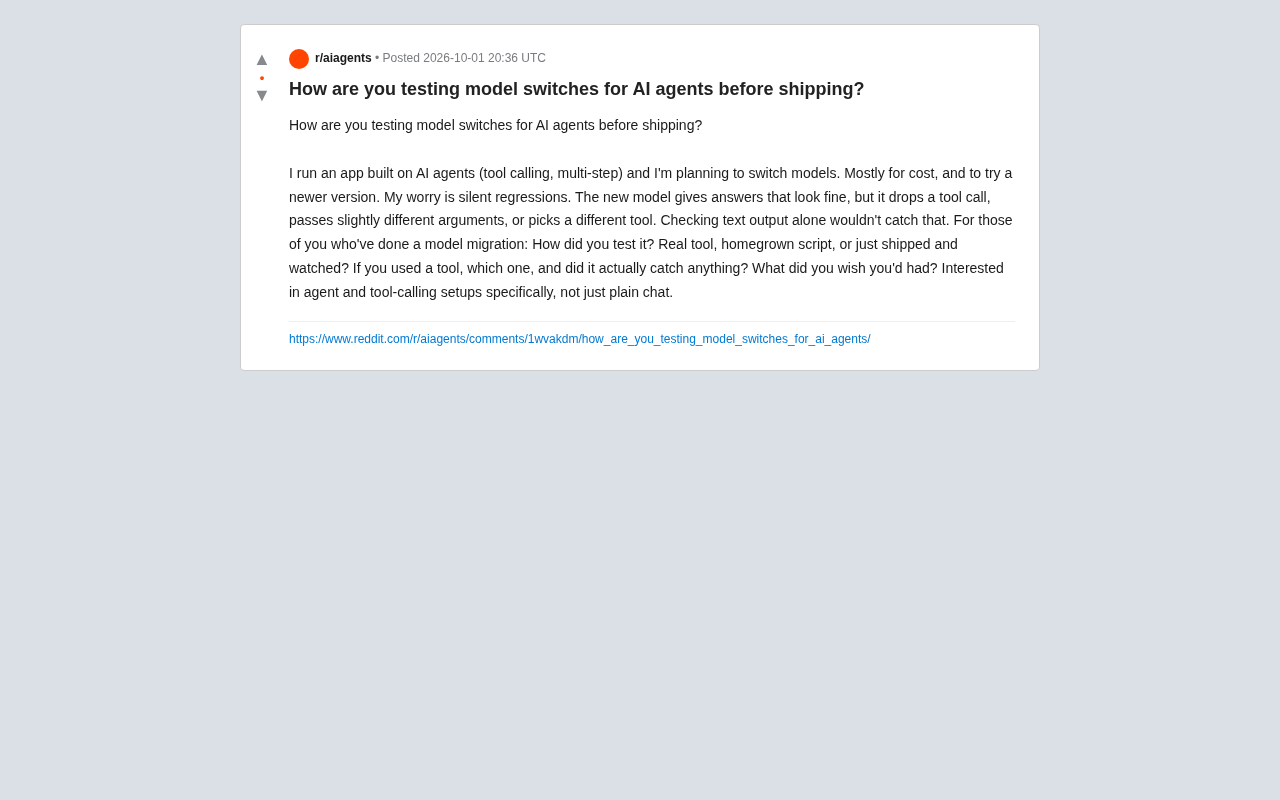
A developer running an AI Agent application on Reddit raised a challenge many teams face: when you want to switch the underlying model to a cheaper or newer version, how do you make sure you won't introduce "silent regressions"?
The problem is tricky because Agent applications typically involve tool calling and multi-step reasoning. The new model's text responses might look perfectly fine on the surface, while something has quietly changed underneath — it might have skipped a tool call, passed slightly different parameters, or chosen an entirely different tool to complete the task.
If you're only checking text output, these issues are completely invisible — until users run into them in production.
Why Text Comparison Falls Far Short
Traditional model evaluation often stays at the "Q&A comparison" level: given a prompt, see which model gives a better answer. This approach works well enough for pure chat scenarios, but it's a dangerous blind spot for Agents.
An Agent's core value isn't in "what it says" — it's in "what it does." A complete Agent execution trace typically includes:
- Tool selection: which tool the model decides to call
- Parameter construction: whether the arguments passed to the tool are correct
- Call ordering: the execution sequence of tools in multi-step tasks
- Result integration: how the model uses tool return values to make the next decision
After switching models, any deviation in the above steps can cause business logic errors — even while the final text presented to the user "looks fine." This is exactly the core scenario the original poster was worried about.
Execution Trace refers to the complete record of all intermediate steps an Agent takes to complete a task, including the name, input parameters, return values of each tool call, and the model's reasoning process at each step. Unlike single-turn Q&A, an Agent's behavior is fundamentally a decision sequence: the model selects the next action at each step based on current context, until the task is complete or fails. This means that even if the final output text "looks about the same," the intermediate path can be completely different — for example, the old model might call a search tool first and then summarize, while the new model answers directly from memory. The text results may be similar, but the latter has entirely bypassed the data validation steps required by the business. These path differences are completely invisible in pure text comparison, yet they can cause serious consequences in real-world operations — data errors, permission bypasses, or logic short-circuits.
Practical Testing Strategies
For model migrations in tool-calling scenarios, there are several layers of commonly used approaches.
Build a Trace-Based Regression Test Set
The most robust approach is to collect a set of real production requests, record the complete execution traces of the old model on those requests, and use them as a "golden set." After switching to the new model, replay the same inputs and compare item by item:
- Were the same tools called?
- Are the tool parameters within an acceptable margin of difference?
- Are the number of steps and call order consistent?
- Does the final output satisfy expected assertions?
The key is that assertions target structured tool-call events, not the text itself. Only then can you catch those "text looks fine, behavior is wrong" regressions.
The quality of your "Golden Set" construction directly determines the effectiveness of regression testing. An ideal golden set should cover several types of scenarios: high-frequency normal paths, edge cases (such as how the agent handles empty tool results), and special inputs that have caused bugs in the past. You don't need a huge sample size — 20–50 carefully selected requests are often more valuable than hundreds of random ones. For assertion design, a tiered approach works well: apply strict matching for tool selection and call order, allow some semantic equivalence for parameter values (e.g., different date formats with the same meaning), and for final text output, only assert on key fields or structure rather than word-for-word comparison. This tiered assertion strategy reduces false positives while genuinely catching regressions at the business logic level.
Leverage Existing Evaluation and Observability Tools
The original poster specifically asked whether there are tools that can actually "catch problems." The current ecosystem offers several directions:
- LLM observability platforms (such as LangSmith, Langfuse, Braintrust, etc.) support recording complete traces and performing structured assertions and comparative evaluations on tool calls.
- Agent evaluation frameworks can define success criteria for multi-step tasks, rather than just single-turn output quality.
- Custom scripts are entirely viable for Agents with relatively simple logic — the core is extracting the "tool call sequence" and running a diff.
There's no silver bullet. The right choice depends on your Agent's complexity and your team's investment capacity.
Canary Releases and Live Monitoring
Offline testing cannot cover all real-world distributions. A safer approach to going live is a canary release: let the new model handle a small portion of traffic first, while monitoring tool call success rates, error rates, call distributions, and other metrics. Only after confirming no anomalies do you gradually increase traffic.
"Ship and watch" is the highest-risk but lowest-effort approach, and is only suitable for scenarios with high fault tolerance and fast rollback capabilities.
Canary releases in Agent scenarios require special attention to the granularity of traffic splitting. Because multi-turn conversations from the same user depend on contextual continuity, switching models mid-session can cause tool-call state inconsistencies. Therefore, a safer approach is to canary at the "session" or "user" level, rather than on a per-request basis. Beyond standard error rates and latency, monitoring should focus heavily on tool-call-level signals: changes in the total number of tool calls (is the new model tending to skip certain tools?), drift in the input parameter distribution of specific tools, and task completion rates (which require clearly defined success criteria from the business side). These metrics often surface problems earlier than user complaints do.
What to Prepare Before Migrating
Starting from the original poster's question — "what do I wish I had prepared" — the capability worth building in advance is: treating every Agent execution as a structured, auditable, replayable event.
If you continuously accumulate trace data during normal operations, you'll naturally have a regression test set ready when it's time to switch models — instead of scrambling to piece one together at the last minute. In other words, the difficulty of model migration depends largely on how much you've invested in observability along the way.
For teams planning a model switch, here's a recommended minimum action checklist:
- Select a set of real requests covering core scenarios
- Record the old model's tool call traces as a baseline
- Replay with the new model and perform structured comparisons
- Go live with a canary release at low traffic and monitor key metrics
- Keep a fast rollback path available
Conclusion
This question from Reddit reflects a truth that's easy to overlook in the engineering of Agent applications: improved model capability does not equal behavioral compatibility. Now that tool calling and multi-step reasoning have become mainstream, the focus of evaluation must shift from "text quality" to "behavioral correctness." Only by incorporating execution traces into your testing framework can you adopt cheaper or newer models without letting silent regressions quietly slip into production.
Related articles

Free Unlimited Claude Code Solution: Agnes AI + CC Switch Setup Guide
No paid subscription needed — pair the free AI platform Agnes AI with the open-source tool CC Switch to provide a backend for Claude Code, enabling unlimited free calls to text, image, and video models. This guide covers the full setup, test results, and usage boundaries.

A Complete Zero-Cost Guide to Getting Started with Claude Code for Beginners in China
A beginner's guide to Claude Code for users in China: two installation methods (command line and IDE plugin), full configuration steps for replacing the official API with the free domestic LongCat model, and a hands-on demo of building a small tool with natural language, plus tips.

When the NSA Gets Involved: The AI Supply Chain Crisis Behind Open-Source CVEs and API Key Hijacking
Multiple open-source projects disclosed severe CVEs in one day, PHP flaws alarmed the FBI, and Railway and OpenCode were breached with API keys stolen. This article breaks down the vulnerability window, AI-accelerated exploitation, and the AI supply chain crisis behind the API key black market, with a developer defense checklist.