Huawei Accelerates AI Ambitions: Ascend 960DT Chip Targets Q1 2027 Launch to Challenge Nvidia
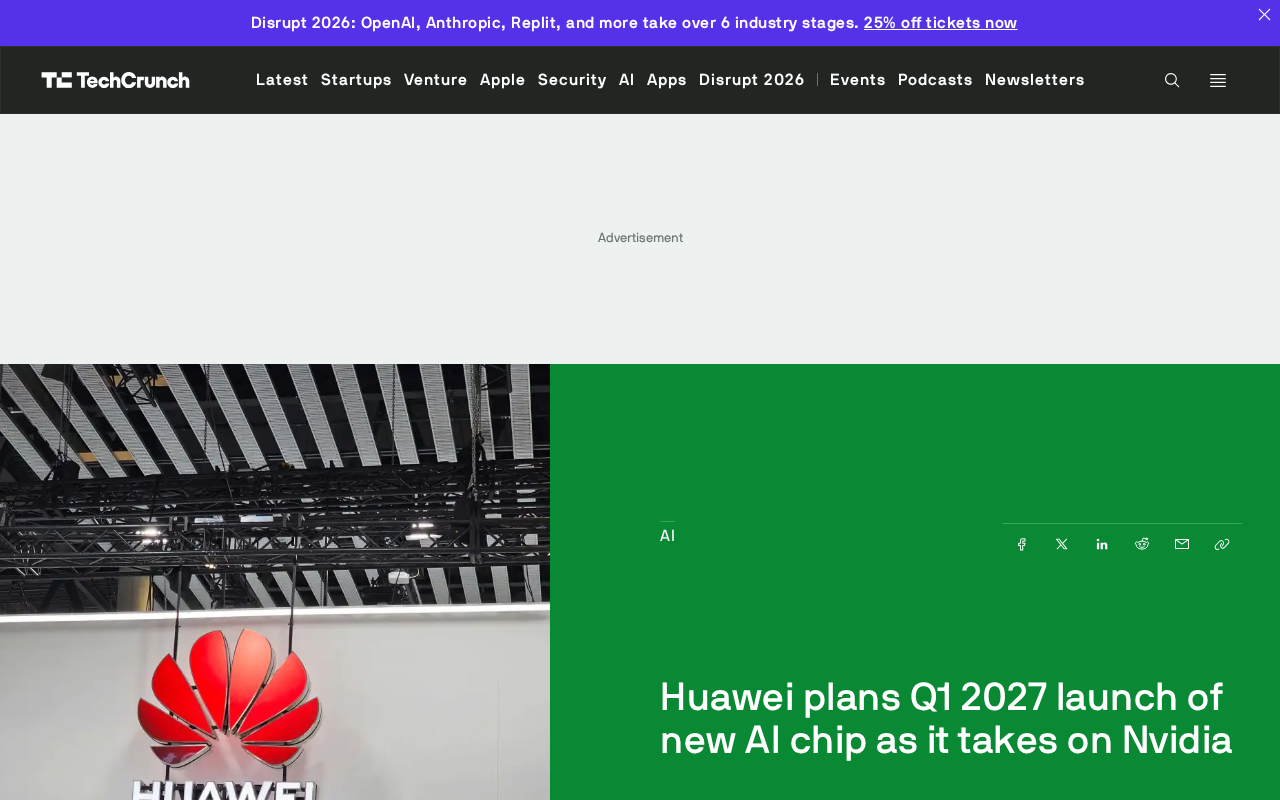
Huawei accelerates its Ascend 960DT AI chip development, targeting a Q1 2027 launch to challenge Nvidia.
Huawei is accelerating development of its next-generation Ascend 960DT AI chip, targeting a Q1 2027 launch to directly challenge Nvidia's dominance in global AI compute. This push comes amid tightening U.S. export controls and surging domestic AI demand. The 960DT represents the latest iteration of the Ascend series, aiming for advances in process, architecture, and multi-chip interconnect — though Huawei must also overcome the formidable challenge of building a software ecosystem to rival Nvidia's CUDA. A successful launch could significantly strengthen China's domestic AI compute supply chain.
Huawei Doubles Down on the AI Chip Battlefield
Huawei is accelerating the development and commercialization of its next-generation AI chip — the Ascend 960DT — with its sights set squarely on Nvidia's dominance in AI computing. According to original reports, Huawei aims to use this new chip to narrow the AI compute gap between China and the United States.
This move comes against the backdrop of intensifying global competition for AI compute. As the demand for large model training and inference grows exponentially, whoever can deliver more powerful, stable, and independently controlled AI chips will command the core of the AI industry. Huawei's decision to accelerate at this moment is clearly a bid to gain an early advantage in what will be a long-term race.
What the Ascend 960DT Represents
The Ascend 960DT is the latest generation in Huawei's Ascend series. This lineup has steadily built its reputation in China's AI training and inference market, becoming a critical alternative for many Chinese enterprises and research institutions facing restricted access to Nvidia's high-end GPUs.
Based on its naming and positioning, the 960DT represents further iteration in process technology, architecture, and interconnect capabilities. For China's AI industry, a more powerful domestically produced chip means not only more compute options, but also greater supply chain security and technological self-reliance. Reports indicate Huawei is targeting a Q1 2027 launch, a timeline that signals a noticeably faster development cadence.
Why the Push to "Accelerate"
Reports specifically highlight that Huawei is accelerating this chip's time to market. This urgency stems from several converging factors: robust and growing domestic demand for AI compute; restricted access to high-end chips from abroad, which is forcing improvements in local supply capacity; and competitive pressure from Nvidia's performance lead, which requires faster product iteration to close the gap.
The Ascend series uses Huawei's in-house DaVinci architecture, optimized for AI matrix operations, paired with a software stack called CANN (Compute Architecture for Neural Networks) — Huawei's answer to Nvidia's CUDA. The widely used previous-generation product, the Ascend 910B, delivers approximately 256–320 TFLOPS of FP16 performance, compared to Nvidia's H100 at roughly 1,979 TFLOPS — a substantial gap remains. Huawei's chips are also constrained by domestic foundry capacity, currently relying primarily on SMIC's 7nm/5nm processes, which lag behind TSMC's advanced nodes in transistor density and power efficiency — a key bottleneck for further performance gains.
Taking On Nvidia's Compute Dominance
Nvidia has long held an iron grip on the global AI training chip market through its GPUs and the CUDA ecosystem. For Huawei to challenge this head-on, it must compete not only on hardware performance, but across the full spectrum — software ecosystem, developer habits, and large-scale deployment experience.
On the hardware side, Huawei needs to continually close the gap — and in some cases surpass Nvidia — in single-chip compute, power efficiency, and multi-chip interconnect scaling. On the ecosystem side, it must continuously refine its Ascend software stack to reduce the cost for developers migrating from Nvidia's platform. This is no easy path, but for Huawei, which is committed to narrowing the China-US AI compute gap, it is a necessary one.
Nvidia's CUDA ecosystem, built since 2006, has accumulated millions of developers, tens of thousands of optimized libraries, and native support from major deep learning frameworks like PyTorch and TensorFlow — creating an enormously high barrier to migration. Huawei has countered with its MindSpore framework and operator optimizations through CANN, but the vast majority of existing AI models and training code are still written with CUDA as the default backend. Migrating requires re-adapting operators and re-tuning, which carries non-trivial costs. Some Chinese companies currently adopt a "dual-stack" strategy: using Nvidia GPUs during development and research, then adapting trained models to Ascend for inference deployment — balancing performance needs with supply chain independence.
Far-Reaching Implications for China's AI Industry
If the Ascend 960DT launches on schedule and meets its performance targets, its significance will extend well beyond a single product. It could meaningfully reinforce the domestic supply foundation for China's AI compute, giving large model vendors, cloud service providers, and research institutions more reliable access to the compute they need.
From an industry perspective, a more competitive domestic AI chip can stimulate the growth of China's local AI ecosystem, drive hardware-software co-optimization, and potentially reshape market dynamics around pricing and supply stability. Of course, whether it can truly "match Nvidia" ultimately depends on real-world performance after launch, ecosystem maturity, and validation at commercial scale.
Conclusion
Huawei's decision to accelerate the Ascend 960DT's launch schedule sends another clear signal about its long-term strategy in the AI chip arena. In an era where compute is competitive advantage, this chip — targeting a Q1 2027 debut — deserves close attention from both domestic and international industry observers. How much ground it can actually close on Nvidia, and how significantly it reshapes China's AI compute landscape, will only become clear once more technical details and real-world benchmark data emerge.
(Note: This article is based on publicly available reports. Specific product specifications and launch timelines are subject to official Huawei announcements.)
Background Context
On the export control front, the U.S. Department of Commerce began placing Nvidia's high-end AI chips — including the A100 and H100 — on export control lists starting in 2022, and further tightened restrictions on downgraded variants like the H800 and A800 in 2023. This has dramatically narrowed the compliant channels through which Chinese companies can access top-tier compute. This backdrop has directly fueled intense domestic demand for high-performance homegrown AI chips, and has opened a historic market opportunity window for domestic chip makers like Huawei. Accelerating time to market helps Huawei capture customer mindshare and deployment scale before the competitive landscape solidifies.
Related articles
Cursor Cloud Agent: AI Writes the Code, Then Records a Video to Prove It Works
Cursor Cloud Agent lets AI write code and attach a screen recording as proof — no manual testing needed. Learn how Walkthrough Artifacts and parallel VM isolation work.

Testing 11 WAN 2.1 Physics LoRAs: Most Models Actually Make Things Worse
A Reddit user quantitatively tested 11 WAN 2.1 physics LoRAs using optical flow and frame-differential energy. Most models underperformed the baseline. Here's what the results reveal.

SpawnRipple: An External Social Environment Built for Autonomous AI Agents
SpawnRipple is an external social environment for autonomous AI agents — providing identity, publishing, discovery, interaction, and API without running any agent models.