Hugging Face Integrates OpenRouter: Easier Access to Open-Source AI Models

Hugging Face integrates OpenRouter with unified Token and endpoint, plus real-time stats and a new inference widget.
Hugging Face and OpenRouter have partnered to integrate OpenRouter directly into the Hugging Face platform. Users can call OpenRouter services with the same Token and endpoint, eliminating the need to switch platforms or maintain two authentication systems. The integration also adds real-time model statistics on the Hub and a redesigned inference widget for direct model trials. This connects the model repository with model routing, positioning the collaboration as "accelerating open-source AI."
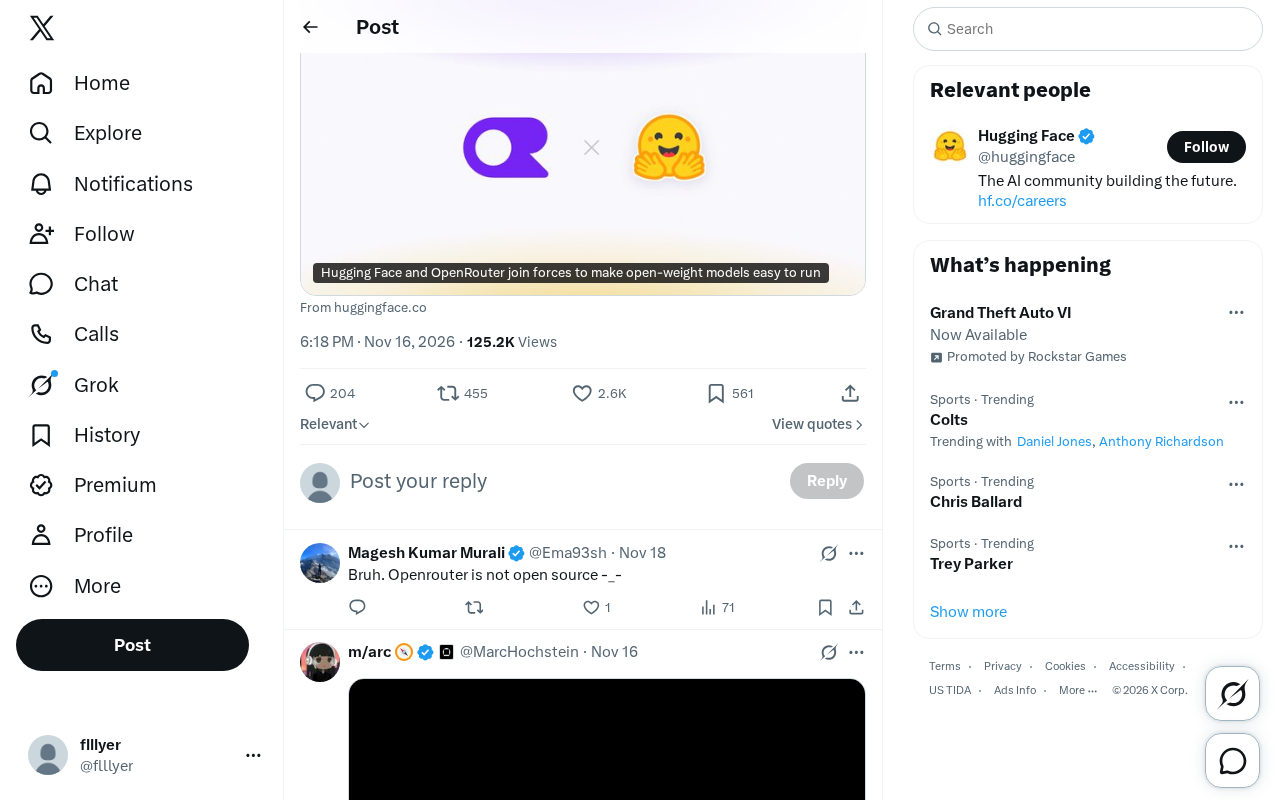
Hugging Face and OpenRouter have announced a partnership to integrate OpenRouter directly into the Hugging Face platform. The news was shared by the official team on Twitter, marking a significant change in how open-source AI models are accessed and experienced.
Integration Core: Same Token and Endpoint
According to the official announcement, after the integration, users can use the same Token and the same endpoint to directly call OpenRouter's services on the Hugging Face platform. This means developers no longer need to switch between multiple platforms or maintain two separate authentication systems, greatly simplifying the process of accessing open-source models.
OpenRouter itself is an API platform that aggregates multiple AI models. This deep integration with Hugging Face creates a shorter loop from model discovery to testing to deployment.
Token (access token) is a credential string used by API platforms for identity authentication and authorization, typically placed in HTTP request headers as Bearer. Each account can generate multiple tokens to distinguish different applications, control permission scopes, and support revocation at any time. Endpoint refers to the specific URL address for API requests, such as https://openrouter.ai/api/v1/chat/completions. The phrase "same Token and same endpoint" means that code developers originally wrote for either Hugging Face or OpenRouter can access the other party's services without modifying authentication information or request addresses, typically implemented through gateway proxying or a unified authentication layer. This reduces configuration costs when using multiple platforms in parallel and avoids expanding the surface for key leakage.
New Features: Real-Time Model Statistics and Inference Widget
Beyond connecting tokens and endpoints, the integration brings two practical features:
- Real-time model statistics on the Hub: Users can view real-time runtime data for models directly on the Hugging Face Hub, helping them assess actual performance and availability.
- Redesigned inference widget: Both parties jointly redesigned the inference widget, allowing users to try inference directly on the model page and reducing trial-and-error costs.
These features integrate the path of "discover model — experience model — call model" into a single interface, delivering a clear efficiency boost for developers in the open-source AI ecosystem.
Inference Widget is an interactive trial module built into Hugging Face model pages, allowing users to send inputs to a model and view outputs in the browser without writing code. It is typically powered by a backend inference API and supports tasks such as text generation, classification, and images. The redesigned widget improves response speed, parameter adjustment, and result display, and is connected to OpenRouter's call chain, making the trial experience closer to real API calls. For model authors, this widget is the first entry point for showcasing model capabilities; for users, it provides a low-cost way to quickly validate whether a model meets their needs before formal integration.
Significance for the Open-Source AI Ecosystem
Hugging Face is the most important hub for open-source AI models, while OpenRouter provides unified access to multiple models. Their combination essentially connects the "model repository" with "model routing."
The official team frames this partnership as "accelerating open-source AI" and emphasizes "the best of open source, all in one place." From a developer's perspective, this integration reduces repetitive infrastructure work, allowing teams to focus more on model selection and application development. For open-source model authors, the real-time statistics and inference widget on the Hub also provide more direct exposure and feedback channels.
Currently, the official information focuses on the integration approach and features. Specific performance, billing details, and the range of covered models have not yet been detailed in the announcement and are worth watching going forward.
Model Routing refers to the ability to dynamically distribute requests to different models or inference providers in a multi-model environment based on task type, cost budget, latency requirements, or availability. This is the core value of OpenRouter: it aggregates numerous models and backend providers, exposes a unified OpenAI-compatible interface, and handles routing, load balancing, and failover internally. Connecting this routing capability to Hugging Face is like adding a "scheduling layer" on top of the "model repository," allowing developers to compare and switch models horizontally under the same interface without having to integrate SDKs and billing systems separately for each model.
One-line Summary
Hugging Face integrates OpenRouter with unified Token and endpoint, plus new real-time statistics and inference widget.
Paragraph Summary
Hugging Face and OpenRouter have announced a partnership to integrate OpenRouter directly into the Hugging Face platform. After the integration, users can call OpenRouter services using the same Token and endpoint, without switching between platforms or maintaining two authentication systems. The two parties also bring two new features: real-time runtime statistics for models on the Hugging Face Hub, and a redesigned inference widget that lets users try inference directly on model pages. This partnership connects the "model repository" with "model routing," integrating model discovery, experience, and invocation into a single interface, positioned by the official team as "accelerating open-source AI." Specific performance, billing details, and the range of covered models have not yet been disclosed.
Related articles

Pure-Code Video Generation Tested: Which AI Model Actually Follows Instructions?
A Bilibili creator tested three AI models' pure-code video generation with unified prompts and three revisions each: Xiaonaomao has a high ceiling but lacks stability, GPT 6.2 Extra models well but only follows half the instructions, and OPAS 5.5 remains the benchmark.

GPT-6 Six-Tier Hands-On Test: Astra Ultra Dominates but Bills Double
GPT-6 six-tier test: Astra Ultra sweeps 3:0 in 3D tasks thanks to sub-agents and runs 14% faster, but hidden backend bills make its real cost 2.6x single-threaded.

GPT-6.2 Astra vs Fable 5.2: Huge Cost-Efficiency Gap Across 12 Real-World Tests
Bilibili creator tests GPT-6.2 Astra vs Fable 5.2 across 12 real tasks: Fable wins 7-5 but costs 7.2x more and takes nearly 5x longer. Token efficiency emerges as the key selection metric.