Hugging Face v5.20.1 Released: Integrates Reflection AI's New Model Beam
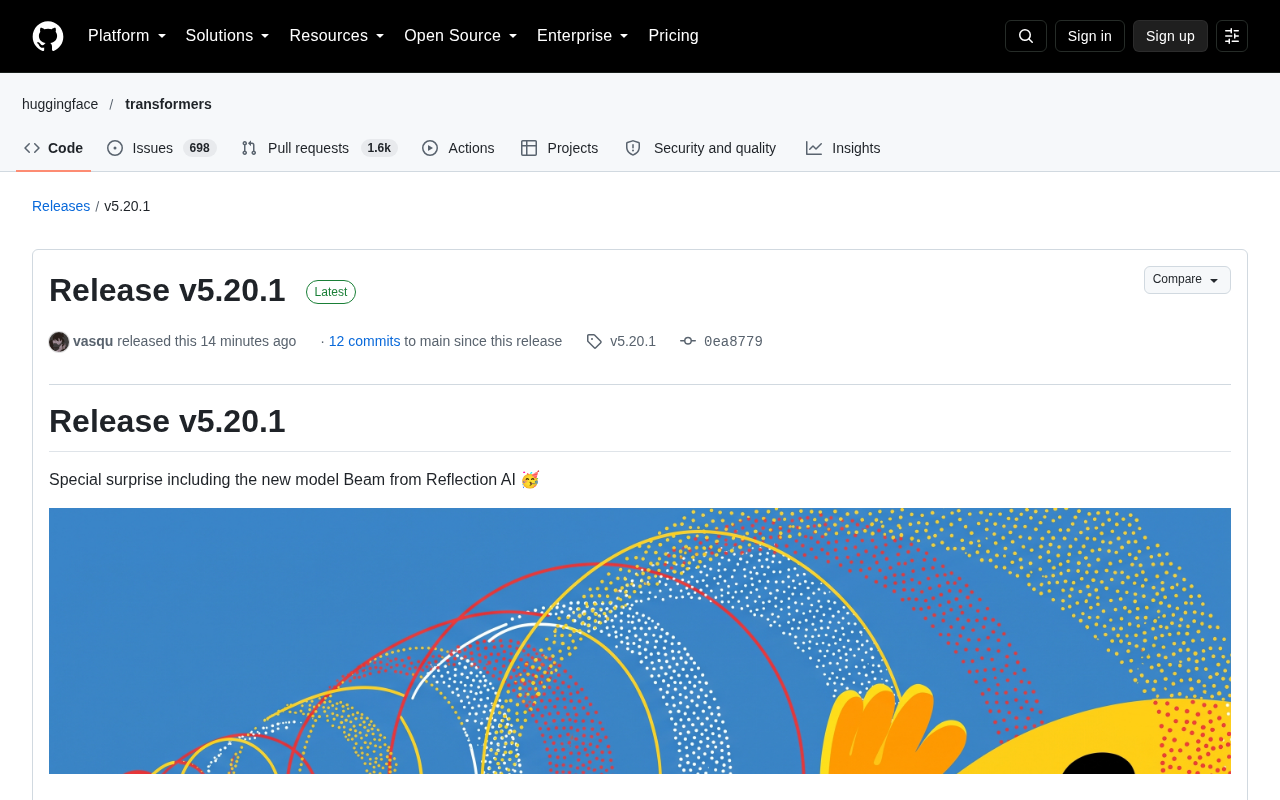
Hugging Face transformers v5.20.1 integrates Reflection AI's Beam model and fixes multiple compatibility issues.
Hugging Face has released transformers v5.20.1, adding the Beam model from Reflection AI, which emphasizes token efficiency for programming and agent use cases and supports deployment and customization on your own hardware, infrastructure, or in the cloud. This patch also focuses on fixing model loading compatibility issues, including the previous failure to load on older torch versions, and addresses HunYuan-VL batch generation image allocation, DeepGEMM Mega MoE expert parallelism, from_pretrained support for torch 2.7, DtensorShardOperation backward compatibility, and auto mappings. The release was led by vasqu, with 5 contributors and 12 commits; users can view the complete changelog on GitHub.
Hugging Face has officially released version v5.20.1 of the transformers library. In addition to fixing several compatibility bugs, this update introduces a notable new addition—the Beam model from Reflection AI.
Beam Model: An Efficient Choice for Coding and Agent Use Cases
According to the official announcement, Beam is a "token-efficient, frontier-scale" model focused on programming and agentic use cases. Its core positioning is to enable teams to run a powerful model on their own hardware, infrastructure, or in the cloud, and customize it to their specific needs.
This description reveals several key signals: Reflection AI is clearly targeting the two hottest directions in current AI deployment—code generation and agent applications. The "token-efficient" phrasing also suggests that the model has been optimized for inference cost, which is particularly important for enterprises looking to deploy large models locally.
The official announcement also provides a documentation link to help developers get started with integration quickly.
On "token-efficient": In large model inference, "token-efficient" typically means the model consumes fewer tokens while achieving the same task quality, or produces better results within a fixed token budget. This is especially critical for agent scenarios, since agents often require multiple rounds of tool calls and long-context reasoning, where token consumption multiplies rapidly. Token efficiency means lower inference latency and cost, and also makes the model easier to deploy on single-machine multi-GPU setups or even consumer-grade hardware—aligning with Reflection AI's emphasis on running on "your own hardware or in the cloud."
On Reflection AI: Reflection AI is a company focused on frontier large model research and development, and its name hints at an emphasis on models' "self-reflection/reasoning" capabilities. As its first model integrated into the transformers ecosystem, Beam chooses programming and agents as its entry point, which is highly consistent with the current industry demand for models that can "execute and call tools." Distribution through Hugging Face's official library also means developers can load it directly using standard interfaces like AutoModel, lowering the barrier to integration.
Compatibility Fixes: Older torch Users No Longer "Locked Out"
Another focus of this patch is fixing model loading compatibility issues. The official announcement acknowledges that the previous version "broke model loading on older torch versions," and v5.20.1 addresses this.
Specific fixes include:
- HunYuan-VL batch generation image allocation fix (#49557): resolved the image allocation issue for multimodal models during batch inference
- DeepGEMM Mega MoE expert parallelism fix (#49428): addressed computation issues for the MoE architecture in expert parallelism scenarios
- from_pretrained compatibility with torch 2.7 (#49652): distributed checkpointing now requires torch>=2.8 to avoid silent failures
- DtensorShardOperation backward compatibility (#49657): enables this operation to run correctly on torch 2.6 and 2.7
- auto mappings minor bug fix (#49664)
These fixes cover multiple critical scenarios, from older torch compatibility to distributed training and MoE parallelism. For users of HunYuan-VL or DeepGEMM, upgrading to v5.20.1 can resolve actual runtime issues they encounter.
On distributed checkpointing and torch version requirements: Distributed checkpointing is used to save and restore model states during multi-GPU or multi-node training, involving metadata consistency for sharded tensors. If the torch version is too old, certain metadata API behaviors may be inconsistent, potentially causing state misalignment during loading without reporting an error—the so-called "silent failure." Therefore, the official team explicitly requires torch>=2.8 and adds version validation in from_pretrained, exposing issues early rather than crashing mid-training.
On DtensorShardOperation: DTensor is PyTorch's distributed tensor abstraction, and DtensorShardOperation is part of its sharded operator interface. The signature or behavior of this interface may change between torch versions. This fix enables it to run correctly on torch 2.6 and 2.7 as well, ensuring that users on older framework versions won't be interrupted by incompatible operators after upgrading transformers.
How to Get It
Users can view the complete changelog (v5.20.0...v5.20.1) and obtain the update through Hugging Face's GitHub repository. This release was led by vasqu, with 5 contributors participating and 12 commits included.
For teams using transformers in production, it's recommended to evaluate whether this compatibility fix resolves current blocking issues before deciding when to upgrade.
Upgrade recommendation: For production environments, it's advisable to first reproduce the original issue in an isolated test environment using the same models and data, confirm that the fix in v5.20.1 actually works, and then plan a gradual rollout. Especially when the project depends on a specific torch version or uses MoE and multimodal inference, focus on validating the HunYuan-VL and DeepGEMM-related paths. If there are no current blocking issues, you may also wait for the next stable release to upgrade, reducing regression risk from frequent changes.
One-line Summary
Hugging Face transformers v5.20.1 integrates Reflection AI's Beam model and fixes multiple compatibility issues.
Paragraph Summary
Hugging Face has released transformers v5.20.1, adding the Beam model from Reflection AI, which emphasizes token efficiency for programming and agent use cases and supports deployment and customization on your own hardware, infrastructure, or in the cloud. This patch also focuses on fixing model loading compatibility issues, including the previous failure to load on older torch versions, and addresses HunYuan-VL batch generation image allocation, DeepGEMM Mega MoE expert parallelism, from_pretrained support for torch 2.7, DtensorShardOperation backward compatibility, and auto mappings. The release was led by vasqu, with 5 contributors and 12 commits; users can view the complete changelog on GitHub.
Related articles

Free Unlimited Claude Code Solution: Agnes AI + CC Switch Setup Guide
No paid subscription needed — pair the free AI platform Agnes AI with the open-source tool CC Switch to provide a backend for Claude Code, enabling unlimited free calls to text, image, and video models. This guide covers the full setup, test results, and usage boundaries.

A Complete Zero-Cost Guide to Getting Started with Claude Code for Beginners in China
A beginner's guide to Claude Code for users in China: two installation methods (command line and IDE plugin), full configuration steps for replacing the official API with the free domestic LongCat model, and a hands-on demo of building a small tool with natural language, plus tips.

When the NSA Gets Involved: The AI Supply Chain Crisis Behind Open-Source CVEs and API Key Hijacking
Multiple open-source projects disclosed severe CVEs in one day, PHP flaws alarmed the FBI, and Railway and OpenCode were breached with API keys stolen. This article breaks down the vulnerability window, AI-accelerated exploitation, and the AI supply chain crisis behind the API key black market, with a developer defense checklist.