HuggingFace Open-Sources ml-intern: An AI Engineer That Reads Papers and Trains Models Autonomously

Hugging Face open-sources ml-intern, an autonomous AI engineer that reads papers, trains models, and ships ML code.
Hugging Face has open-sourced ml-intern, an autonomous Agent built on smolagents that reads papers, writes training scripts, and finetunes LLMs from a single natural-language prompt. Deeply integrated with the HF ecosystem, it supports flexible model switching and cloud tools—and may replace junior ML roles while amplifying senior engineers.
Train a Model with a Single Sentence
"Can AI replace ML engineers?" This is an anxiety-inducing topic that every machine learning practitioner inevitably confronts. And a recently open-sourced project from Hugging Face has made this question far more concrete—ml-intern, whose tagline reads directly: an open-source ML engineer that can read papers, train models, and ship ML code.
The way it works is astonishingly simple. You just describe your goal in a single sentence of natural language, such as "Finetune Llama on my dataset," and it autonomously plans the task, consults documentation, writes code, and executes training. The entire workflow requires no step-by-step human intervention, yet you can interrupt and redirect it at any time.
According to an analysis by Bilibili creator Value AI in the finale of their "Digging Through GitHub's Monthly Rankings" series, this may be one of the open-source Agents with the greatest impact on the ML industry.

Deeply Integrated with the Hugging Face Ecosystem
As one of the most important open-source platforms in the AI field, Hugging Face's Transformers library is virtually the de facto standard for NLP—as of 2025, the library boasts over 140,000 stars on GitHub and hosts more than 900,000 pretrained model checkpoints, covering mainstream modalities such as text, images, and audio, and has become shared infrastructure for both academic research and industrial deployment. ml-intern is built precisely on top of the official smolagents framework, deeply integrating with the entire HF ecosystem.
smolagents is a lightweight Agent-building framework officially released by Hugging Face. Its design philosophy is to let the LLM directly generate and execute Python code, rather than relying on predefined tool-calling chains. To understand what makes this design unique, it helps to contrast the two paradigms of mainstream Agent frameworks: the tool-calling type (such as the early Chain mechanism in LangChain) requires developers to pre-enumerate the set of tools the Agent can use, and the Agent can only select from them and invoke them in a fixed format each time; whereas smolagents' Code-First paradigm lets the LLM directly output executable Python code snippets. This means the Agent can call multiple tools within a single inference, assign intermediate results to variables, write conditional branches to handle exceptions, and even dynamically construct new function logic.
This flexibility is especially critical in ML training scenarios—when the loss curve shows abnormal oscillations, the Agent doesn't need to match a preset "hyperparameter-tuning tool." Instead, it can directly write a diagnostic script to analyze the gradient distribution, then decide whether to adjust the learning rate schedule, switch optimizers, or check the data preprocessing pipeline. The entire decision-execution loop is fully driven by generated code. Notably, this design of smolagents is not built out of thin air—it draws on the core idea of the ReAct (Reasoning + Acting) framework, namely alternating "thinking" and "acting," where the result of each code execution serves as input for the next reasoning step, forming a closed-loop self-correction mechanism. The ReAct framework was originally proposed by Google in a 2022 paper, and experiments demonstrated that this "think-while-doing" alternating pattern significantly outperforms pure chain-of-thought reasoning or pure action execution on tool-use tasks—the former tends to hallucinate in complex tasks due to lack of real feedback, while the latter cannot dynamically adjust its strategy based on execution results. smolagents engineered this academic finding and, through the concrete form of code execution, endowed it with stronger expressive power. This architecture gives the Agent greater robustness than pure instruction-execution frameworks when facing unexpected situations such as training failures.
Fully Leveraging Site-Wide Resources
ml-intern can access Hugging Face's Docs, Papers, Datasets, and cloud Compute. It runs on top of HF's knowledge base and compute, making it a truly autonomous Agent that "fully leverages site-wide resources."
This deep integration means that whether it's referencing the training method from a certain paper or invoking a public dataset, everything can be completed seamlessly within the same ecosystem, without switching back and forth between multiple platforms. It's worth mentioning that ml-intern accesses HF Docs and Papers not through simple web scraping, but through structured knowledge interfaces, which ensures the accuracy and timeliness of content—a direct manifestation in a concrete product of the "standardization of context acquisition" trend seen in the monthly rankings.
At the paper-retrieval level, ml-intern can connect to the arXiv preprints indexed on the Hugging Face Papers page. This means the Agent can proactively consult the latest technical approaches before training a model—for example, when finetuning a vision model, it automatically retrieves the original papers on parameter-efficient fine-tuning (PEFT) methods such as LoRA and QLoRA, extracts key hyperparameter recommendations, and then decides which strategy to adopt based on the current dataset's scale and characteristics. This "consult the literature first, then experiment" working style essentially reproduces the decision-making habits of a senior ML engineer, rather than simply applying templates.
What is PEFT? Parameter-Efficient Fine-Tuning refers to customizing a pretrained model by adjusting only a small number of additional parameters, without updating the full parameter set. Take LoRA (Low-Rank Adaptation) as an example: its core idea is to decompose the update to the weight matrix into the product of two low-rank matrices, compressing the number of trainable parameters to just 0.1%–1% of the original model while maintaining performance close to full fine-tuning. QLoRA builds on LoRA by introducing 4-bit quantization, making it possible to fine-tune a 65-billion-parameter model on a single consumer-grade GPU. ml-intern's ability to automatically select an appropriate PEFT strategy based on the user's hardware conditions is a concrete embodiment of its "paper-reading" capability.
An Extremely Simple Onboarding Process
The barrier to installation is extremely low: git clone the repository, uv sync to install dependencies, and run the ml-intern command to launch. Give it a goal, such as "Finetune Llama on my Dataset," and it begins working autonomously—reading relevant papers, writing training scripts, setting hyperparameters, monitoring loss, and evaluating results, all in one seamless flow.
Here, uv is a dependency management tool that has emerged prominently in the Python ecosystem in recent years. Rewritten in Rust by the Astral team, it offers an order-of-magnitude improvement in dependency resolution speed compared to traditional pip, and comes with built-in virtual environment management. Compared to the traditional pip + virtualenv combination or conda, uv's core advantage lies in its dependency solver based on the PubGrub algorithm—this algorithm can resolve dependency conflicts in polynomial time, whereas traditional pip's backtracking-based solving suffers exponential time blowup when facing large dependency trees. The PubGrub algorithm was originally implemented and formally named by pub, the package manager for the Dart language. Its essence is to model the dependency resolution problem as a Constraint Satisfaction Problem (CSP), achieving efficient solving through SAT-solving techniques such as Unit Propagation and Conflict-Driven Clause Learning (CDCL)—these techniques are precisely the core components of modern Boolean satisfiability solvers, and their migration to the dependency management domain has significantly reduced solving complexity. In projects like ml-intern that depend on heavyweight ML libraries such as PyTorch, Transformers, and smolagents, uv sync can typically complete in seconds an environment configuration that traditional pip would take minutes to finish. The choice of uv sync as the installation method is itself a detail reflecting the maturing trend of developer toolchains—fast, reproducible environment configuration is becoming the new standard for open-source ML projects.
Flexible Model Selection and Tool Cloud
ml-intern offers extremely high flexibility in model invocation, which is precisely what sets it apart from many closed-source solutions.
Use Whatever Model You Want
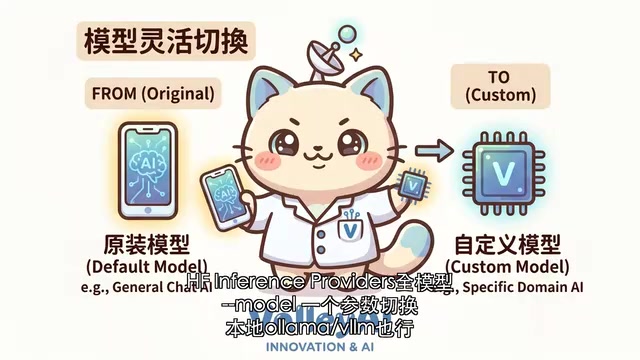
All API calls go through Hugging Face Inference Providers—a unified model inference access layer provided by the HF platform. To understand the value of this layer, one must first grasp the current fragmentation of the AI inference market: the same open-source model (e.g., Llama-3.1-70B) may be simultaneously deployed on more than a dozen platforms such as AWS SageMaker, Azure AI, Google Cloud Vertex AI, Replicate, and Together AI, each with its own authentication method, request format, and billing logic. Inference Providers abstracts these heterogeneous endpoints into a single standardized API interface, with HF responsible for maintaining partnerships with each provider—users only need one HF Token to access thousands of open-source models through the same invocation method, while enjoying HF's unified management of model versions, quantization formats, and inference parameters. This is precisely the underlying support that enables ml-intern to switch between different models with a single click—switching requires just one parameter, for example --model moonshot/kimi-k2 or --model openai/gpt-5.
For users wishing to deploy locally, ml-intern supports OpenAI-compatible interfaces via LiteLLM. LiteLLM is an open-source LLM proxy layer that uniformly maps the APIs of more than 100 different LLM providers into OpenAI-format invocation interfaces. Its core value lies in "integrate once, use everywhere"—any application supporting the OpenAI SDK can seamlessly switch to Anthropic Claude, Google Gemini, Cohere, or locally deployed open-source models through LiteLLM, without modifying business code. For local inference, Ollama focuses on efficiently running quantized models (such as the Llama and Mistral series) on consumer-grade hardware, using 4-bit/8-bit quantization in GGUF format to compress 70B models—which originally required A100-class GPUs—to run smoothly on consumer-grade GPUs with 16GB of VRAM or even Apple Silicon chips. vLLM, on the other hand, is a high-throughput inference engine aimed at production environments. Its core innovation, PagedAttention, draws on the paged memory management concept of operating system virtual memory, changing the originally contiguously allocated KV Cache (the VRAM region storing historical key-value pairs in the attention mechanism) into a non-contiguous paged management scheme, thereby eliminating VRAM fragmentation caused by varying sequence lengths.
A Deeper Understanding of PagedAttention: In traditional Transformer inference, each request's KV Cache must occupy a contiguous region of VRAM, whose size must be pre-allocated when the request begins (usually based on the maximum sequence length). When multiple requests of different lengths run concurrently, the VRAM fragments freed by completed requests often cannot be reused by new requests, leading to low VRAM utilization. PagedAttention splits the KV Cache into fixed-size "pages," similar to operating system memory paging, and maintains a Page Table recording the mapping between logically contiguous addresses and physical pages, allowing the KV Caches of different requests to be interleaved in physical VRAM. This design raises VRAM utilization from about 60%–70% in traditional schemes to over 90%, and can improve throughput by several times over naive implementations in multi-concurrency scenarios. Simply add the corresponding prefix to connect vLLM to ml-intern as an inference backend.
From an architectural perspective, this multi-backend support design follows the Dependency Inversion Principle: ml-intern's Agent logic does not depend on a specific LLM implementation, but rather on a unified abstract interface. This means that when a new inference backend appears (such as a possible dedicated NPU inference framework in the future), one only needs to implement the corresponding adapter layer to connect it, without modifying the Agent's core logic. In short: everything from an individual developer's MacBook to an enterprise-grade GPU cluster can serve as an inference backend—HF users get the best experience, and other users can use it just as smoothly.
Agent + Tool Cloud in Real-World Practice
The most noteworthy feature is Sandbox Tools. Once this parameter is enabled, the Agent can invoke sandbox tools on Hugging Face Space. HF Space is an application hosting service provided by the HF platform, allowing developers to deploy ML applications built on frameworks like Gradio and Streamlit as publicly accessible web services. ml-intern's Sandbox Tools wrap these Space applications into tool endpoints that the Agent can invoke—when the Agent determines it needs image generation capabilities, it automatically sends an API request to a Space running Stable Diffusion; for speech recognition, it invokes an ASR tool.
This mechanism of invoking cloud-based specialized models on demand solves, at the engineering level, a core contradiction that has long plagued multimodal Agents: an all-in-one Agent equipped with capabilities such as vision, speech, and code execution would require VRAM that exceeds a single machine's limit if all models were loaded locally; on-demand remote invocation, however, decouples each capability into an independent microservice, and the Agent orchestrates them as needed through a unified tool interface—preserving richness of capability while avoiding pointless consumption of local resources.
Examined from a software architecture perspective, Sandbox Tools are essentially a concrete implementation of Microservices Architecture at the AI capability layer—each HF Space bears a single responsibility (image generation, speech recognition, text translation, etc.), exposing its capabilities externally through standardized HTTP APIs, with the Agent serving as the orchestration layer responsible for dynamically combining these atomic capabilities according to task requirements. This forms a sharp contrast with the traditional "big and comprehensive" multimodal model: the latter seeks to internalize all capabilities within a single model, while the former achieves more flexible combination and lower marginal cost through capability externalization.
The AI-ification of Microservices Architecture: Microservices architecture was formally characterized by Martin Fowler and James Lewis in 2014, with core principles of "single responsibility, loose coupling, high cohesion, and independent deployment." Traditional software microservice decomposition is usually bounded by business functions (user service, order service, payment service), whereas AI capability-layer microservices are bounded by modality or task type (image understanding service, speech synthesis service, code execution service). The two are highly aligned in architectural philosophy, but AI capability services have their own peculiarities: the computational overhead of each call is far greater than that of traditional microservices (a single LLM inference may consume several seconds), and service quality (output accuracy) is difficult to measure with traditional SLA metrics. This drives AI capability microservices to require dedicated quality monitoring mechanisms, such as output consistency checks, hallucination detection, and online evaluation based on user feedback—which is precisely an important research direction in the current AI infrastructure field.
This avoids the VRAM pressure of loading multiple large models locally at the same time, representing a typical form of "Agent + Tool Cloud" moving from concept to real implementation, rather than remaining at the demo stage.

Will ml-intern Replace ML Engineers?
This is the sharpest part of the entire topic. Value AI's verdict is quite pragmatic: it will replace junior ML engineers, but cannot replace senior-level work.
Pressure on the Low End, Amplification on the High End
Under the impact of AI automation, ML engineering positions are experiencing clear polarization. The core work of junior engineers—data cleaning, fine-tuning, and reproducing paper baselines—relies heavily on standardized processes, which happen to be exactly the type of task current code-generation Agents excel at, and these positions face the most direct impact.
To understand the technical roots of this impact, one must recognize the true capability boundaries of current LLMs in Program Synthesis tasks: for standard tasks covered by abundant training samples (such as "implement a cosine annealing learning rate scheduler with warmup in PyTorch"), the success rate of modern code LLMs already approaches a practical threshold; but for novel tasks requiring the combination of cross-domain knowledge (such as "design an adaptive data augmentation strategy suitable for long-tailed medical image distributions"), the models often lack the ability to judge the problem's constraints, and tend to produce solutions that are locally reasonable but globally wrong.
Benchmarks for Evaluating Program Synthesis Capability: Academia typically uses HumanEval (proposed by OpenAI, containing 164 programming problems), MBPP (proposed by Google, containing 374 entry-level Python problems), and the newer SWE-Bench (software engineering tasks based on real GitHub Issues) to quantify the code-generation capabilities of LLMs. Notably, there is a significant "evaluation gap" between these benchmark scores and actual production value—a model scoring 90% on HumanEval often performs far below expectations when facing real ML engineering tasks involving complex business logic, legacy code, and implicit constraints. This corresponds precisely to the essential difference between the nature of junior and senior engineers' work: junior tasks are closer to the form of benchmark problems (with clearly defined inputs and outputs), whereas senior tasks are more like open-ended research problems (where the constraints themselves need to be discovered and defined).
From an economic standpoint, this polarization aligns with the predictions of the Skill-Biased Technological Change (SBTC) theory: new technologies tend to have a substitution effect on low- and medium-skill tasks while having a complementary effect on high-skill tasks, thereby widening the skill premium. Historically, spreadsheet software replaced a large amount of junior accounting work but simultaneously amplified financial analysts' ability to handle complex modeling problems; CAD software replaced draftsmen but enabled architects to explore more complex design spaces. The emergence of ml-intern is very likely another repetition of this historical pattern in the ML field.
The core value of senior engineers, meanwhile, lies in judging the boundaries of a problem (how to define evaluation metrics), attributing the root causes of failures (vanishing gradients or data distribution shift), and exploring new directions (when to abandon the current architectural paradigm). This cognitively intensive work requires the accumulation of a large amount of tacit experience. Current LLMs, lacking domain context, tend to give advice that appears reasonable but is actually misleading, making them hard to replace. A more accurate positioning is: AI is a lever, enabling a single senior ML engineer to simultaneously manage multiple "ml-intern" instances, compressing experiments that would originally take weeks into days. Low-end positions bear the impact, while high-end capabilities are amplified several-fold—this may well be a microcosm of the polarization of engineer value in the AI era.
Four Major Trends in AI Tools Seen from the Monthly Rankings
As the finale of Value AI's "Digging Through GitHub's Monthly Rankings" series, the author also summarized the overall directions from 22 popular projects:
-
AI Agent Engineering: Agents are no longer toys but tools that can genuinely take on production tasks. The hallmark of this shift is the involvement of reliability engineering—production-grade Agents begin to focus on idempotency (consistency of results when the same task is executed repeatedly), observability (complete logging and tracing of the execution path), and graceful degradation (fallback strategies when tool invocations fail), which are precisely the migration of decades of software engineering experience into the Agent domain. Notably, platforms focused on Agent observability such as LangSmith, Langfuse, and Weights & Biases Weave are rapidly rising. They migrate the concepts of traditional APM (Application Performance Monitoring) to LLM invocation chains, providing real-time tracking of key metrics such as token consumption, latency distribution, and error rates, marking the formal entry of Agent development into a "measurable, optimizable" engineering phase;
-
Local LLM Popularization: Through solutions like Ollama and vLLM, the barrier to local deployment continues to fall. This trend is driven not only by the maturing toolchain but also by hardware-side developments—Apple Silicon's Unified Memory Architecture (UMA) eliminates the data-copying bottleneck between traditional CPU and GPU, allowing the memory bandwidth of the M-series chips (the M3 Max reaches 400GB/s) to demonstrate better-than-expected cost-effectiveness when running quantized LLMs. Meanwhile, NVIDIA's consumer-grade RTX 4090/5090 series provides 24GB of VRAM for local inference. These hardware conditions together form the material foundation for the popularization of local LLMs. At the same time, progress at the model level is equally noteworthy: the emergence of "small but powerful" models such as Mistral 7B, Llama 3.2, and Phi-3 Mini proves that, with reasonable training strategies and data quality assurance, models in the billion-parameter range can approach the performance of tens-of-billions-parameter models on professional tasks, greatly lowering the compute barrier to local deployment;
-
Standardization of Context Acquisition: The way Agents acquire knowledge, documents, and data is trending toward standardization and unification. At the engineering practice level, this trend is mainly reflected in the rapid popularization of the Model Context Protocol (MCP)—MCP was proposed by Anthropic to provide a unified protocol specification for Agents to access external data sources, similar to how USB-C standardized hardware interfaces. MCP adopts a client-server architecture: the MCP Server encapsulates the access logic for specific data sources (such as code repositories, databases, and API services), while the MCP Client (the Agent's host application) communicates with any Server through a unified protocol, allowing tool developers to implement once and reuse everywhere. As of 2025, hundreds of official and community MCP Servers cover various capabilities from file systems to browser control, and are forming a tool marketplace similar to the npm ecosystem. Before MCP, different Agent frameworks each defined their own tool interface formats (LangChain's Tool abstraction, AutoGPT's Plugin system, OpenAI's Function Calling), making tools impossible to reuse across frameworks; MCP, by introducing a standardized JSON-RPC 2.0 communication protocol and a unified three-layer abstraction model of resources/tools/prompts, is poised to end this fragmentation;
-
Maturing Developer Toolchain: The complete pipeline from code to deployment is becoming increasingly refined. This is reflected not only in the enhanced functionality of individual tools but also in the improved Composability between tools—stages such as code generation, testing, containerization, and monitoring are beginning to connect with one another through standard interfaces, making the complete loop of "generate and deploy an ML service with a single sentence" increasingly technically feasible. A typical modern ML engineering toolchain already exhibits highly modular characteristics:
uvhandles dependency management,Ruffhandles code style checking (its Rust-based parallel syntax analysis makes checks over 100 times faster than traditional flake8),pytestcombined with AI-generated test cases ensures code quality,Docker+GitHub Actionsimplement CI/CD automation, andPrometheus+Grafanaprovide production monitoring—each stage has a clear open-source standard tool, and the integration friction between tools is being continuously reduced. This modularization and standardization of the toolchain is precisely a concrete manifestation of the "AI infrastructure-ization" trend in developers' daily workflows.

To sum it up in one sentence: AI is no longer a demo, but infrastructure. The emergence of ml-intern is a typical representative of this trend—it fully runs through the core workflow of an ML engineer, "reading papers, training models, and shipping code," in an open-source, autonomous, and interruptible form. For every ML practitioner, rather than fretting about being replaced, it is better to think about how to turn it into a lever in your own hands.
Key Takeaways
Related articles

Automate Job Search with AI Agents and Residential Proxies for Precise Matching
Build an AI Agent with MCP and residential proxies to bypass recruitment site anti-scraping and geo-restrictions, scrape thousands of DevOps jobs, then have Claude score and rank each against your resume. Includes proxy comparison experiments, project structure, and cost analysis—filtering only, no auto-submission.

The AI Task Assistant That Knows When to Back Off: A Cure for Activation Struggles
One Small Step is an AI assistant for task initiation struggles, using agentic decisions for guilt-free reminders, timely retreat, and cross-platform task management. The developer shares real test results on 13 tasks and architectural trade-offs.

FastAPI: A High-Performance Python Framework and a Production-Ready API Development Powerhouse
FastAPI is a high-performance web framework based on Python type hints, supporting async and automatic OpenAPI docs. With over 100k GitHub stars, this article analyzes its core strengths, production readiness, and selection advice.