Humanoid Robots Learn to Play Ball: How Adaptive Motion Planning and Tracking Bridge the Sim-to-Real Gap

A hierarchical framework lets humanoid robots match professional athlete movement style while reliably completing ball-sport tasks.
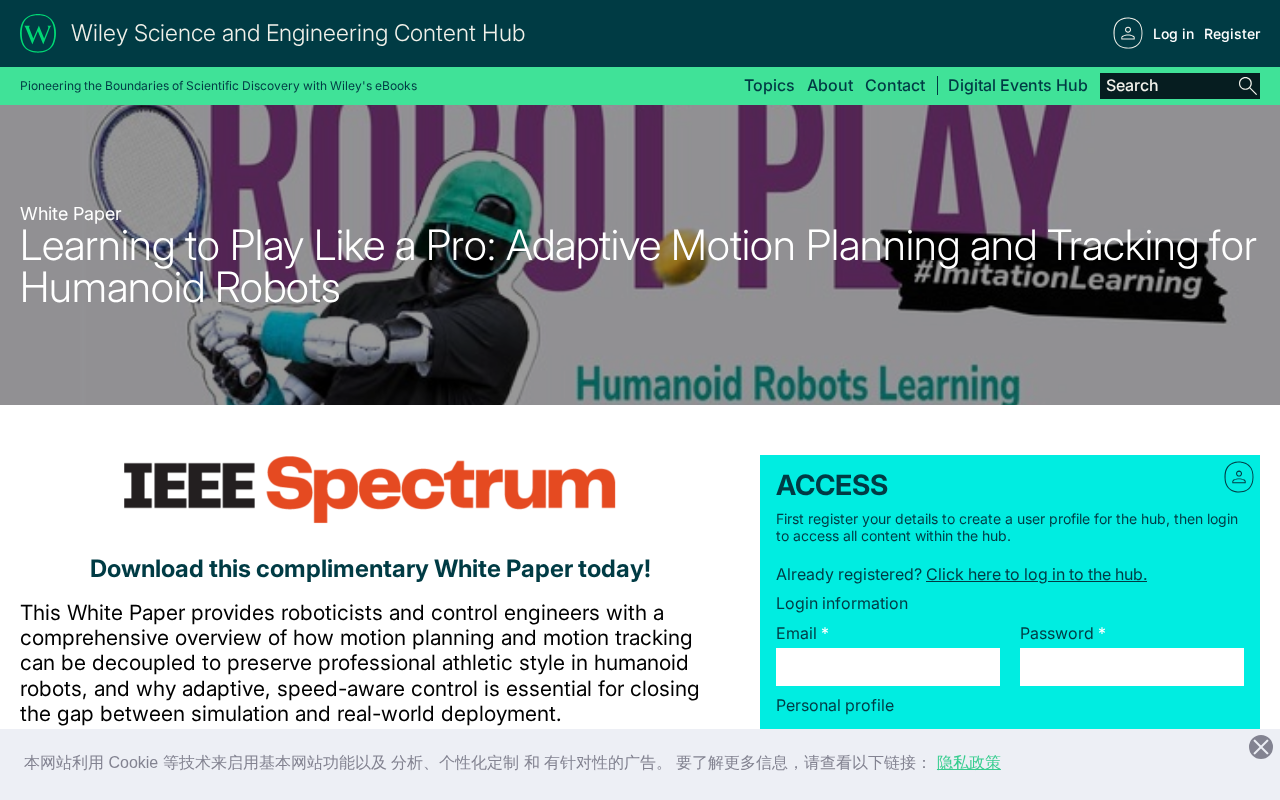
This Noitom Robotics white paper tackles the challenge of balancing style and reliability in humanoid robot ball sports with a hierarchical control methodology: a high-level planner extracts and physically corrects reference motions from sports broadcast footage, while a low-level tracker handles stable execution on hardware. To overcome sim-to-real error accumulation, the framework introduces speed randomization during training and a learnable motion-speed adapter, giving the system greater tolerance for real-world uncertainty. The approach has been validated on two humanoid platforms, including a full-size robot completing a serve in-the-wild without any motion capture assistance.
Making Robots Move Like Professional Athletes
Can humanoid robots play ball sports while preserving the stylistic flair of professional athletes and reliably completing tasks at the same time? This has long been an open challenge in robotics. A white paper published by Noitom Robotics offers a systematic framework for robotics researchers and control engineers: decouple motion planning from motion tracking, enabling robots to retain professional-grade movement aesthetics even in complex actions.
There is an inherent tension between movement style and task performance. Optimizing purely for task success often makes a robot's movements stiff and mechanical, while faithfully imitating the fluid style of a professional athlete can compromise stability and reliability. The white paper's solution is a hierarchical design — a high-level planner generates stylistically accurate reference motions, while a low-level tracker handles stable execution on physical hardware. Each layer has a clearly defined role and can be optimized independently.
From Broadcast Video to Trackable Reference Motions
A critical component of this work is acquiring high-quality human motion data. The research team extracts motion information from sports broadcast footage and motion capture recordings, then transforms it into reference motions that humanoid robots can safely track through a three-step pipeline: reconstruction, retargeting, and physical correction.
The value of this pipeline lies in its independence from expensive, constrained laboratory motion capture setups — it can instead leverage the vast amount of publicly available professional sports footage. Serves, swings, and other motions captured in broadcast video become the raw material for robot learning. Physical correction is a particularly critical step: human motions applied directly to a robot often violate joint limits or dynamic constraints, and must be corrected before they can be safely executed.
Retargeting is the process of mapping human skeletal motion onto a robot with different limb proportions and degrees of freedom — a classic challenge in motion imitation research. Human limb proportions and joint ranges differ significantly from those of humanoid robots, and directly copying joint angles leads to distorted poses or collisions. Common approaches involve mapping in task space (end-effector positions) rather than joint space, or solving for feasible joint trajectories closest to the original motion through optimization. Physical correction then applies dynamic constraints to the retargeted result, ensuring the generated trajectory satisfies conditions such as center-of-mass momentum and contact forces — the critical leap from "geometrically feasible" to "dynamically feasible."
Bridging the Sim-to-Real Gap
Sim-to-real transfer is a core obstacle to deploying humanoid robots in the real world. Policies trained in simulation accumulate and amplify tracking errors once deployed on real hardware, causing motion distortion or instability.
The white paper's solution is a "velocity-aware" adaptive control approach. This involves two key strategies: first, randomizing execution speeds during tracker training so the tracker remains robust across a range of speeds; and second, incorporating a learnable motion-speed adapter into the planner that dynamically adjusts the tempo of motions to match the actual capabilities of the hardware.
This adaptive, speed-aware design directly targets the root cause of sim-to-real error accumulation. Compared to rigid control at a fixed speed, randomized training provides the system with greater fault tolerance when facing real-world uncertainty, significantly improving performance on physical hardware.
The root cause of the sim-to-real problem is that simulators inevitably simplify physical reality: joint friction, motor latency, sensor noise, ground contact dynamics, and other details are often idealized in simulation. When a trained policy is transferred to real hardware, these small errors are repeatedly amplified in the closed-loop control, ultimately manifesting as motion drift or instability. Common mitigation strategies in the field include domain randomization (randomly perturbing physical parameters during training to make policies more robust), system identification (precisely measuring real hardware parameters and feeding them back into simulation), and online fine-tuning with real-world data. The speed randomization used in this white paper is essentially a form of domain randomization, specifically targeting the dimension of motion execution tempo — a lightweight and targeted engineering choice.
Dual-Platform Validation and Real-World Serving
The persuasiveness of any theoretical framework ultimately depends on experimental validation. The white paper reports that this adaptive framework was validated on two different humanoid robot platforms, including a full-size robot completing a serve in a real-world, in-the-wild environment — with no motion capture system of any kind.
Achieving this "in-the-wild" validation without motion capture means the approach is no longer confined to controlled laboratory settings, representing a meaningful step toward practical deployment. For tasks like ball sports — which demand precise timing, force control, and coordination — completing a serve without any external localization assistance is a substantial result.
Implications for Humanoid Robot Motion Control
The core contribution of this white paper is not a single algorithmic breakthrough, but rather a clear engineering methodology: decouple planning from tracking, leverage publicly available video data, and combat sim-to-real errors through randomization and adaptive mechanisms. These ideas offer a useful reference for teams working on humanoid robot motion control.
As humanoid robots gradually move beyond showcase demos toward complex dynamic tasks, balancing "looking good" with "working reliably" will become increasingly critical. Infusing robots with the movement style of professional athletes while ensuring task reliability is exactly the problem this line of research aims to address. Interested engineers can download the full white paper for a deeper look at the methodology and experimental data.
Related articles

LLaMA-Factory in Practice: A Complete No-Code Guide to Fine-Tuning Large Models
An introduction to LLaMA-Factory, the open-source fine-tuning tool: its 60.1K-star background, supported models and algorithms, local vs. cloud deployment, and CUDA setup steps.

Zeng Ming's Deep Retrospective: Why OpenAI May Not Be the Ultimate Winner — and Why the Corporate System Will Disappear
Zeng Ming's deep retrospective on the AI endgame: model companies are just infrastructure, OpenAI and Anthropic won't be the final winners; the next battle is the Agent entry point standard; the corporate system will disappear as AI restructures collaboration, and only mission-driven companies can survive the cycle.

OpenHands v1.28.0: OpenCode and PI Added as Built-in Agents, API Keys Requestable In-Conversation
OpenHands ships 5 releases in 21 days: v1.27.0 adds OpenCode and PI as built-in agents, v1.28.0 enables in-chat key requests. ACP integration, credential reuse, model list changes, and upgrade advice.