HybridAgent: Hybrid Reasoning Agent Makes AI Thinking 2.6x More Efficient

Together Computer proposes HybridAgent, enabling LLM agents to dynamically switch between latent space reasoning and text interaction with 10.4% performance gains and nearly 4x cost reduction.
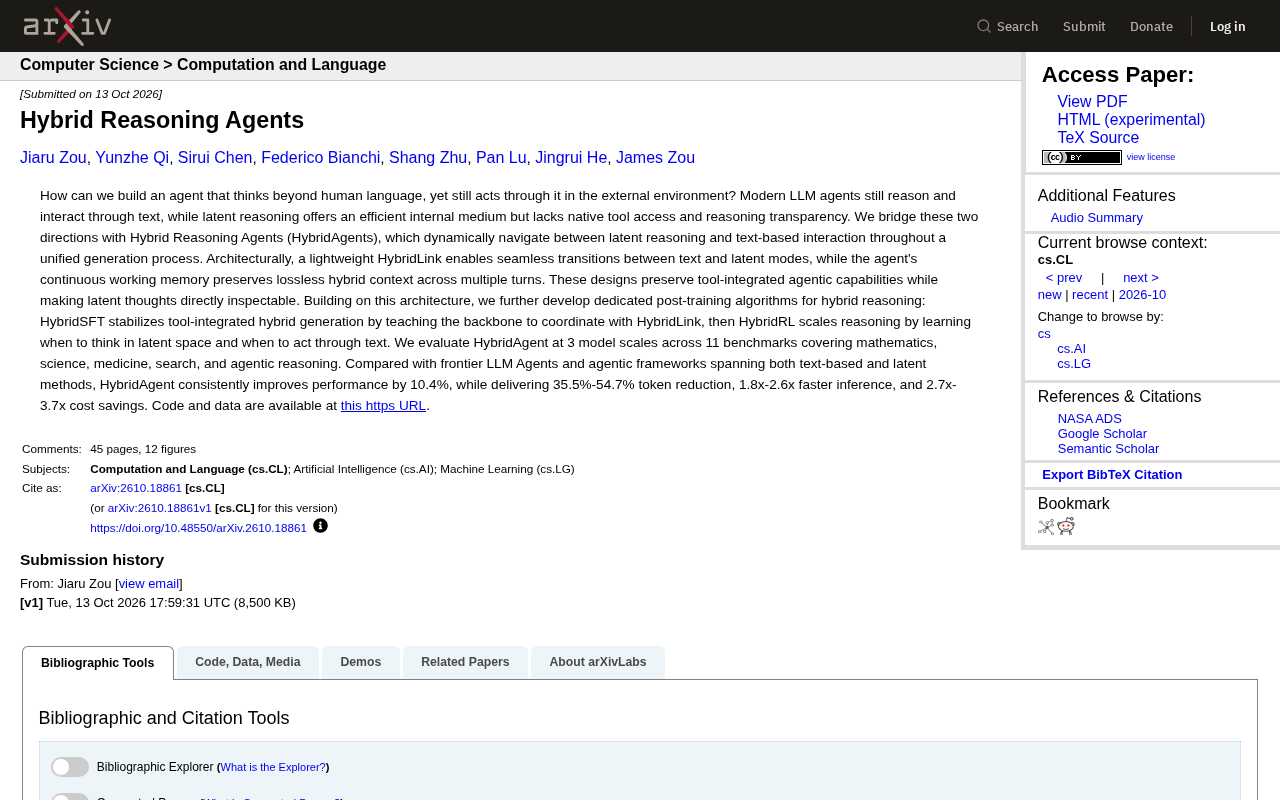
HybridAgent addresses the fundamental contradiction of LLM agents—where text reasoning is expensive and slow while latent space reasoning is closed and non-interactive—by proposing a hybrid architecture that dynamically switches between the two modes within a unified generation process. Its core component HybridLink enables seamless conversion between text tokens and latent space vectors, while continuous working memory ensures lossless transfer of hybrid context. Training uses HybridSFT and HybridRL to let the model adaptively decide when to think and when to act. Across 3 model scales and 11 benchmarks, HybridAgent achieves 10.4% performance improvement with 35.5%-54.7% fewer tokens and 1.8-2.6x faster inference.
Large language model agents are transforming how we collaborate with AI, but a fundamental contradiction persists: models need to "think" in text, yet text-based reasoning is both expensive and slow. Can AI think efficiently in latent space while retaining the ability to call tools and interact with the outside world? Together Computer's Hybrid Reasoning Agents (HybridAgent) offers a compelling answer.
The Bottleneck of Text Reasoning and the Dilemma of Latent Space Reasoning
Nearly all mainstream LLM agents today rely on text for reasoning and interaction. Chain-of-Thought has models write out their thinking process step by step—the advantage being transparency, debuggability, and natural compatibility with tool calls. But the cost is equally obvious: every token must go through the full generation pipeline, and the longer the reasoning chain, the higher the latency and cost.
Another path is latent space reasoning—having the model think in continuous vector space without generating intermediate text. This approach has inherent efficiency advantages, but the problems are equally prominent: the reasoning process in latent space cannot be directly observed, and the model struggles to call external tools or interact with the environment mid-process.
HybridAgent's core insight is that these two approaches are not mutually exclusive. If the model can dynamically switch within a unified generation process—entering latent space mode when deep thinking is needed, and returning to text mode when tools need to be called or results need to be output—then both efficiency and capability can be achieved simultaneously.
Chain-of-Thought (CoT) is a prompting technique proposed by Google Research in 2022. The core idea is to have the model explicitly write out intermediate reasoning steps before giving a final answer. This method significantly improves accuracy on tasks like math word problems and logical reasoning, because step-by-step generation is equivalent to decomposing a complex problem into multiple simpler sub-problems, with each step's output serving as context input for the next. Subsequent variants like Zero-shot CoT, Self-Consistency, and Tree-of-Thought further extended this paradigm. CoT's transparency makes it naturally suited for scenarios requiring auditability, and allows tool calls to be inserted at any node in the reasoning chain—the model simply needs to generate a call instruction in text. However, the cost is that each reasoning step requires the full autoregressive decoding process, with every token passing through a complete forward pass. The longer the reasoning chain, the more significant the cumulative latency and computational cost.
Latent space reasoning refers to the model completing multi-step reasoning in continuous latent vector space rather than generating discrete text tokens, only decoding the result into text at the end. Representative works include Coconut (Chain of Continuous Thought) and others. Its efficiency advantage stems from two factors: first, it skips token-by-token autoregressive generation; second, a single step in continuous space can carry far more information than a single token. But the core limitation is that continuous vectors cannot be directly mapped back to human-readable text, making the reasoning process uninterpretable; at the same time, since the model does not generate tool-call instructions in text form, external tools cannot be triggered mid-reasoning. Essentially, latent space reasoning trades transparency and interactivity for computational efficiency—precisely the contradiction that hybrid approaches attempt to resolve.
How HybridLink Bridges the Two Reasoning Modes
The key technical challenge in achieving hybrid reasoning is that text tokens and latent space vectors are completely different representation forms—how can the model seamlessly switch between them?
HybridAgent's solution is a lightweight HybridLink module. It acts as a "translator" between text mode and latent space mode, allowing the model to smoothly transition from one mode to another during generation. More importantly, the agent maintains a continuous working memory that preserves lossless hybrid context across multiple rounds of interaction—whether text tokens or latent space vectors, nothing is lost during switching.
The direct benefit of this design is that "thinking" in latent space becomes directly inspectable. Researchers and developers can observe what the model does in latent space—something that was impossible with previous pure latent space reasoning methods. At the same time, tool integration capabilities are fully preserved—the model can still call external tools like search engines and calculators when needed.
Continuous working memory is the core mechanism by which HybridAgent maintains context consistency across multi-turn interactions. Unlike traditional agents that only use historical text tokens as context, it simultaneously stores text token embeddings and continuous vectors produced by latent space reasoning, forming a unified hybrid representation sequence. When the model switches between text mode and latent space mode, the two types of representations in working memory are concatenated into a complete context for subsequent generation. The key challenge of this design is that text embeddings and latent space vectors may reside in different representation subspaces, and HybridLink needs to map them into compatible spaces—otherwise mode switching would cause contextual semantic breaks. The losslessness of working memory ensures that the model does not lose prior reasoning states due to mode switching during long-horizon multi-turn interactions.
Training Strategy from HybridSFT to HybridRL
Beyond architecture, HybridAgent also requires specialized training methods to teach the model "when to think, when to act." The research team designed a two-stage post-training pipeline for this purpose.
HybridSFT (hybrid supervised fine-tuning) addresses basic coordination: teaching the backbone model to work with HybridLink and stably generate hybrid reasoning trajectories. This stage ensures the model doesn't "get lost" during mode switches.
HybridRL (hybrid reinforcement learning) goes further: through reinforcement learning, the model learns to judge when it should think deeply in latent space and when it should interact with the external environment through text. This adaptive decision-making capability is what distinguishes HybridAgent from simple mode switching—it doesn't switch according to fixed rules, but dynamically adjusts based on task requirements.
HybridRL (hybrid reinforcement learning) here has the core task of learning a mode-switching policy: at each decision point in the trajectory, the model needs to determine whether to enter latent space to continue thinking or output text to call tools or give an answer. This decision is essentially a sequential decision problem, suitable for optimization with policy gradient methods. Reward signals typically come from a combination of task completion quality (e.g., answer correctness) and efficiency metrics (e.g., token consumption), enabling the model to find a balance between accuracy and cost. Unlike fixed-rule switching, the policy learned by HybridRL is data-driven—the model discovers through trial and error that certain task patterns (such as multi-step mathematical derivation) are better suited for latent space thinking, while scenarios requiring external information retrieval must switch to text mode. This adaptive capability is the key leap from "can switch" to "switches correctly" for hybrid architectures.
Dual Improvement in Efficiency and Performance
The research team evaluated HybridAgent across 3 model scales and 11 benchmarks, covering scenarios in mathematics, science, medicine, search, and agent reasoning.
The results are noteworthy:
- Compared to frontier LLM Agents and agent frameworks (including both pure text and pure latent space methods), HybridAgent achieves a consistent 10.4% performance improvement
- Token consumption reduced by 35.5% to 54.7%
- Inference speed improved by 1.8x to 2.6x
- Cost reduced by 2.7x to 3.7x
The significance of these data points is that efficiency and performance are no longer a trade-off. HybridAgent achieves improvements in both simultaneously by having the model use the appropriate reasoning mode in the appropriate scenario. For application scenarios requiring extensive agent calls—such as automated research, complex problem solving, and multi-turn tool calling—this improvement translates directly into substantial cost savings and enhanced user experience.
Implications for Agent Architecture Design
HybridAgent's work points to a broader trend: agent reasoning architectures are moving from "single mode" to "hybrid mode." Pure text reasoning is general but inefficient; pure latent space reasoning is efficient but closed; hybrid approaches open up new design space.
There are still many questions worth exploring in this direction. For example, although the interpretability of latent space reasoning has improved through direct inspection, how to enable humans to truly understand the reasoning logic in latent space remains an open problem. Another example is whether the "when to think" policy learned by HybridRL can generalize to scenarios outside the training distribution—this also requires further validation.
Code and data have been open-sourced on GitHub. For developers and researchers building agent systems, this is an architectural paradigm worth studying in depth.
One-line Summary
Together Computer proposes HybridAgent, enabling LLM agents to dynamically switch between latent space reasoning and text interaction, improving performance by 10.4% while reducing costs by nearly 4x.
Paragraph Summary
HybridAgent addresses the fundamental contradiction of LLM agents—where text reasoning is expensive and slow while latent space reasoning is closed and non-interactive—by proposing a hybrid architecture that dynamically switches between the two modes within a unified generation process. Its core component HybridLink enables seamless conversion between text tokens and latent space vectors, while continuous working memory ensures lossless transfer of hybrid context across multi-turn interactions. The training adopts a two-stage strategy of HybridSFT and HybridRL—the former coordinates basic mode switching, while the latter uses reinforcement learning to let the model adaptively decide when to think and when to act. Across 3 model scales and 11 benchmarks, HybridAgent achieves a consistent 10.4% performance improvement, reduces token consumption by 35.5%-54.7%, improves inference speed by 1.8-2.6x, and reduces costs by 2.7-3.7x, proving that efficiency and performance can be achieved together.
Related articles

Free Unlimited Claude Code Solution: Agnes AI + CC Switch Setup Guide
No paid subscription needed — pair the free AI platform Agnes AI with the open-source tool CC Switch to provide a backend for Claude Code, enabling unlimited free calls to text, image, and video models. This guide covers the full setup, test results, and usage boundaries.

A Complete Zero-Cost Guide to Getting Started with Claude Code for Beginners in China
A beginner's guide to Claude Code for users in China: two installation methods (command line and IDE plugin), full configuration steps for replacing the official API with the free domestic LongCat model, and a hands-on demo of building a small tool with natural language, plus tips.

When the NSA Gets Involved: The AI Supply Chain Crisis Behind Open-Source CVEs and API Key Hijacking
Multiple open-source projects disclosed severe CVEs in one day, PHP flaws alarmed the FBI, and Railway and OpenCode were breached with API keys stolen. This article breaks down the vulnerability window, AI-accelerated exploitation, and the AI supply chain crisis behind the API key black market, with a developer defense checklist.