HyNote for Mac: A Free Local Meeting Transcription Tool Where Data Never Leaves Your Device

HyNote for Mac offers free, fully local meeting transcription with zero cloud uploads and no meeting bots.
HyNote for Mac is a free meeting transcription tool that runs entirely on-device, ensuring meeting data never leaves your Mac. It captures system audio directly without deploying meeting bots, works across Zoom, Google Meet, and Teams, and leverages Apple Silicon's Neural Engine for real-time speech recognition. Topped Product Hunt's daily chart, it targets privacy-conscious users seeking a cost-free, frictionless alternative to cloud-based transcription services.
Three Major Pain Points in Meeting Transcription That HyNote Aims to Solve at Once
In an era where remote work and online meetings have become the norm, demand for meeting transcription tools is growing rapidly. However, mainstream transcription solutions on the market often come with several unavoidable issues: data privacy risks, friction in user experience, and hefty subscription fees.
HyNote for Mac, which recently topped the Product Hunt daily chart, targets precisely these three pain points. Built by developers Sandy Kong, Mia Lian, and Ristan Nakko, this Mac application earned the #1 spot with 189 upvotes and generated discussion across 33 comments. Its core value proposition is remarkably straightforward — free, fully local, 100% privacy-protected meeting transcription.
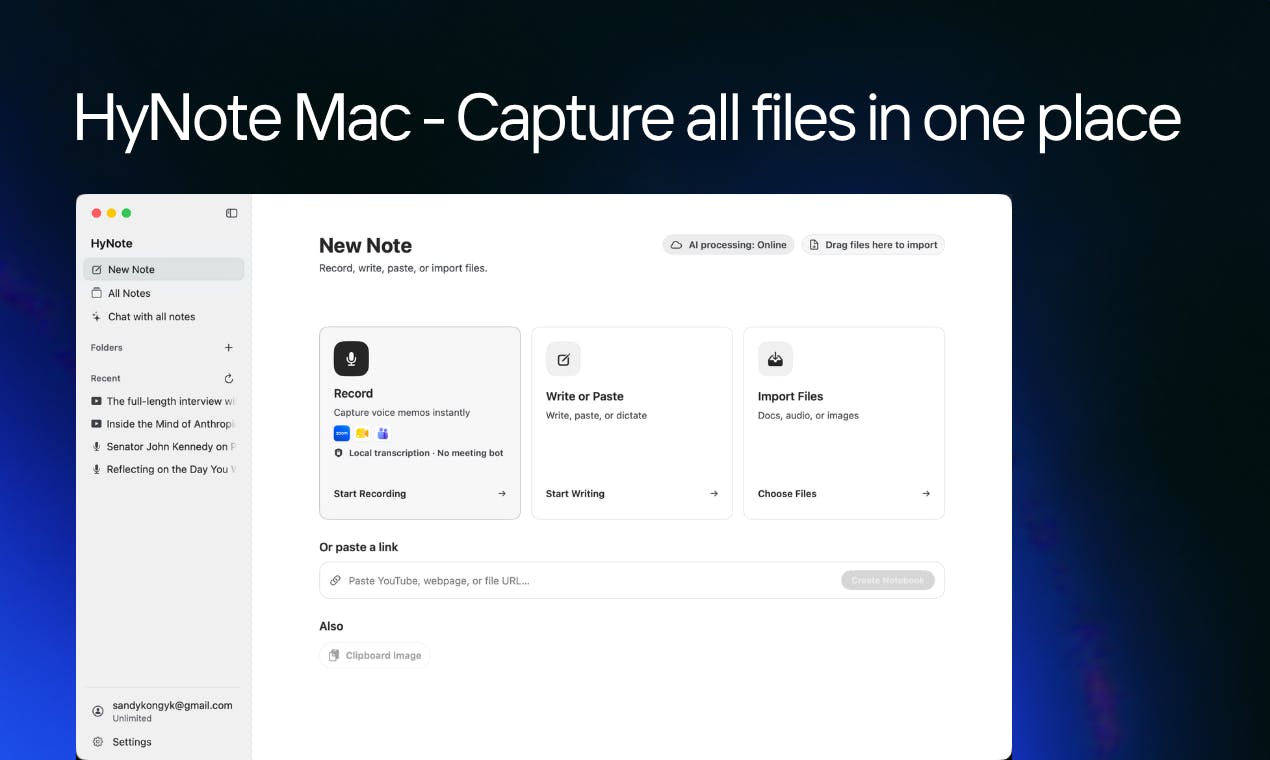
Fully Local Processing: Meeting Data Never Leaves Your Device
HyNote's biggest differentiator is its on-device speech-to-text architecture. Unlike the vast majority of transcription tools that rely on cloud APIs, HyNote runs the entire speech recognition process completely on the user's Mac hardware.
The core of on-device speech recognition technology lies in compressing deep learning speech recognition models and deploying them to run on local hardware. Traditional cloud-based speech recognition (such as Google Cloud Speech-to-Text and Amazon Transcribe) relies on GPU clusters in data centers to process audio streams, while on-device solutions leverage the device's built-in neural network engine for inference. In recent years, OpenAI's open-source Whisper model has become a popular foundation for local transcription solutions, with several streamlined versions (tiny, base, small, medium) capable of running in real-time on consumer-grade hardware. Apple Silicon chips (M1/M2/M3/M4 series) integrate 16-core or larger Neural Engines capable of executing trillions of operations per second, providing ample computing power to run such models locally.
This means your meeting content, confidential discussions, and commercially sensitive information never gets uploaded to any third-party server. For lawyers, doctors, corporate executives, investors, and others who place a high premium on data compliance and confidentiality, this design delivers near-essential value.
As Apple Silicon continues to strengthen its local AI inference capabilities, running large speech models on-device has transitioned from "experimental" to "practical." HyNote is a quintessential product of this trend — it proves that local devices are already sufficient to support high-quality real-time transcription without sacrificing privacy.
Why Local Transcription Matters So Much
While cloud transcription services are convenient, they carry risks related to data transmission, storage, and potential leaks. In recent years, corporate concerns about data sovereignty in SaaS tools have intensified, with some companies explicitly prohibiting employees from using cloud transcription services for internal meetings.
Data Sovereignty refers to the principle that data is subject to the laws of the country or region where it resides. Under global data protection legislative frameworks such as GDPR (EU General Data Protection Regulation), China's Data Security Law, and various US state privacy regulations (like CCPA), enterprises face complex compliance challenges when using cloud SaaS tools to process sensitive data. For example, if a European company uses a cloud transcription service provided by a US company, its meeting data may be transferred to US data centers, potentially triggering GDPR cross-border data transfer restrictions. In 2023, Italy's data protection authority issued a temporary ban on ChatGPT — a textbook case of data sovereignty disputes. Local solutions eliminate this risk at the architectural level — since data never leaves the user's device, cross-border transfer and third-party storage concerns simply don't exist.
HyNote's local solution fills precisely this compliance gap.
Seamless System Audio Capture: Say Goodbye to Awkward Meeting Bots
HyNote's second major highlight is its zero-friction user experience.
Many traditional transcription tools (such as Otter.ai and Fireflies) need to join meetings as a "bot participant" to record and transcribe content. This not only creates an awkward "AI Bot" entry in the attendee list but sometimes requires the host to manually approve the bot's entry, causing disruption and workflow interruption.
A "Meeting Bot" refers to a transcription service that joins an online meeting as a virtual participant, capturing recordings through the meeting platform's audio stream. Products like Otter.ai's OtterPilot, Fireflies.ai's Fred Bot, and Grain all use this approach. This design sparked widespread controversy during 2023-2024: on one hand, many companies discovered employees had enabled AI recording without informing other participants, triggering trust crises; on the other hand, platforms like Zoom and Teams began tightening permissions for third-party bot access. In 2024, multiple enterprises explicitly required in their internal policies that meeting recording must obtain consent from all participants, and some platforms began displaying more prominent recording notifications.
HyNote instead uses a direct system audio capture approach. It doesn't deploy any bots, doesn't appear in the attendee list, and runs "invisibly" in the background, capturing the audio stream directly at the system level.
From a technical implementation perspective, macOS's audio architecture is based on the Core Audio framework, with system audio streams managed through the HAL (Hardware Abstraction Layer). To capture system audio output at the application layer, developers typically need to install a virtual audio driver (such as creating an aggregate device through the Audio Server Plugin mechanism) that "mirrors" the system output audio stream to a virtual input channel readable by applications. ScreenCaptureKit, introduced in macOS 14 (Sonoma), also provides system-level audio capture APIs, reducing implementation complexity. The fundamental difference between this approach and the "bot participant" method is: the former intercepts audio data at the operating system level, while the latter needs to access the meeting room through the meeting platform's API or client protocol, thereby exposing the AI tool's presence.
This approach delivers two direct benefits:
- Non-disruptive to meetings: Other participants are completely unaware — no one gets concerned by seeing "Someone's AI Assistant has joined";
- Cross-platform compatibility: Since it works at the system audio level, HyNote natively supports Zoom, Google Meet, Microsoft Teams, and other major meeting platforms without needing platform-specific adaptations.
As a Menu Bar App, HyNote resides permanently in the Mac's top menu bar, available on demand, further lowering the barrier to use. Menu bar apps are a uniquely lightweight application form in the macOS ecosystem — they don't occupy Dock space, don't require a standalone window in the foreground, but instead embed as a small icon in the system menu bar at the top of the screen. Users can click the icon for quick actions and move on. This design philosophy emphasizes "not interrupting your workflow" — the app acts like an always-ready assistant with minimal presence but within arm's reach. For meeting transcription scenarios that require "one-click activation when needed, complete invisibility when not," the menu bar form factor is arguably the optimal interaction paradigm.
Completely Free: Lowering the Barrier to Try Transcription Tools
The third pain point is cost. Full-featured transcription tools on the market generally adopt subscription models, with monthly fees ranging from a dozen to several dozen dollars — a significant expense over the long term.
HyNote directly plays the free card. While publicly available information hasn't yet detailed whether premium paid features or usage limits exist, the combination of "free + local + no bots" is inherently compelling. For individual users and small teams, this dramatically reduces the cost of trying and switching.
Notably, HyNote's ability to offer a free service is inextricably linked to its local architecture. The primary operating costs for cloud transcription tools come from GPU computing power and bandwidth — every minute of audio transcription consumes server resources, necessitating subscription models to cover these variable costs. HyNote offloads computation to users' own hardware, eliminating ongoing computing expenses for the development team, making the free model commercially sustainable.
HyNote vs. Otter.ai and Other Competitors: A Positioning Comparison
From a product positioning perspective, HyNote precisely targets a niche market overlooked by major players: privacy-conscious Mac users who don't want to pay and dislike bot interruptions.
Its competitors are primarily cloud transcription tools like Otter.ai, Fireflies.ai, and Fathom. These products are more mature in feature richness (such as meeting summaries, action item extraction, and team collaboration), but privacy and cost are exactly where HyNote holds its advantage.
HyNote's strategy is "retreat to advance" — first establish differentiation through privacy and free access, then gradually build out features. Of course, on-device solutions have inherent limitations:
- Platform constraints: Currently Mac-only, and likely highly dependent on Apple Silicon computing power;
- Model capability ceiling: Local models may not match cloud-based large models in multilingual support and specialized terminology recognition in the short term;
- Missing advanced features: AI summaries, intelligent Q&A, and other features heavily dependent on large models are more costly to implement locally.
Regarding model capability limitations, the core challenge of on-device AI inference is balancing model scale with hardware computing power. Cloud speech recognition can use models with billions of parameters, paired with dedicated accelerators (like Google TPUs and NVIDIA H100) for millisecond-level response; while local devices, constrained by memory bandwidth, thermal management, and battery life, can typically only run streamlined models with hundreds of millions of parameters. To address this, the industry has developed techniques like quantization (compressing model weights from 32-bit floating point to 4-bit or 8-bit integers), knowledge distillation (training smaller models using larger models), and model pruning to reduce model size. Apple's Core ML framework and MLX open-source library further optimize model execution efficiency on Apple Silicon. As M4 series chips expand unified memory up to 192GB, the capacity for running larger-scale models locally continues to grow.
A Pragmatic Example of On-Device AI Transcription
HyNote for Mac's rise to the top of Product Hunt reflects genuine user demand for the combination of privacy-first, seamless experience, and cost-effective solutions. It may not be the most feature-complete transcription tool, but on the dimension of "privacy" — which is increasingly valued — it offers a pragmatic and elegant solution.
As on-device AI inference capabilities continue to improve, there's good reason to believe that "data never leaving the device" will evolve from a special requirement of privacy-sensitive users to a default standard for more AI applications. HyNote is an early example worth watching in this trend.
Related articles

Apple HomeView Hands-On Review: Is the $300 Smart Home Hub Worth It?
Apple HomeView hands-on: a $300 smart home hub with facial recognition for quick account switching, but no App Store or voice recognition. Is the wall-mounted version worth it? Should you buy the first generation?

Meta Muse Wonder Launch: What It Means for Meta's Return to the Frontier AI Race
Meta releases Muse Wonder and WonderFull, benchmarks reach the frontier, community feedback is polarized. An in-depth look at Meta's return to the frontier AI race, its personal agent strategy, and Zuckerberg's different path.

Apple Home Smart Home Lineup Leaked: LG and Schneider Team Up, UWB Door Lock on Board
Apple Home ecosystem gains new LG and Schneider devices: UWB smart lock with proximity unlock, 2.5K dual-camera doorbell, privacy indoor camera, and AirPods-like seamless pairing.