Hyperfocus: An In-Depth Look at the Free, Goals-First Planning Tool for Mac
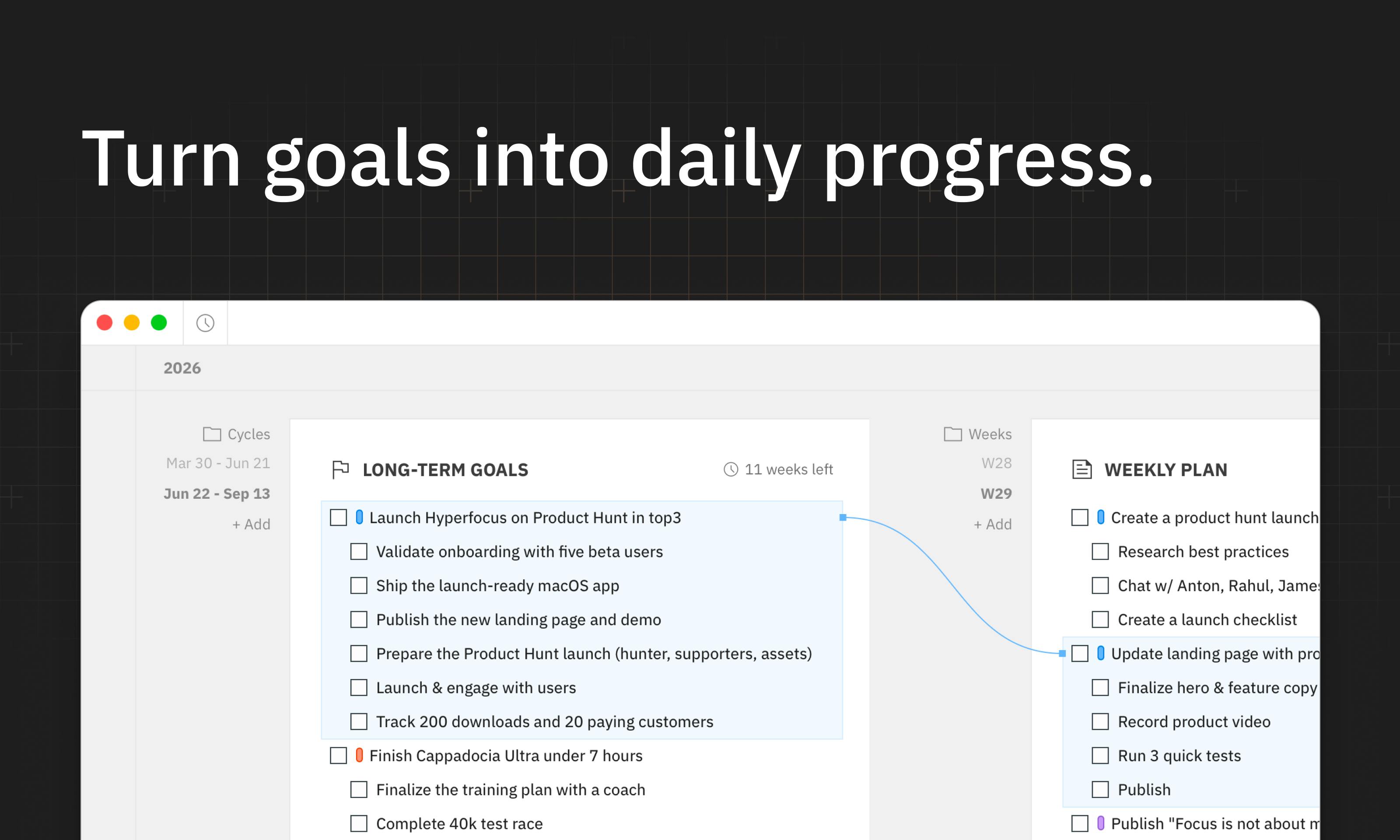
Hyperfocus is a free Mac planner that puts goals before tasks to help you focus on what truly matters.
Hyperfocus is a free macOS planning tool by indie developer Dmitrii Tsepelev that flips traditional task management on its head. Instead of encouraging endless to-do lists, it adopts a goals-first approach: users define key outcomes, break them into weekly and daily plans, and make progress through focused work sessions. Aimed at developers and deep workers, it embodies principles from OKR, Essentialism, and Deep Work philosophies.
A Mac Planning Tool That Goes Against the Grain
In today's oversaturated world of productivity tools, most task management apps encourage users to "capture more" — more to-do lists, more projects, more reminders. Yet this approach often backfires, trapping users in an endless pile of tasks rather than driving real results. Hyperfocus, a macOS app that recently launched on Product Hunt, takes a fundamentally different path: it's a free, goals-first planning tool.
According to its Product Hunt page, Hyperfocus was built by developer Dmitrii Tsepelev. Since launch, it has received 23 upvotes and 20 comments, ranking 14th on its launch day and categorized under "Productivity," "Task Management," and "Developer Tools."
The Core Philosophy of Hyperfocus: Less Is More in Goal Management
From "What to Do" to "Why You're Doing It"
The core logic of Hyperfocus can be summed up in one sentence: First identify the few outcomes that truly matter, then organize your weekly and daily plans around them. This stands in stark contrast to the traditional GTD (Getting Things Done) approach of "capture everything first, then process one by one."
GTD is a personal productivity methodology proposed by efficiency expert David Allen in his 2001 book of the same name. Its core workflow consists of five steps — capture, clarify, organize, reflect, and engage — emphasizing the need to "offload" all to-do items from your brain into an external system. This methodology has profoundly influenced the design of nearly every mainstream task management tool since, including OmniFocus, Things, and Todoist. However, GTD's "capture everything" philosophy is often criticized for leading to list bloat — users spend so much time maintaining the system itself that they drift away from what truly matters. Hyperfocus's design is clearly a deliberate "course correction" against this classic methodology.
According to its official description, the tool helps users plan across three levels:
- Choose key outcomes: Focus only on "the few goals that matter most" to avoid goal dilution;
- Break them down into weeks and days: Decompose long-term goals into actionable weekly and daily plans;
- Make consistent progress through focused work: Advance tasks in units of "focused work."
This top-down structural design fundamentally combats the most common trap facing modern knowledge workers — "being busy without producing results." When every day has a clear goal to point toward, the tasks themselves become meaningful. It's worth noting that this approach — "define key outcomes first, then break down actions" — closely mirrors the OKR (Objectives and Key Results) framework widely adopted in corporate management. OKR was pioneered by former Intel CEO Andy Grove and later popularized by John Doerr at tech giants like Google. Its core principle is likewise to focus on a small number of key objectives with measurable results. Hyperfocus can be seen as bringing this organizational-level goal management philosophy down to the granularity of personal daily planning.
Why "Goals-First" Design Is More Effective Than Traditional Task Management
The problem with most task apps is that they treat "tasks" as first-class citizens, while "goals" get buried among hundreds of to-do items. Hyperfocus flips this on its head: goals are the skeleton; tasks are just the filler. This design forces users to think about "what truly matters" before diving into action, reducing low-value busyness at the source.
This philosophy aligns closely with "Essentialism," a concept introduced by Greg McKeown in 2014. In his bestselling book Essentialism: The Disciplined Pursuit of Less, McKeown presents a core argument: "Almost everything is noise, and only a very few things are of exceptional value." Essentialists don't try to get more things done — instead, they systematically identify what is absolutely important and then channel all their energy into it. Hyperfocus's product design is essentially an embodiment of Essentialism at the software level — it uses product mechanisms themselves to enforce "subtraction" rather than relying solely on personal discipline.
A Dedicated Tool for Mac Developers and Deep Workers
Here's a telling detail: Hyperfocus is currently available exclusively on macOS, and the developer himself categorized it under "Developer Tools." This positioning is no accident — software developers often need to balance deep focus (deep work) with frequent context switching, and a "goals-first" planning approach is particularly well-suited for scenarios that require prolonged immersive work.
The concept of "deep work" was systematically articulated by Georgetown University computer science professor Cal Newport in his 2016 book Deep Work: Rules for Focused Success in a Distracted World. Newport defines deep work as "professional activities performed in a state of distraction-free concentration that push your cognitive capabilities to their limit, creating new value, improving skills, and being hard to replicate." The opposite is "Shallow Work" — logistical tasks that don't require much cognitive effort and can be performed in a distracted state. Newport's research shows that in the knowledge economy, the ability to do deep work is becoming increasingly rare and increasingly valuable. Software developers are quintessential deep work practitioners — writing complex code, designing architecture, and debugging typically require hours of uninterrupted focus. Research shows that programmers need an average of 23 minutes to regain their previous level of focus after an interruption, making any context switch enormously costly in cognitive terms.
For programmers, designers, and other creative knowledge workers, a tool that helps them "filter out noise and lock onto key goals" may be far more valuable than a feature-heavy project management platform. Hyperfocus's choice of macOS as its launch platform also aligns with this user profile — Mac has long been the preferred work device for developers and creative professionals, and the Apple ecosystem has fostered a wealth of premium tools aimed at professional users.
Pricing Strategy and Market Positioning Analysis
In a productivity software market dominated by paid subscriptions, Hyperfocus has opted for a completely free model. This decision offers clear advantages for acquiring early users and building reputation, but it also raises questions about long-term sustainability.
In recent years, the shift from one-time purchases to subscription models has become the industry norm for productivity software. Notion offers a free personal tier but charges teams ($8–15 per user per month), Todoist's Pro plan costs $4 per month, while Things 3 sticks to a one-time purchase model ($49.99 for the Mac version). The subscription model's advantage lies in providing developers with recurring cash flow to sustain long-term development, but it has also triggered "subscription fatigue" among users — when someone subscribes to over a dozen SaaS tools simultaneously, the cumulative monthly cost often exceeds expectations. Against this backdrop, Hyperfocus's completely free strategy lowers the psychological barrier to trying it out, but it also means the developer will need to find other ways to sustain the project (such as launching a premium paid version in the future, accepting donations, or using it as part of personal brand building).
Judging from the 20 comments on Product Hunt, this indie developer project has garnered some community attention, but it's still in the early validation stage.
The Differentiation Advantage of Indie Developer Products
Hyperfocus is a classic indie developer product — led and developed solely by Dmitrii Tsepelev. The indie developer ecosystem has experienced significant growth over the past decade, forming a unique culture particularly on macOS and iOS platforms. Apple's App Store provides indie developers with a direct channel to reach users, while communities like Product Hunt and Hacker News have become important platforms for cold-starting new products. Notable indie developer success stories include Panic (makers of Transmit and Nova), Rogue Amoeba (audio tools), and the recently high-profile Raycast.
These products typically win on clarity of vision, high focus, and the ability to deliver clean solutions to specific pain points without carrying the feature bloat baggage of large companies. However, indie developer products also face inherent challenges — limited developer bandwidth slows feature expansion, the lack of a stable business model may affect long-term maintenance, and the "bus factor" risk of single-developer projects (i.e., if the sole developer can no longer work on it, the project may stall). For users tired of "do-it-all" tools like Notion and Todoist, a "small but beautiful" focused planning tool might be exactly what they need.
Things to Know Before Using Hyperfocus
From a product philosophy standpoint, Hyperfocus addresses a real and widespread pain point: In an age of information overload, focus is scarcer than efficiency. Its "goals-first" design approach deserves recognition and aligns with the recent popularity of productivity philosophies like "deep work" and "essentialism."
That said, as an early-stage product, users should approach it with realistic expectations:
- Platform limitations: Currently macOS-only, with no mobile or cross-platform support, which may limit the ability to plan on the go;
- Unknown maturity: As a new product from an indie developer, its stability, feature completeness, and long-term maintenance still need to be proven over time;
- Concerns about the free model: While being completely free lowers the barrier to trying it, users should keep an eye on the developer's future monetization path — there's no shortage of excellent indie projects that were abandoned due to a lack of sustainable revenue.
Conclusion: Focus on Less, Achieve More
Hyperfocus represents a commendable direction in the productivity tool space — not helping you manage more, but helping you focus on less. In an era that encourages multitasking, this "anti-efficiency-at-all-costs" design philosophy is especially valuable. As Cal Newport has pointed out, in an age where attention is the scarcest resource, tools that help users protect their focus are inherently irreplaceable.
For Mac users — especially developers and creative professionals who need long stretches of focused work — this free goal-planning tool is at least worth a try. Whether it can gain a foothold in a fiercely competitive market will depend on the developer's ability to iterate and build community going forward.
Related articles

Free Unlimited Claude Code Solution: Agnes AI + CC Switch Setup Guide
No paid subscription needed — pair the free AI platform Agnes AI with the open-source tool CC Switch to provide a backend for Claude Code, enabling unlimited free calls to text, image, and video models. This guide covers the full setup, test results, and usage boundaries.

A Complete Zero-Cost Guide to Getting Started with Claude Code for Beginners in China
A beginner's guide to Claude Code for users in China: two installation methods (command line and IDE plugin), full configuration steps for replacing the official API with the free domestic LongCat model, and a hands-on demo of building a small tool with natural language, plus tips.

When the NSA Gets Involved: The AI Supply Chain Crisis Behind Open-Source CVEs and API Key Hijacking
Multiple open-source projects disclosed severe CVEs in one day, PHP flaws alarmed the FBI, and Railway and OpenCode were breached with API keys stolen. This article breaks down the vulnerability window, AI-accelerated exploitation, and the AI supply chain crisis behind the API key black market, with a developer defense checklist.