Hyperresearch: The Verifiable Agentic Search Agent That Eliminates AI Hallucinations

Hyperresearch provides trustworthy AI research agent search centered on verifiable citations and refusal to fabricate.
Hyperresearch is an AI search tool ranked #10 on Product Hunt, featuring "verifiable agentic search." Its workflow: after a user asks a question, it generates a report with citations, each cited claim cross-checked against the original source, and all sources stored in a searchable library. It ranks #1 on the DRACO benchmark, supports MCP and API integration, and aggregates 4 AI search engines and 40+ data sources to eliminate hallucinations. The product targets developers and researchers, emphasizing credibility over flashy interfaces.
In today's landscape of endless AI search tools, one core pain point remains unsolved: how do you ensure the AI's answers are真实可靠的 and not fabricated? Hyperresearch, ranked #10 on Product Hunt, attempts to answer this question with "verifiable agentic search."
Core Philosophy: Every Citation Must Stand Up to Scrutiny
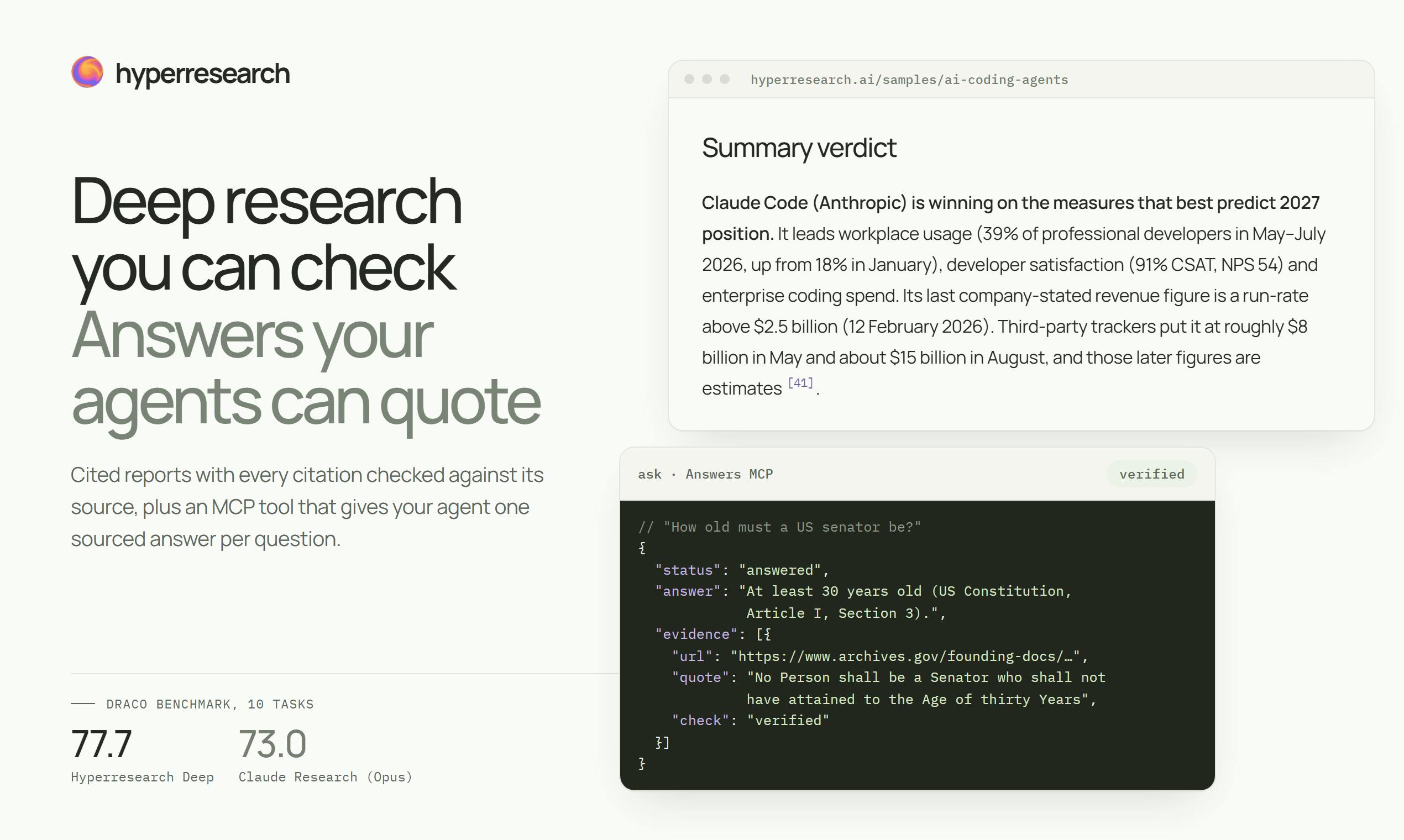
Hyperresearch's tagline is "Durable, verified agentic search." Its workflow is straightforward: after a user asks a question, they receive a report with citations, and every cited claim in that report is cross-checked against the original source. All sources are stored in a searchable library for easy traceability.
This design directly targets the Achilles' heel of current AI search—models can generate plausible-sounding but entirely fabricated content. By enforcing citation verification, Hyperresearch puts "evidence" before "answers."
Performance: #1 on the DRACO Benchmark
According to official claims, Hyperresearch is the "world's #1 research agent" on the DRACO benchmark. While the materials provided don't include specific scores, this claim itself demonstrates the team's confidence in the product's capabilities. DRACO is a benchmark for evaluating deep research agents, covering multi-step reasoning and information integration tasks. Topping this benchmark means Hyperresearch is competitive in complex research scenarios.
DRACO (Deep Research Agent Competition & Benchmark) is a benchmark suite specifically designed to evaluate deep research AI agents, jointly promoted by academia and industry. It simulates real research workflows, requiring agents to perform multi-step retrieval, cross-validation, and综合推理 across multiple heterogeneous information sources, ultimately generating structured reports. Evaluation dimensions typically include factual accuracy, citation completeness, information coverage, and the soundness of reasoning chains. Unlike traditional single-turn Q&A benchmarks, DRACO places greater emphasis on an agent's planning capabilities and self-correction in long-horizon tasks. Therefore, ranking highly on this benchmark generally means the agent has strong robustness and reliability in complex, open-ended research scenarios.
Developer-Friendly: MCP and API Integration
Hyperresearch recently added support for MCP (Model Context Protocol) and APIs. This means developers can embed Hyperresearch's search capabilities into their own AI agent workflows.
Specifically, when your agent calls the ask interface, it receives one of two outcomes: a short answer with verbatim citations, or a simple "not found." The team emphasizes this is to "eliminate hallucinations"—better to admit not knowing than to fabricate information.
This design is particularly important in scenarios requiring high reliability, such as辅助研究 in legal, medical, or financial fields.
MCP (Model Context Protocol) is an open protocol proposed by Anthropic, designed to standardize how AI models interact with external tools and data sources. It allows developers to provide context information to AI agents in a unified way—such as database queries, file retrieval, or API calls—avoiding the need to write a separate adapter layer for each tool. MCP uses a client-server architecture: the model acts as the client initiating requests, and tools act as servers responding, supporting dynamic discovery and permission control. For Hyperresearch, supporting MCP means its search capabilities can seamlessly integrate into the MCP-based agent ecosystem. Developers can call its research interface in MCP-compatible environments like Claude Desktop and Cursor without additional wrapping, significantly reducing integration costs.
Data Coverage: Aggregating 4 Major AI Search Engines and 40+ Data Sources
To provide "the broadest and deepest" access, Hyperresearch integrates 4 AI search engines and over 40 other data sources. This aggregation strategy gives it an advantage in information breadth, especially suitable for research tasks requiring cross-database retrieval. However, the materials don't disclose which specific search engines and data sources are included, so actual performance still requires user verification.
Market Reception and Positioning
Hyperresearch received 82 upvotes on Product Hunt, ranking #10 for the day, with category tags including API, Developer Tools, Artificial Intelligence, and GitHub. Judging by the comment count (3), discussion volume isn't particularly high, but as a developer-focused tool, its value is more about the efficiency gains realized through actual integration.
Conclusion: A Small Step Toward Trustworthy AI Search
Hyperresearch doesn't try to attract attention with flashier interfaces. Instead, it focuses on the trust problem in AI search. Through citation verification, refusal to fabricate, and aggregation of multi-source data, it offers a verifiable paradigm for "research agents." For developers and researchers who need reliable information to support their work, this may be an option worth watching.
One-line Summary
Hyperresearch provides trustworthy AI research agent search centered on verifiable citations and refusal to fabricate.
Paragraph Summary
Hyperresearch is an AI search tool ranked #10 on Product Hunt, featuring "verifiable agentic search." Its workflow: after a user asks a question, it generates a report with citations, each cited claim is cross-checked against the original source, and all sources are stored in a searchable library. It ranks #1 on the DRACO benchmark, demonstrating capability in complex research scenarios. It supports MCP and API integration—developers calling the ask interface receive answers with verbatim citations or an explicit "not found," eliminating hallucinations. In terms of data coverage, it aggregates 4 AI search engines and over 40 data sources, providing broad and deep information access. The product targets developers and researchers, emphasizing credibility over flashy interfaces, and offers a verifiable paradigm for research agents.
Related articles

9 AI Subscription Plans Compared: The Real Cost Per 100M Tokens Revealed
Bilibili creator tests 9 AI subscription plans from Volcano, Alibaba, Tencent, Baidu, Zhipu, Xiaomi, MiniMax and more, converting them all to real cost per 100M tokens, breaking down fixed-quota vs. three-tier coefficient billing and how caching, time-of-day discounts, and window limits affect actual quota.

Vibe Coding for Beginners: Expressing Intent Instead of Handwriting Code
What is Vibe Coding? A 137-episode Bilibili course defines it: the core is expressing intent, not writing code. This article analyzes Vibe Coding's productivity logic, target audience, and entry expectations to help beginners decide if it's worth learning.

LangChain Beginner's Guide: An Agent Development Roadmap from LangGraph to Deep Agents
Clarify the encapsulation relationship among LangChain, LangGraph, and Deep Agents, and master the learning path and selection logic for agent development frameworks—suitable for beginners in large model development.