I Built an Interactive AI Clone of Myself — and It Left Me with Mixed Feelings

A writer built an AI clone of themselves, trained it on venture fraud, and came away with deeply mixed feelings.
A tech writer built an interactive AI avatar of themselves using voice cloning, talking head generation, and LLM-powered Q&A — then trained it to discuss venture fraud. The experiment reveals the technology's dual nature: on one side, a 24/7 digital presence that scales knowledge and personal reach; on the other, thorny questions about content accuracy, identity authenticity, and the risk of deepfake misuse. The writer's concluding "mixed feelings" reflect the broader industry tension between rapidly advancing capabilities and still-evolving ethical guardrails.
When Your AI Avatar Starts Talking
Turning yourself into a digital avatar you can have a conversation with anytime sounds like something out of a sci-fi film — but it's now very much within reach. A tech writer decided to build their own interactive avatar from scratch, then trained it to discuss a highly specialized topic: venture fraud. When it was all over, they were left with a complicated, contradictory set of feelings about the whole experience of creating an AI clone of themselves.
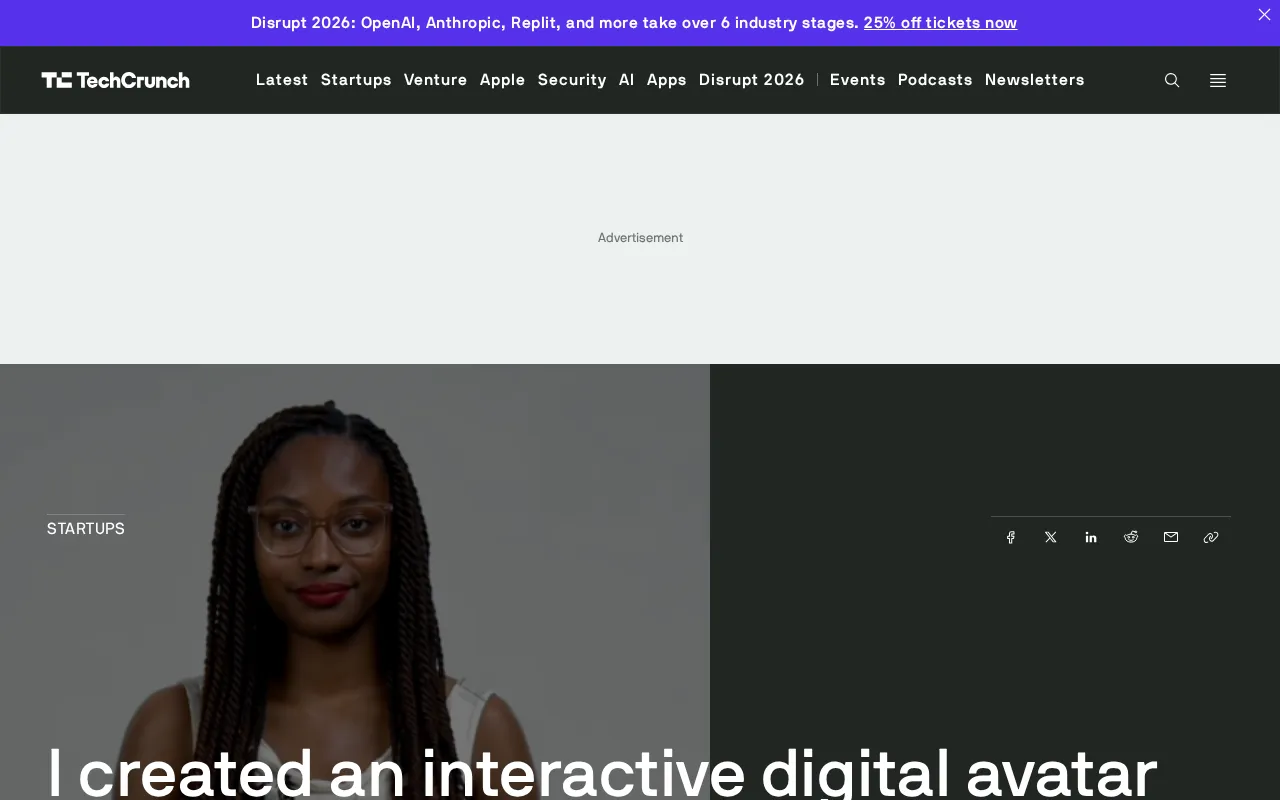
At its core, an interactive digital avatar takes a real person — their appearance, voice, manner of expression, and even their domain knowledge — and packages it into an AI persona capable of real-time conversation. Instead of staring at a cold chat box, users interact with a virtual figure that looks like you and sounds like you. Under the hood, this blends several technologies: voice synthesis, facial animation, and large language model (LLM)-powered question answering.
The technical implementation of an interactive avatar typically relies on a few key modules working in concert. Voice cloning captures minutes to hours of a person's real audio to train a synthetic model that mimics their timbre, intonation, and rhythm. Talking head generation maps voice signals in real time to lip movements and facial expressions, making the virtual figure appear to speak naturally and fluidly. The underlying LLM handles understanding user questions and generating responses, which are then rendered through those two layers into a fully audio-visual video stream. Commercial platforms like HeyGen, Synthesia, and D-ID already offer end-to-end services: upload a photo or short video, record a voice sample, and within hours you have an interactive digital avatar — no deep learning expertise required. This kind of plug-and-play productization has lowered the barrier from specialized research labs to something any everyday creator can afford.
From "Building the Avatar" to "Training It to Talk Specialty Topics"
What makes this experiment particularly noteworthy is that the author didn't settle for a digital avatar that just makes small talk. They specifically trained it to engage with venture fraud — a niche and serious domain. That means the avatar isn't just a visual gimmick; it carries the ability to express specific knowledge and viewpoints.
Getting an AI avatar to speak meaningfully about a specialized topic requires injecting relevant knowledge into the model and constraining and tuning its response style so that it reflects the person's actual perspective without going off the rails. This combination of "personality plus domain expertise" pushes the digital avatar from entertainment novelty toward something closer to a productivity and content distribution tool.
Enabling an AI avatar to command vertical domain knowledge typically leverages Retrieval-Augmented Generation (RAG). The approach involves chunking domain-specific materials — articles, reports, transcripts — and storing them in a vector database. When a user asks a question, the system first retrieves the most relevant passages from the database, then feeds them as context to the language model, anchoring responses to a specific knowledge base rather than relying on the model's general pre-trained memory. Compared to direct fine-tuning, RAG is cheaper, easier to update, and makes it simple to add new material at any time. On a high-stakes topic like venture fraud, RAG can also reduce hallucination risk by grounding answers in source documents — though it can't eliminate the problem entirely. That residual risk is, in fact, one of the technical roots of the author's ambivalence.
The Mixed Feelings That Come with AI Cloning
The author summed up the experience with the phrase "mixed feelings" — which is perhaps the most honest description of where AI cloning technology stands today. On one hand, the prospect of creating a digital figure that's online 24/7, can answer questions on your behalf, and keeps spreading your knowledge even when you're not around is genuinely compelling. It scales your personal reach and lets you "keep talking" even when you're absent.
On the other hand, the technology raises a set of questions that are hard to brush aside. When an AI avatar speaks with your face and your voice, does what it says actually represent you? If it drifts off course while discussing something as sensitive as investment fraud, who bears responsibility? And once a digital avatar exists, where are the boundaries around how your likeness and voice can be used — and is there a real risk of misuse or fabrication?
Real-World Promise and Real-World Concerns
From an industry perspective, interactive digital avatars are emerging as one of AI's most interesting new application frontiers. They have potential across education, customer service, content creation, and personal brand building. Imagine an expert packaging their knowledge into a conversational avatar so that anyone can "consult" them at any time — that's a genuine multiplier for how efficiently knowledge can spread.
But the more realistic the technology becomes, the sharper the ethical and trust questions get. As "the digital you" becomes increasingly indistinguishable from "the real you," concerns about identity authenticity, content credibility, and deepfake misuse inevitably follow. The author's post-experiment "mixed feelings" represent, at their core, a clear-eyed recognition of this technology's double-edged nature: it can empower personal expression, but it can also blur the line between the real and the fabricated.
Deepfake misuse is one of the most closely watched risks around avatar technology. Unlike early face-swapping methods that required large training datasets, modern generative AI can reconstruct a highly realistic audiovisual likeness from just a handful of photos and a few dozen seconds of audio — at dramatically lower cost and in far less time. Governments are beginning to respond: several U.S. states have passed bans on election-related deepfakes, the EU AI Act classifies manipulative synthetic content as a high-risk application, and China introduced the Provisions on the Administration of Deep Synthesis Internet Information Services in 2022, requiring prominent labeling of AI-generated content. But the pace of technological change far outstrips the pace of regulatory implementation. The identity verification challenge — "how do you prove this video is really me speaking?" — has no mature, universal solution yet, and industry discussions around digital watermarking and content provenance standards are still ongoing.
Final Thoughts
This experiment in building a conversational AI clone offers a vivid window into where avatar technology stands right now. The technical barriers are coming down — ordinary people can now create their own digital personas — but the conversations about identity, accountability, and trust are only just beginning. Embracing the convenience is one thing; figuring out where to draw reasonable lines around AI cloning is a challenge every future experimenter will have to grapple with.
(Note: This article is based on limited source material. For specific product names and technical details, please refer to official documentation.)
Related articles

Build an AI Super Employee System at Zero Cost: A Full Breakdown of Automated Agent Workflows
A deep breakdown of the AI super employee system demoed on Bilibili: agent orchestration, digital human voiceovers, map and enterprise lead generation, 24/7 customer service, and legal modules. We analyze the business logic and compliance risks behind zero-cost signup to help entrepreneurs judge the real ROI of this AI digital employee system.

The Essential Difference Between Chatbots and AI Agents: Crossing from Conversation to Execution
What's the difference between a chatbot and an AI agent? Based on the MCP series on the Learn Tech channel, this article uses examples like booking flights and summarizing notes to explain: a chatbot only gives answers, while an agent actually completes tasks through a think-act-observe loop. It breaks down the four core components—model, tools, memory, and goal—as well as MCP's role as a bridge, and discusses agents' applicable boundaries and permission risks.

Free GitHub Repo: 342 Hours of AI Courses, from Math to MCP Servers
A free GitHub repo offers 342 hours of AI courses: 523 lessons across 20 phases, from math fundamentals to agent building and MCP servers. Nearly 100,000 learners have started.