ICLR 2027 Deadline Before NeurIPS 2026 Decisions Sparks Controversy: The Deeper Conflicts in Top Conference Timelines

ICLR 2027 deadline preceding NeurIPS 2026 decisions exposes structural flaws in ML conference scheduling.
ICLR 2027's full paper deadline is set 8 days before NeurIPS 2026 announces decisions, breaking the traditional submission pipeline where researchers revise rejected papers for the next conference. This timeline conflict hurts authors who need NeurIPS feedback to improve their work, while potentially serving to reduce ICLR's reviewer load from resubmission floods. The controversy highlights deeper structural issues in AI academic publishing: exploding submission volumes, strained reviewer resources, and an evaluation culture that prioritizes paper quantity over quality.
Conference Timeline Conflicts Back in the Spotlight
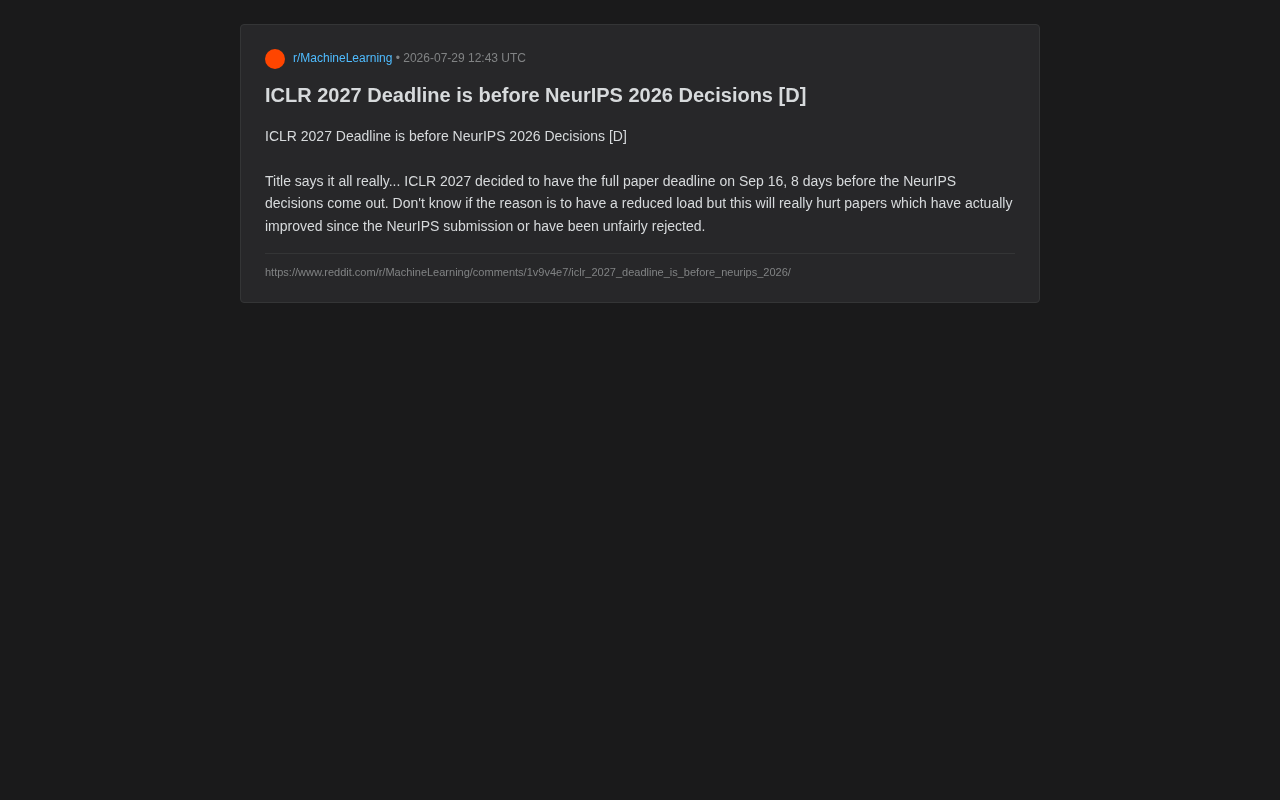
Recently, a discussion about the submission scheduling of top machine learning conferences has gained significant attention on Reddit. According to the discussion, ICLR 2027 has set its full paper submission deadline on September 16th — exactly 8 days before NeurIPS 2026 announces its review decisions.
ICLR (International Conference on Learning Representations) was founded in 2013, co-initiated by deep learning pioneers Yoshua Bengio and Yann LeCun, and is known for its open review mechanism (OpenReview). It stands as one of the most influential top-tier conferences in the machine learning field. NeurIPS (Neural Information Processing Systems) has a longer history, dating back to 1987, and is widely recognized as one of the most prestigious academic conferences in AI and machine learning. Together with ICML, these three are commonly referred to as the "Big Three" of machine learning conferences, each receiving over 10,000 submissions annually with acceptance rates typically between 20%-30%. It is precisely because of the parallel academic influence of these two conferences that their timeline conflicts have triggered such widespread concern.
For researchers who regularly submit to top conferences, this kind of timeline overlap is nothing new. However, the proximity of these two major conference milestones has once again triggered community-wide reflection on the rationality of academic submission mechanisms.
The Real-World Dilemmas Behind the Timeline Conflict
Who Gets Affected
The original poster bluntly identified the core issue: ICLR 2027's deadline preceding NeurIPS 2026's decisions will "genuinely hurt papers that have made substantial improvements since NeurIPS submission, or papers that were unfairly rejected."
There's a clear logical chain behind this concern. In the machine learning field, researchers often submit the same work sequentially across conferences — if rejected at NeurIPS, resubmitting to ICLR is a common and reasonable choice. Specifically, the submission cycle for top ML conferences typically includes: deadline, reviewer assignment, initial review, author rebuttal, reviewer discussion, and final decision, spanning roughly 3-4 months from deadline to results. Researchers typically plan submissions following a NeurIPS (May-June deadline) → ICLR (September-October deadline) → ICML (January-February deadline) cycle, where papers rejected from one conference are revised and submitted to the next — an iterative path accepted as standard practice in academia. However, when ICLR's deadline falls before NeurIPS results are announced, this path is broken, leaving researchers in a dilemma:
- Unable to improve papers based on NeurIPS reviews: NeurIPS review feedback typically contains valuable critiques that can help authors significantly improve paper quality. But if results haven't been announced, authors cannot incorporate this feedback before submitting to ICLR.
- Forced into "blind submissions" or duplicate submissions: Authors must either submit the paper to ICLR without knowing the NeurIPS outcome, or skip this ICLR cycle entirely and wait for next year.
- Double penalty for unfairly rejected papers: If a paper is unjustly rejected at NeurIPS, authors should have the opportunity to thoroughly revise and resubmit to ICLR, but the tight timeline eliminates this buffer space.
It's worth noting that the OpenReview platform, pioneered by ICLR, makes review comments publicly accessible after paper acceptance, and this transparency in the review process should theoretically help reduce unfair reviewing. Yet even with this transparency mechanism, fluctuations in review quality remain one of researchers' biggest pain points — reviews that are overly brief, lack constructive feedback, or even contain obvious misreadings of the paper are not uncommon. When these issues compound with timeline conflicts, researchers find themselves in an even more passive position.
Reducing Load or Shifting Pressure
The original poster also proposed a possible explanation: ICLR's move might be aimed at "reducing reviewer load." By advancing the deadline, it could prevent a flood of papers hastily resubmitted after NeurIPS rejections, thereby reducing pressure on reviewers.
This hypothesis touches on a deep-seated contradiction facing current top conferences. In recent years, submission volumes in AI have exploded — NeurIPS, ICLR, ICML, and other conferences receive tens of thousands of papers annually, creating severe strain on reviewer resources. Taking NeurIPS as an example, submissions exceeded 13,000 in 2023 and approached 15,000 by 2024. Each paper typically requires 3-4 reviewers, meaning a single conference demands tens of thousands of person-reviews. Reviewers are mostly academic researchers participating on a voluntary, unpaid basis, while also facing their own heavy research and teaching responsibilities. Conference organizers, when designing timelines, genuinely need to balance "reducing reviewer burden" against "protecting author rights."
Structural Contradictions in the Top Conference Submission Ecosystem
Chain Reactions from Surging Submission Volumes
From a broader perspective, the ICLR 2027 timeline controversy is merely a microcosm of the pressure on the AI academic publishing system. As deep learning and large model research continues to boom, submission growth rates far outpace the expansion of the reviewer pool.
To cope with this pressure, major conferences have continuously adjusted their submission policies: some have introduced mandatory reviewer obligations (submitting requires participating in reviewing), some have tightened simultaneous submission rules, and others stagger timelines to "distribute" submissions. ICLR 2027's earlier deadline is very likely a product of such distribution strategies.
However, no timeline design can satisfy everyone. When a conference tries to reduce its own load, it often means shifting some costs onto researchers — especially those who depend on conference feedback to iteratively improve their work. The root of this contradiction lies in the current academic evaluation system's heavy reliance on top conference paper counts, forcing researchers to race against the clock within a limited number of submission windows. Any minor adjustment to timing can trigger cascading effects on the publication plans of large numbers of researchers.
The Tension Between Academic Pace and Research Quality
More worthy of reflection is whether this compressed submission pace actually benefits research quality itself. Ideally, academic peer review should form a virtuous cycle: submit — receive feedback — improve — resubmit. The value of review comments lies in helping research continuously improve.
But when conference deadlines squeeze against each other and authors exhaust themselves "racing deadlines," this cycle breaks down. Researchers may be unable to fully absorb feedback from the previous round, forced to continue submitting unpolished versions. This ultimately both increases reviewer burden and harms the quality of the papers themselves. Some scholars estimate that a significant proportion of top conference submissions are essentially "resubmission" versions of the same paper with minimal modifications — this not only wastes reviewer resources but also drags down the overall efficiency of academic discourse.
Community Reflection and Possible Improvements
Although this discussion originated from a specific scheduling issue, it reflects the broader anxiety across the AI academic community about existing publication mechanisms. Several possible improvement directions are worth exploring:
- More reasonable timeline coordination: Could major top conferences coordinate to some degree in their timeline design to avoid direct conflicts at critical junctures? In fact, informal communication channels already exist between the organizers of NeurIPS, ICLR, and ICML, but no institutionalized timeline coordination mechanism has yet been established.
- Introducing rolling review or rebuttal buffers: Giving authors more adequate time to respond to review feedback and improve their papers. The ACL conference in natural language processing launched the ARR (ACL Rolling Review) system in 2021, allowing authors to submit papers at any time with continuous reviewing, and authors can choose to submit reviewed papers to any cooperating conference. This model could theoretically alleviate submission floods before deadlines and give authors more flexible scheduling, but in practice it has also revealed issues such as uncertain review cycles and increased system complexity. Whether the machine learning community will adopt this model remains to be seen.
- Re-evaluating the "quantity-first" submission culture: Fundamentally alleviating the pressure from surging submission volumes may require academia to reflect on its paper-count-oriented evaluation system. When faculty hiring, PhD graduation, and grant applications all use top conference paper counts as core metrics, researchers naturally maximize submission frequency, which fundamentally drives up system load.
For the broader research community, given fixed conference timelines, the pragmatic approach is to plan submission strategies early and prepare to allocate work across different time points. For conference organizers, finding the balance between ensuring review quality, reducing reviewer burden, and protecting author rights will remain a long-standing challenge.
Key Takeaways
Related articles
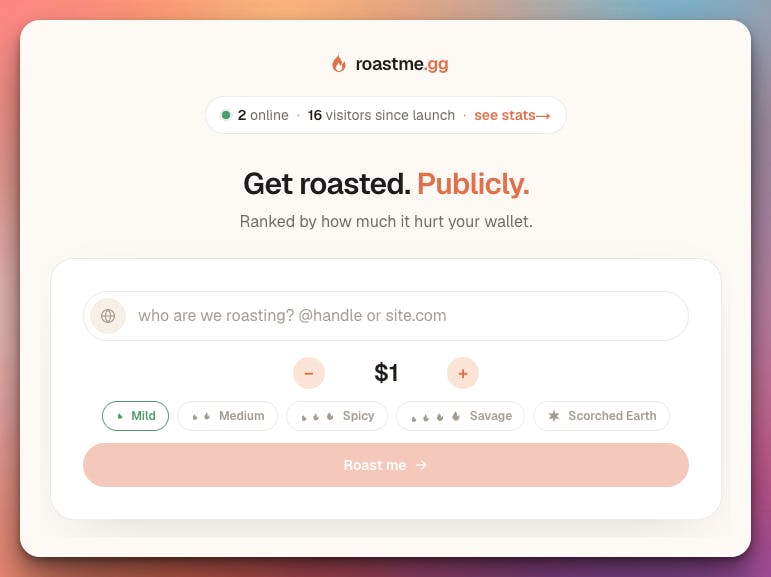
roastme.gg: How a Counterintuitive Product That Charges Users to Get Publicly Roasted by AI Engineered Viral Spread
Deep dive into roastme.gg's product design: users pay $1-$1000 to get publicly roasted by Claude AI, leveraging leaderboards and social cards for viral spread. Exploring AI entertainment business models.

TruIntel Review: An Analytics Tool for Monitoring Brand Visibility in AI Search
TruIntel is a brand visibility analytics tool for AI search, tracking how brands are cited in ChatGPT, Gemini, and Perplexity responses. Deep dive into GEO trends and practical value.

New Orleans Uses AI to Triage 911 Calls: How Smart Dispatching Is Changing Emergency Response
New Orleans deploys AI to triage backlogged 911 calls using speech recognition and emotion analysis. Explore how AI dispatch works, its risks, and impact on public safety.