ICLR 2027 Reciprocal Reviewers With Zero Assignments Spark Debate: Mechanisms and Strategies

ICLR 2027 reciprocal reviewers with zero paper assignments spark Reddit debate; no official response yet.
A Reddit user reported receiving no paper assignments as an ICLR 2027 reciprocal reviewer, sparking widespread community discussion. The reciprocal reviewer mechanism requires authors to commit to reviewing in exchange for their submissions being reviewed, but zero assignments are not an isolated case. Community analysis suggests possible causes include an oversupplied reviewer pool, domain matching failures, system delays, or qualification screening. Users disagree on whether to worry; some fear it may affect reviewer reputation, but there is no official policy confirmation. The article suggests checking email, contacting Program Chairs, checking the FAQ, and being patient, while noting that the incident reflects common challenges in reviewer assignment and management at large AI conferences.
Background: A Reddit Post Draws Attention
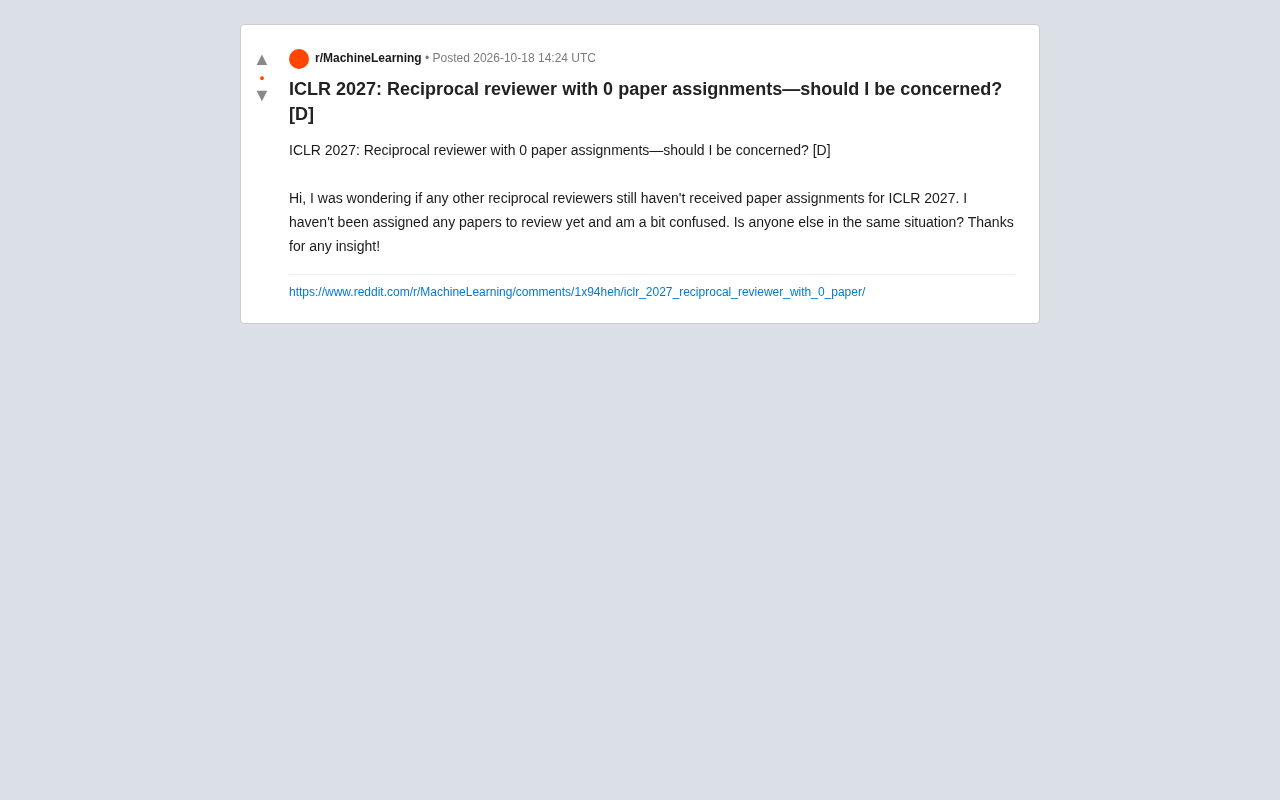
Recently, a Reddit user posted: "ICLR 2027: Reciprocal reviewer with 0 paper assignments—should I be concerned?" The user said that as a reciprocal reviewer they had not received any paper assignments so far, felt confused, and asked whether others had encountered a similar situation (according to a screenshot of the Reddit post). The post quickly sparked discussion, but no official explanation appeared in the replies.
What Is a Reciprocal Reviewer?
At top AI conferences such as ICLR, the reciprocal reviewer mechanism usually means that when authors submit a paper, they must commit to reviewing a certain number of papers in exchange for the eligibility of their own submission to be reviewed. However, the specific rules vary by conference. The detailed policy for ICLR 2027 has not yet been publicly explained, but based on community discussion, zero assignments are not an isolated case.
ICLR (International Conference on Learning Representations) is a top academic conference in the fields of deep learning and representation learning, ranked alongside NeurIPS and ICML as one of the three major machine learning conferences. In recent years, ICLR submissions have continued to climb, exceeding 7,000 in 2024 and growing further in 2025, with demand for reviewers surging accordingly.
The typical design of the reciprocal reviewer mechanism is that each submission requires at least one author to register as a reviewer and commit to completing a certain number of review tasks (usually 3-5), thereby ensuring that the reviewer pool expands in sync with submission volume. If reviewers fail to complete their committed review load, some conferences impose restrictions on their future submissions, such as rejection or requiring additional reviews. However, enforcement varies greatly across conferences, and ICLR's handling of those who fail to fulfill review obligations has not always been publicly transparent.
Possible Reasons for Zero Assignments
According to analyses by multiple community members, zero assignments may have several explanations:
- Oversupply in the reviewer pool: If the number of people committing to review far exceeds actual demand, the system may be unable to assign papers to everyone.
- Domain matching issues: The areas selected by the reviewer do not match the keywords of submitted papers, making assignment impossible.
- System delays or failures: There may be technical delays in the assignment process, and some reviewers may not yet have been assigned.
- Trust or qualification screening: Newly registered reviewers or those lacking a track record may be temporarily skipped.
A Bilibili creator speculated in a video that ICLR 2027 submissions may hit a new high, leading to a surplus of reviewers. However, this claim has not been officially confirmed, and the creator also emphasized that it was "only a personal guess."
Conference review assignment usually relies on domain-matching algorithms based on keywords or abstracts (such as the Toronto Paper Matching System, TPMS), which compute similarity between reviewers' self-reported expertise and paper topics, followed by manual adjustments by Area Chairs. When a reviewer's self-reported areas are too broad, too obscure, or severely misaligned with that year's submission distribution, the matching score may fall below the system threshold, causing the reviewer to enter a "pending pool" and remain unassigned for a long time. In addition, some conferences prioritize assigning papers to reviewers with historical review records and high scoring quality, while newly registered reviewers with no historical data may be downweighted by the system, which can also create the impression of zero assignments.
Divergent Community Views
In the Reddit discussion, some users believed there was no need to worry about zero assignments because "assignments will eventually come," while others worried it could affect their reviewer reputation or future submission eligibility. One user noted: "If you ultimately don't review, you may be flagged as failing to fulfill review obligations." But this claim has not been supported by official policy.
At present, ICLR officials have not issued a statement on the matter. Those affected are advised to watch for updates via official emails or the conference homepage.
On platforms such as OpenReview, reviewer reputation is a gradually accumulated implicit metric. Although conference organizers usually do not disclose specific scores, they record whether reviewers submit on time, the length and quality of reviews, and whether they respond to follow-up inquiries from Area Chairs. For reciprocal reviewers, if they are ultimately not assigned any papers, there is theoretically no negative record; but if they are assigned and fail to complete the review, they may be flagged as "failing to fulfill obligations," affecting reviewer eligibility checks for future submissions. Because ICLR has not publicly disclosed the details of its reputation calculation, community concerns are mostly based on analogies with experience from other conferences (such as NeurIPS) and lack direct evidence.
Suggested Responses
If you are also a reciprocal reviewer with zero assignments, you can take the following steps:
- Check your spam folder: Make sure you have not missed an assignment notification.
- Contact the Program Chairs: Politely inquire about assignment status through official channels.
- Check the conference FAQ: Some conferences explain the assignment timeline in their FAQ.
- Be patient: Assignments may be made in batches, especially in years with large submission volumes.
Reflections on the Reviewer Mechanism
This incident also reflects the challenges of reviewer management at large AI conferences. As submissions surge, how to assign review tasks fairly and efficiently has become a difficult problem. The reciprocal reviewer mechanism, while ensuring review quality, also needs to avoid wasting resources. Future conferences may need more transparent assignment algorithms or more flexible reviewer pool management.
(This article is based on public Reddit discussion and community analysis and does not represent an official position.)
Related articles

REA: Reverse Engineer Any App with AI, No Coding Required
REA is a viral open-source AI reverse-engineering tool that lets Claude, Codex, and other AI agents analyze any app and generate functional clones—no coding required. This article covers how it works, installation, a hands-on test, and legal risks.
2026 AI Coding Tools Comparison: Claude, ChatGPT, Gemini — Which Is the Best?
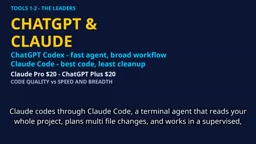
A 2026 comparison of five mainstream AI coding tools — Claude Code, ChatGPT Codex, Gemini, DeepSeek, and GitHub Copilot — on real projects, pricing, and code quality, to help you decide where that $20/month should go.

ChatGPT Codex Can Clone Any Software? Testing the Risks and the Truth
YouTube shorts claim ChatGPT Codex or Claude Code can clone Adobe, Excel, and Figma for lifelong free use. We break down the feasibility, legal risks, and DM-funnel tactics—and explain what AI coding tools are truly good for.