ICLR Reviewers Decry AI Writing: Why Are Academic Papers Increasingly Hard to Read?

ICLR reviewers encounter large volumes of AI-generated text and call for focusing on specific writing defects rather than guessing whether authors used AI.
Starting from an ICLR reviewer's confusion on Reddit, the article shows the logical confusion and semantic vagueness caused by AI-generated academic text. Since AI-assisted editing is widely permitted, reviewers find it difficult to directly criticize "AI writing" and should instead focus on the quality defects of the text itself, such as multiple negations, low information density, and template-like expression. The article outlines typical patterns of over-generated AI text and discusses the necessity of establishing writing quality standards. It emphasizes that regardless of the tools used, clear, accurate, and logically coherent expression remains the cornerstone of academic communication, and authors must take responsibility for AI output.
When AI Writing Infiltrates Academia: An ICLR Reviewer's Dilemma
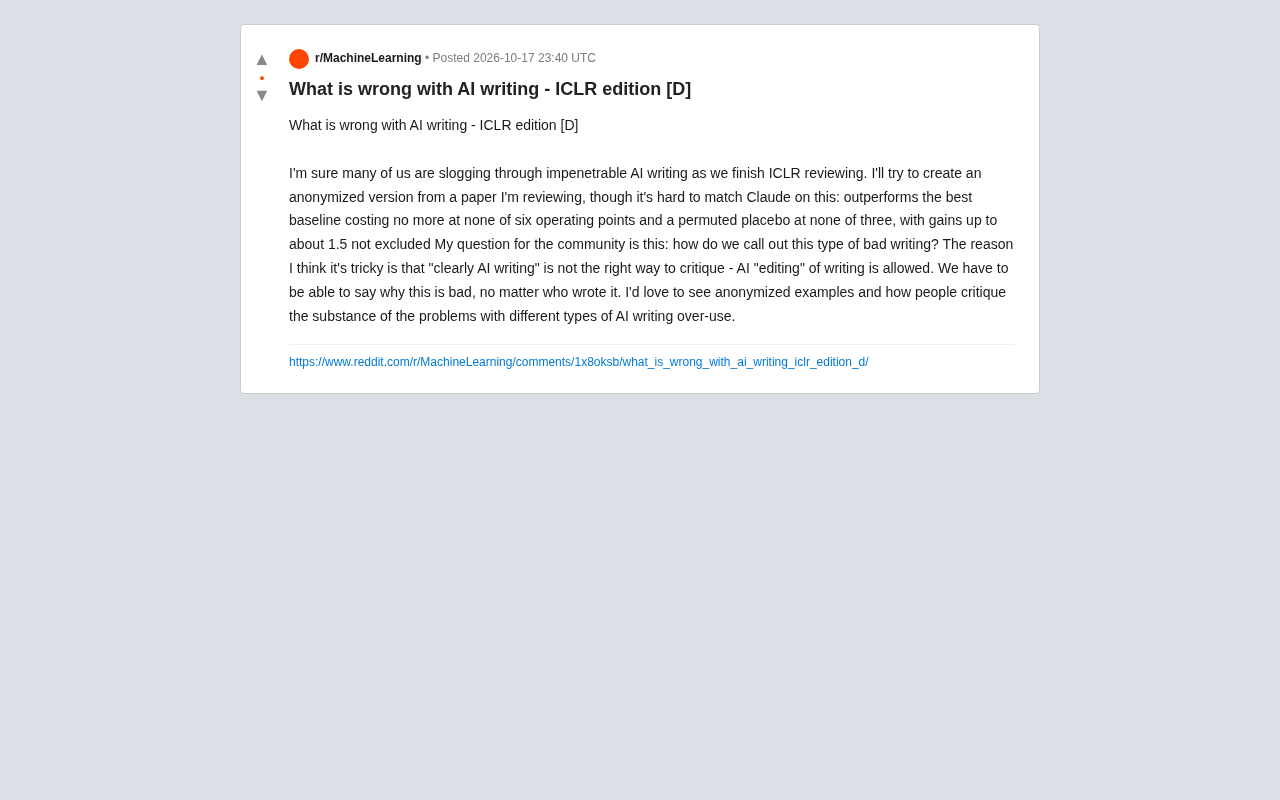
Recently, a post by an ICLR reviewer on Reddit struck a chord with many. During the review process, they encountered a large volume of "incomprehensible" AI-generated text and tried to illustrate the problem with an anonymized example:
"outperforms the best baseline costing no more at none of six operating points and a permuted placebo at none of three, with gains up to about 1.5 not excluded"
This sentence reads like the output of machine translation—logically incoherent and semantically vague. But the problem is that this writing style is spreading throughout academic papers. According to the reviewer, many ICLR submissions suffer from similar issues, yet reviewers struggle to point this out appropriately—because "obviously written by AI" is not a valid criticism. After all, AI-assisted editing is itself permitted.
Why Is "AI Writing" Hard to Criticize Directly?
The Blurry Line Between AI Editing and AI Generation
In academic writing, using AI for grammar checking and language polishing has long been widely accepted. Many journals and conferences explicitly allow authors to use AI tools to improve expression. However, when AI upgrades from an "editor" role to a "generator" role, the problem becomes complicated. Reviewers find it difficult to distinguish whether a passage was written by the author and then polished by AI, or generated by AI from scratch.
As the post says: "AI 'editing' writing is allowed. We have to be able to say why this text is bad, regardless of who wrote it." This means the focus of criticism should shift from "whether AI was used" to "the quality problems of the text itself."
The Real Nature of Bad Writing: Broken Logic and Hollow Information
The core problem exposed by the example above is not "AI traces" but:
- Confused logical relationships: Constructions like "outperforms... at none of six operating points," with multiple negations and stacked conditions, make it impossible for readers to understand the experimental conclusions.
- Extremely low information density: The sentence piles up jargon and numbers without clearly stating results.
- Lack of readability: Even if a human writer produced such a sentence, they should be asked to revise it.
Therefore, what reviewers need is a framework for criticizing "bad writing," not simply blaming AI.
ICLR (International Conference on Learning Representations) is one of the top conferences in machine learning, known for its open review and rigorous peer review process. Its review platform typically makes reviews and author responses public, which puts reviewers under greater public visibility and pressure of accountability. In recent years, ICLR submissions have surged, increasing reviewer workload and making it difficult to carefully assess the writing quality of every paper—which to some extent amplifies the proliferation of AI-generated text. Understanding this context helps explain why "AI writing" has become a controversial focus in the ICLR setting.
The example sentence cited in the article involves a description of experimental comparisons, where "operating points" usually refer to the running states of a system or model under different configurations, "placebo" in experimental design refers to an ineffective control (placebo control), and "permuted placebo" refers to a control baseline constructed by randomly permuting labels or conditions. Multiple negations ("no more at none of six") and stacked conditions make it impossible for readers to determine under which conditions the model outperforms the baseline and whether the gains are significant. The flaw in such expressions lies not in the terminology itself, but in the failure to clearly state the correspondence between experimental design and conclusions—a typical case of unclear scientific expression.
How to Effectively Criticize Bad AI Writing?
Focus on Specific Problems, Not Guessing About the Author
Review comments can point out: "This sentence uses multiple negations and nested conditions, making the conclusion unclear. It is recommended to rewrite it as a direct statement." This avoids accusing the author of using AI while directly targeting the writing flaw.
Identify Typical Patterns of AI Writing
According to community discussions, over-generated AI text often has the following features:
- Overuse of passive voice and nominalization: e.g., "the utilization of..." instead of "we use...".
- Redundant modifiers: e.g., excessive use of "significantly outperforms" without concrete data support.
- Template-like structure: Paragraphs lack logical connections, as if pieced together.
- Vague quantitative statements: Expressions like "gains up to about 1.5 not excluded" are neither precise nor responsible.
Reviewers can propose revisions targeting these patterns rather than criticizing vaguely.
Nominalization refers to the expression of turning verbs or adjectives into noun phrases, for example using "the utilization of" instead of "we use." Moderate use of nominalization in academic writing can enhance formality, but overuse can blur the subject of a sentence, leave the agent of an action missing, and increase the reading burden. Passive voice likewise hides the agent, making it difficult for readers to track the researcher's specific operations. AI-generated text often piles up such structures in pursuit of an "academic tone," leading to decreased information density. After identifying these patterns, reviewers can suggest that authors switch to active voice and concrete verbs to restore the clarity and accountability of sentences.
Promote Community Establishment of Writing Quality Standards
The post sparked another important discussion: Does the academic community need clearer writing norms? Some researchers suggest that conferences could publish "readability guidelines" requiring authors to avoid complex nesting, clearly state contributions, and encouraging reviewers to cite specific sentences in their comments.
Readability guidelines are not new in academic publishing; some journals already require authors to follow specific structured abstracts, plain language checklists, or submission formatting norms. However, machine learning conferences have long focused more on technical contributions, with relatively weak institutional requirements for writing quality. Suggestions raised in community discussions include: adding a "clarity of expression" scoring item to review forms, requiring authors to respond to specific readability issues in rebuttals, and publishing positive and negative writing examples. These measures aim to transform writing quality from a subjective impression into an operational, citable review standard, thereby reducing review disputes caused by AI-generated text.
Rethinking AI-Assisted Writing
The Double-Edged Sword of AI Tools
AI writing tools can indeed help non-native English researchers express their ideas, but over-reliance can cause text to lose individuality and precision. More seriously, when authors do not carefully check AI output, the logically confused sentences described above appear.
The Reviewer's Changing Role
Reviewers are no longer just judging scientific contributions; they also need to serve as "gatekeepers of writing quality." But this requires community consensus: What kind of writing is unacceptable? How do we distinguish "poor language" from "unclear scientific expression"?
Conclusion: Return to the Essence of Clear Expression
The core of this discussion is not resisting AI, but calling for attention to the quality of academic writing. Regardless of who the author is or what tools were used, clear, accurate, and logically coherent expression remains the cornerstone of academic communication. Reviewers need more specific critical language, and authors need to use AI tools more responsibly.
As one commenter put it: "If we cannot point out the specific problems of bad writing, then AI will only make academic papers increasingly hard to read."
One-line Summary
ICLR reviewers encounter large volumes of AI-generated text and call for focusing on specific writing defects rather than guessing whether authors used AI.
Paragraph Summary
The article starts from an ICLR reviewer's confusion on Reddit, showing the logical confusion and semantic vagueness caused by AI-generated academic text. Since AI-assisted editing is widely permitted, reviewers find it difficult to directly criticize "AI writing" and should instead focus on the quality defects of the text itself, such as multiple negations, low information density, and template-like expression. The article outlines typical patterns of over-generated AI text and discusses the necessity of the community establishing writing quality standards. Finally, it points out the double-edged sword effect of AI tools, emphasizing that regardless of the tools used, clear, accurate, and logically coherent expression remains the cornerstone of academic communication, and authors must take responsibility for AI output.
Related articles

Cursor AI Programming in Practice: Build a Student Management System from Scratch in 30 Minutes
A Bilibili creator demonstrates Cursor AI programming: generating a student management system in 30 minutes with natural language. Details on Agent mode, Claude selection, prompt techniques, and thresholds.

Top 20 AI Coding Tools Ranking: From Rock-Solid to Lackluster, a Scored Matrix
Bilibili creator releases top 20 AI coding tools ranking, tiered T0–T4 from rock-solid to lackluster, with Claude Code and Codex tied at T0. This article details the scoring dimensions (capability, reliability, robustness, durability, cost, domestic availability) and tool performances to help developers choose the right AI coding assistant.

Vibe Coding Systematic Tutorial: Master AI-Assisted Programming from Zero
A three-month Vibe Coding tutorial from a Bilibili creator covering Codex, ClaudeCode, and Cursor, from core logic to commercial project practice for beginners.