IDEA Prune: Enlarge First, Prune Later — A New Paradigm for LLM Pretraining
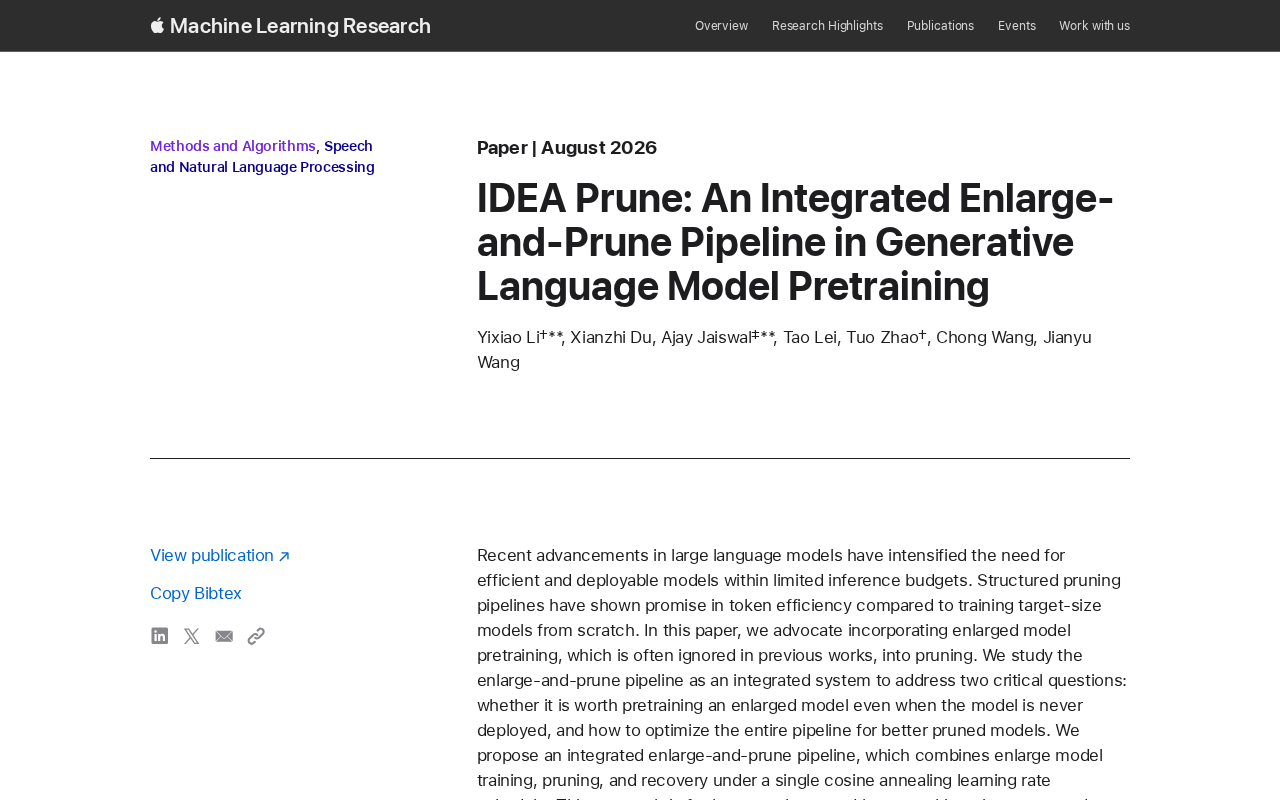
IDEA Prune proposes training oversized LLMs then pruning them down for better efficiency than direct training.
IDEA Prune introduces an integrated enlarge-and-prune pipeline for LLM pretraining, arguing that deliberately training a larger model and then applying structured pruning to reach the target deployment size yields better token efficiency and model quality than training a right-sized model from scratch. By treating enlargement and pruning as a unified optimization system, this approach leverages the redundant representations of large models and offers significant economic advantages given that inference costs dominate total LLM operational expenses.
The Efficiency Dilemma of Model Deployment: A Core Challenge in the Era of Large Models
As large language models (LLMs) continue to grow in scale, achieving high-performance, easily deployable models within limited inference budgets has become a core challenge for both industry and academia. Training a model at exactly the right target size seems straightforward, but researchers have increasingly found that using structured pruning to "carve out" a smaller model from a larger one often yields superior token efficiency.
Structured pruning is one of the core techniques in model compression. Unlike unstructured pruning (which zeros out individual weights), structured pruning removes entire neurons, attention heads, or even whole Transformer blocks as units. The key advantage of this approach is that the pruned model requires no specialized sparse hardware support and can run efficiently on standard GPUs/CPUs out of the box. In the LLM domain, representative structured pruning methods include LLM-Pruner, SliceGPT, and Sheared LLaMA, which typically rely on importance scores (such as metrics based on gradients, Taylor expansion, or activation magnitudes) to determine which structural units to remove, followed by fine-tuning on a small amount of data to recover performance.
A recent paper titled IDEA Prune: An Integrated Enlarge-and-Prune Pipeline in Generative Language Model Pretraining proposes a rather counterintuitive idea: instead of agonizing over training the target model, it's better to deliberately pretrain a larger model first and then prune it down to the deployment size. This "Enlarge-and-Prune" pipeline may redefine the path to building efficient models.
The Core Idea of IDEA Prune: Incorporating Enlarged Pretraining into the Pruning Framework
The Overlooked Link in Structured Pruning
Previous work on structured pruning typically took an "existing large model" as a given starting point, focusing on how to prune and how to fine-tune for performance recovery. But the IDEA Prune paper points out a long-overlooked key element — the pretraining of the enlarged model itself. In other words, the process of "making the model bigger" should not be treated merely as a prerequisite for pruning but should be incorporated into the overall optimization system.
The researchers treat "enlarging" and "pruning" as an integrated pipeline rather than two isolated steps. This shift in perspective enables them to address two key questions that had rarely been explored in depth.
Two Core Questions Driving the Research
The first question is quite bold: Even if the enlarged model will never actually be deployed, is it worth investing resources to pretrain it? This challenges the intuition of "never wasting compute" — training a large model destined to be trimmed down just to obtain a small model seems "wasteful," but from the perspective of the final small model's quality, it may actually be more cost-effective.
The second question is engineering-oriented: How to optimize the entire enlarge-and-prune pipeline to achieve the best balance among enlargement scale, training allocation, and pruning strategy.
Why the "Big First, Small Later" Pruning Strategy May Be Superior
Understanding the Pruning Advantage from a Token Efficiency Perspective
The reason structured pruning has garnered significant attention lies in its token efficiency advantage. Compared to training a target-sized model from scratch, a model of the same size obtained by pruning a larger model can often achieve comparable or even better performance with fewer training tokens.
The concept of token efficiency is closely related to the Chinchilla Scaling Law. This research, proposed by DeepMind in 2022, demonstrates that there is an optimal proportional relationship between model parameter count and training data volume — blindly scaling up models without matching sufficient data actually wastes compute. However, IDEA Prune's research perspective offers an interesting extension: if pruning is factored into the equation, training an "oversized" model and then compressing it to the target size may yield better final performance under the same total compute budget. This essentially introduces a new efficiency dimension — "pruning dividends" — beyond the Scaling Law framework, suggesting that the optimal compute allocation strategy may need to be redefined.
The logic behind this is that large models learn richer, more redundant representations during pretraining, and pruning effectively "distills and concentrates" these high-quality representations, preserving the most valuable knowledge.
The representational redundancy of large models has been confirmed by multiple studies — for example, research has found highly similar feature representations across different Transformer layers, and the contribution of many attention heads to final performance is negligible. IDEA Prune leverages precisely this redundancy: the redundant representations of large models provide a "safety margin" for pruning, so that even when some structures are removed, core knowledge can still be retained. This forms an interesting complement to Knowledge Distillation — distillation uses the large model's soft labels to guide small model training, while pruning directly inherits knowledge from the large model's weights. Both are strategies that leverage the information surplus of large models to improve small model performance, but pruning eliminates the overhead of training a separate student model.
The "Hidden Returns" of Enlarged Pretraining
By incorporating enlarged pretraining into the framework, researchers can systematically evaluate how much performance gain the additional compute invested in the large model ultimately delivers for the final small model. If this gain is significant enough, then "enlarge first, prune later" becomes a rational resource allocation strategy — even if the intermediate large model never sees a real deployment environment.
This approach has direct practical implications for industry. When planning model training budgets, companies typically default to concentrating compute on the target model. IDEA Prune's research suggests that moderately "over-provisioning" the pretraining scale and then pruning back to the deployment size may be an underestimated, high-value path.
From an economics perspective, the rationale for this strategy is backed by solid data. In large-scale LLM services, inference costs typically account for 80%-90% of total operational costs. For GPT-4-class models, a single inference involves matrix operations across hundreds of billions of parameters, requiring large clusters of A100/H100 GPUs to meet latency requirements under high-concurrency scenarios. According to industry estimates, leading AI companies spend millions of dollars per day on model inference compute alone. Therefore, even if investing an extra 10%-20% in the training phase to obtain a smaller, faster model for inference, it is extremely cost-effective from a total lifecycle cost perspective. This is precisely the economic foundation of IDEA Prune's "over-provision during training, stay compact during deployment" strategy.
Engineering Value and Practical Implications of the Integrated Pipeline
From Isolated Steps to End-to-End System Optimization
Perhaps the most important contribution of IDEA Prune lies not in any single technical innovation, but in methodological integration. When enlargement, training, and pruning are optimized as a holistic system, the hyperparameters and strategies for each stage can be co-designed rather than optimized in isolation. This provides a more complete decision-making framework for efficient model development.
Traditional model development follows a linear process of "train → evaluate → compress → deploy," with each stage handled independently by different teams and hyperparameters tuned separately. The end-to-end integrated optimization advocated by IDEA Prune draws on concepts from MLOps and AutoML — treating enlargement ratio, training step allocation, pruning rate, and fine-tuning strategy as joint variables within a unified search space. This methodological shift has precedents in engineering practice: NVIDIA's TensorRT jointly optimizes quantization, layer fusion, and memory allocation during the compilation stage; Google's ENAS (Efficient Neural Architecture Search) also merges architecture search with the training process. IDEA Prune brings this systems thinking to the domain of LLM "scale planning," meaning that model size is no longer a preset fixed parameter but rather a tunable variable within the overall optimization system.
A Fresh Look at Inference Deployment Budgets
In real production environments, inference costs far exceed one-time training costs, especially for high-concurrency, long-term service scenarios. Therefore, any method that can improve model quality within a fixed inference budget holds enormous economic value.
IDEA Prune's approach is designed around precisely this real-world constraint of "limited inference budgets" — it acknowledges that deployment size is a hard constraint while granting greater freedom during the training phase to explore optimal paths. This philosophy of "lavish during training, frugal during inference" aligns perfectly with the industry's intense focus on inference optimization. As Model-as-a-Service (MaaS) becomes more prevalent, every 1% reduction in inference costs can translate to millions of dollars saved in annual operating budgets, giving the training strategy optimization represented by IDEA Prune tangible commercial momentum.
Conclusion: Rethinking Scale and Efficiency in LLM Training
The biggest takeaway from IDEA Prune is that it compels us to reexamine the relationship between "scale" and "efficiency" in model training. It puts forward a proposition worth pondering across the entire industry: The optimal scale during the training phase does not necessarily equal the target scale during the deployment phase.
By explicitly incorporating enlarged pretraining into the pruning pipeline, this research offers a new systematic approach to building efficient, deployable generative language models. Although the specific magnitude of gains and optimal configurations still need validation across more scenarios, the philosophy of "go big first, then shrink, and optimize holistically" has already opened a new window for LLM efficiency research. For teams with limited compute budgets yet demanding high performance, this may well be a viable path that balances both quality and efficiency.
It's worth noting that the ideas behind IDEA Prune resonate with several recent advances in model compression — from quantization to distillation to sparsification, the industry is exploring the shared goal of "achieving the capabilities of larger models at smaller inference costs" from multiple angles. IDEA Prune's unique contribution is that it pushes the optimization starting point forward to the pretraining planning stage, ensuring that the entire model lifecycle serves deployment efficiency from the very beginning.
Related articles
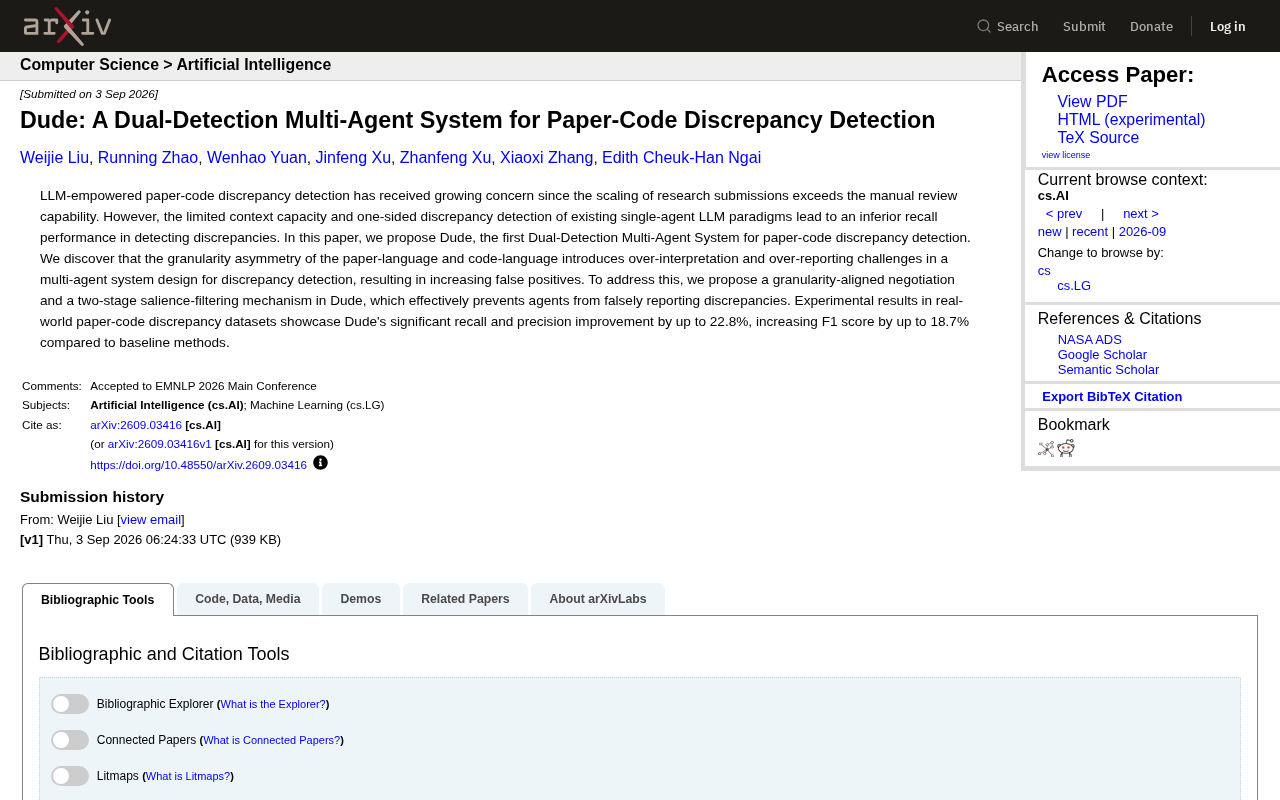
The Dude System: How Dual-Detection Multi-Agent AI Catches Inconsistencies Between Papers and Code
Dude is the first dual-detection multi-agent system for paper-code discrepancy detection, using granularity-aligned negotiation and two-stage salience filtering to boost recall and precision by up to 22.8%.
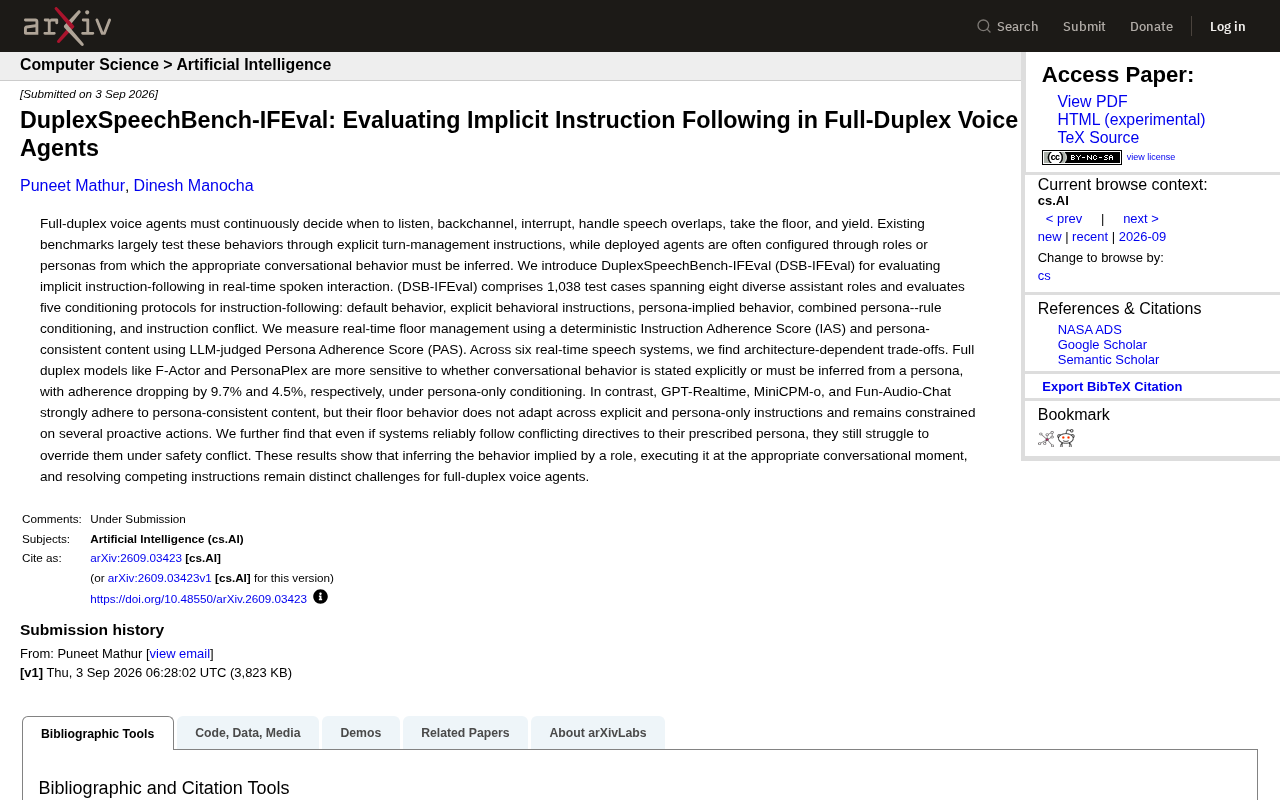
Implicit Instruction Following in Full-Duplex Voice Assistants: DSB-IFEval Benchmark Analysis
In-depth analysis of the DSB-IFEval benchmark reveals full-duplex voice assistants' capability gaps in implicit instruction following, persona reasoning, and conflict resolution. Covers comparative testing of six voice systems and examines behavioral vs. content trade-offs driven by architectural differences.
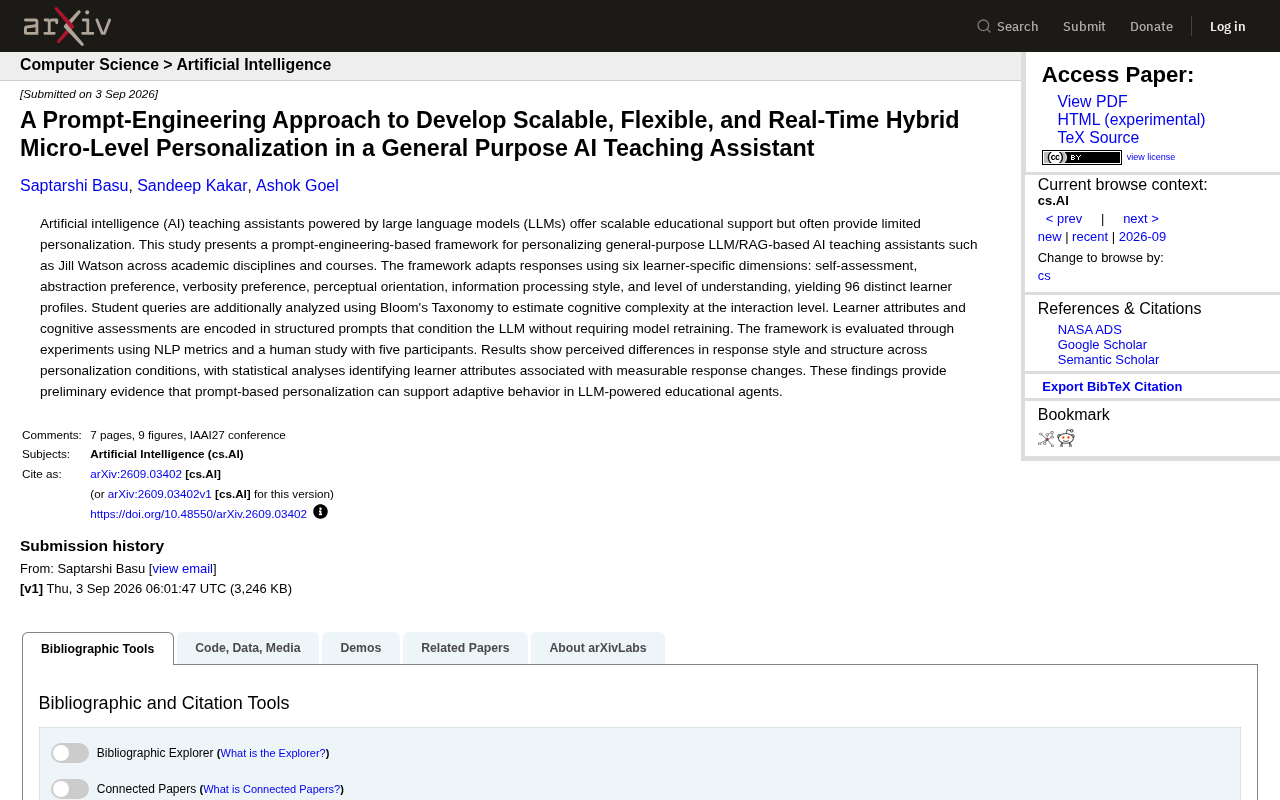
Personalizing AI Teaching Assistants with Prompt Engineering: A Deep Dive into the Six-Dimension Learner Profile Framework
Explore a prompt engineering framework for AI teaching assistants using six-dimension learner profiles and Bloom's Taxonomy to deliver 96 personalized teaching styles without model retraining.