IFA Berlin Tech Roundup: AI Empowers Every Category of Consumer Electronics
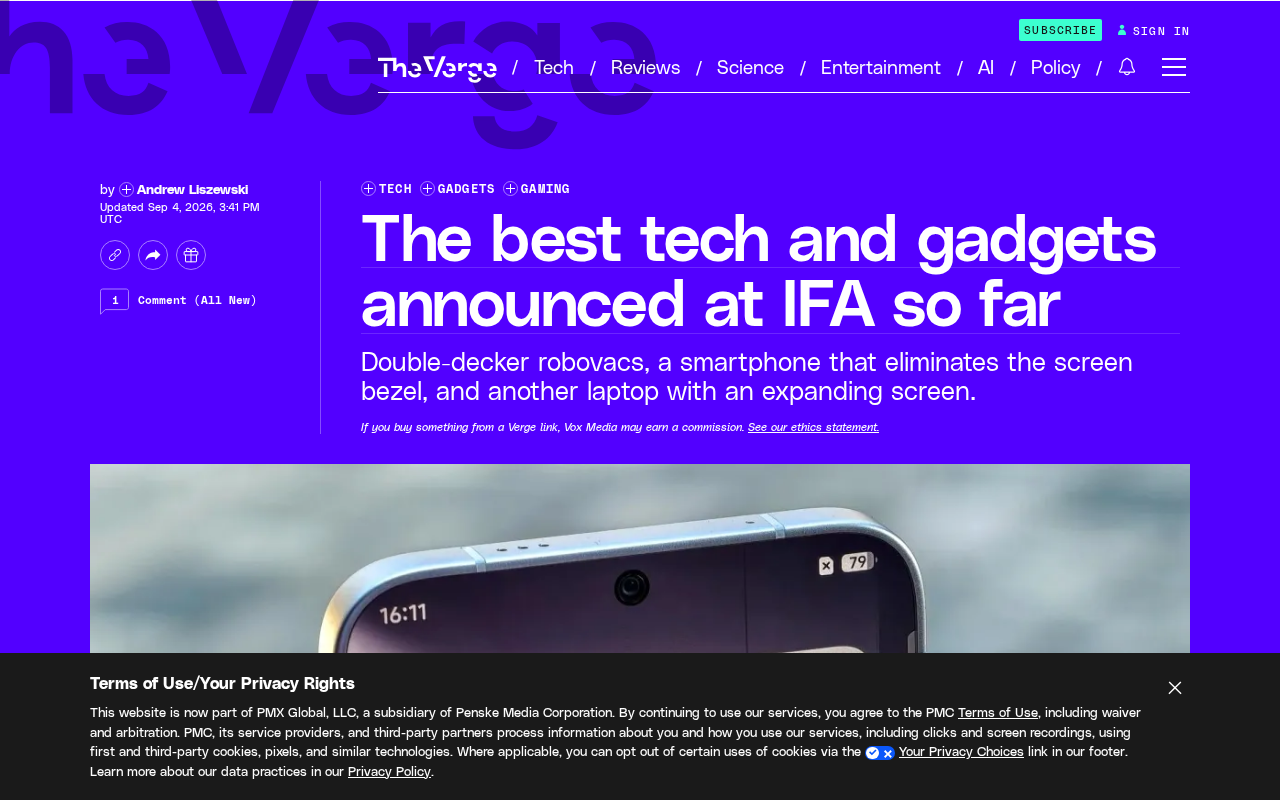
IFA Berlin 2024 highlights AI integration across smartphones, smart homes, wearables, and PCs.
IFA Berlin showcases how AI is becoming the foundational capability across all consumer electronics categories. Smartphones embrace on-device AI for privacy and offline functionality, smart homes accelerate ecosystem integration via Matter, wearables push toward near-medical-grade health monitoring, and AI PCs with dedicated NPUs emerge as the mainstream narrative, signaling a new era of intelligence in consumer tech.
IFA: Europe's Largest Consumer Electronics Show Returns
As Europe's largest consumer technology event, IFA officially opened its doors to the public this week in Berlin, Germany. IFA (Internationale Funkausstellung Berlin), or the "Berlin International Consumer Electronics Exhibition," traces its history back to 1924, making it one of the oldest consumer electronics shows in the world. Over nearly a century, IFA has witnessed multiple technological revolutions—from the radio era to the internet age—and many epoch-defining products have made their debut here. In the week leading up to the show, major manufacturers had already released a flurry of new product announcements, spanning smartphones to smart home devices, wearables to PC hardware, covering virtually every category of consumer electronics.
For readers following the tech industry, IFA has long been an important window for observing industry trends. Compared to CES (Consumer Electronics Show, held every January in Las Vegas), which is dominated by American companies, IFA's timing—just before the second-half consumer spending season—positions it as a strategic platform for manufacturers to showcase their fall and winter products and compete for year-end market share. IFA's European market positioning is more focused on local consumer needs, while also serving as a critical stage for Asian and European brands vying for influence in the European market. This year's show continues that tradition, with deep AI integration becoming the common thread across nearly all new products.
Smartphones & Mobile Devices: On-Device AI Becomes Standard
At this year's IFA, smartphones remain one of the most closely watched categories. Multiple manufacturers showcased flagship models featuring next-generation camera systems and on-device AI processing capabilities. One notable detail: more and more phones are shifting AI functions from the cloud to on-device processing, which not only reduces dependency on network connectivity but also offers better solutions for privacy protection.
The proliferation of on-device AI is driven by the continuous improvement in mobile chip computing power. On-device AI refers to performing artificial intelligence inference directly on the terminal device rather than relying on cloud servers. It depends on dedicated AI accelerator chips—such as Qualcomm's Hexagon NPU, MediaTek's APU, and Apple's Neural Engine—which can execute tens of trillions of operations per second (TOPS) at extremely low power consumption. The prerequisite for this capability is the maturation of model compression and quantization techniques, which allow large models that previously required GPU clusters to run to be streamlined for smooth execution on mobile chips. When phones can run reasonably large-scale models locally, features like real-time translation, image generation, and intelligent summarization can operate smoothly even without an internet connection. This trend is redefining what consumers expect from a "smart" phone—AI is no longer an add-on selling point but a core part of the experience.
From Spec Wars to Experience Competition
In recent years, the smartphone industry was caught up in spec wars over camera megapixels, screen refresh rates, and similar metrics. But the products showcased at this year's IFA reveal a clear shift: manufacturers are placing greater emphasis on AI-driven real-world use cases, such as intelligent photo post-processing and cross-app voice assistant collaboration. This transition from "spec stacking" to "letting the experience speak for itself" reflects an industry that is maturing.
Smart Home & Wearables: Accelerating Ecosystem Integration
IFA has always been a premier showcase for smart home products. At this year's event, everything from smart speakers and smart lighting to home security systems emphasized tighter ecosystem interconnectivity and smarter automation capabilities. As cross-brand interoperability standards like Matter continue to roll out, compatibility issues between devices from different manufacturers are being addressed, further lowering the barrier for consumers to build whole-home smart systems.
Matter is a smart home interoperability protocol led by the Connectivity Standards Alliance (formerly the Zigbee Alliance), with version 1.0 officially released in 2022. The protocol's core objective is to solve the long-standing fragmentation problem in the smart home industry—in the past, consumers buying smart devices from different brands often needed to install multiple apps, configure multiple control hubs, and found it difficult to create cross-device automation. Built on IP protocols, Matter supports communication methods including Wi-Fi, Thread, and Bluetooth Low Energy (BLE), and has gained support from virtually every major tech giant including Apple, Google, Amazon, and Samsung. As Matter iterates through versions 1.3, 1.4, and beyond, the range of supported device categories continues to expand—from light bulbs and smart plugs to robot vacuums and cameras—making truly comprehensive whole-home smart systems increasingly within reach.
The wearables space is also full of highlights. Next-generation smartwatches and health monitoring devices show notable improvements in sensor accuracy, battery life, and health data analytics. The introduction of AI algorithms enables these devices to provide more personalized health recommendations, rather than simply recording data.
Health Monitoring Approaches Near-Medical Grade
One direction worth watching is how consumer-grade wearable devices are moving toward near-medical-grade monitoring. Monitoring accuracy for metrics like blood pressure, blood oxygen, and sleep breathing patterns continues to improve, with some products even beginning to collaborate with professional medical institutions.
From a technical evolution perspective, consumer-grade health monitoring has gone through multiple leaps—from pedometers to photoplethysmography (PPG) sensors, then to bioelectrical impedance analysis (BIA) and miniature radar sensors. Take blood pressure monitoring as an example: the traditional oscillometric method requiring an inflatable cuff is being replaced by cuffless solutions based on pulse transit time (PTT), though the accuracy of the latter remains an ongoing challenge for the industry. Notably, on the regulatory front, if a device claims medical-grade diagnostic capabilities, it must obtain approval from national drug regulatory authorities—such as the FDA's 510(k) clearance in the United States or the EU's CE-MDR medical device certification. This means manufacturers must find a clear product positioning between "consumer-grade health reference" and "medical-grade diagnostic tool." This is both a testament to technological progress and a sign that the boundaries between consumer electronics and healthcare are becoming increasingly blurred.
PCs & Hardware: AI PC Becomes the Mainstream Narrative
In the personal computer space, "AI PC" is undoubtedly the hottest keyword at this year's IFA. Laptops equipped with dedicated NPUs (Neural Processing Units) have become the flagship products pushed by major PC manufacturers. An NPU is a processor architecture specifically optimized for neural network inference tasks. Unlike the general-purpose computing of traditional CPUs or the parallel floating-point computing of GPUs, NPUs deliver extremely high energy efficiency in core AI operations such as matrix multiplication and convolution. In the current AI PC wave, representative chips include Qualcomm's Snapdragon X Elite (with an integrated Hexagon NPU delivering 45 TOPS), Intel's Core Ultra series (with the integrated Intel AI Boost NPU), and AMD's Ryzen AI series (with the integrated XDNA architecture NPU). These devices can efficiently run AI tasks locally, delivering smoother intelligent experiences across productivity, creative, and entertainment scenarios.
With deep operating system-level support for local AI capabilities—for example, Microsoft's Copilot+ PC certification standard requires devices to have NPU computing power of at least 40 TOPS, and Windows now includes built-in features like Recall and Cocreator that rely on local AI—AI PCs are no longer just a marketing concept. Whether it's real-time captions, image processing, or localized intelligent assistants, users can directly feel the tangible benefits of hardware computing upgrades. AI capabilities are sinking from the application layer down to the operating system and hardware layer, becoming foundational infrastructure for the PC platform. This wave of product iteration is likely to drive a new PC upgrade cycle.
AI Runs Through It All: Consumer Electronics Enters a New Era of Intelligence
Looking across all the new products at IFA, one clear theme runs throughout—artificial intelligence has evolved from a differentiating feature of a few high-end products to a foundational capability spanning every category. Whether it's smartphones, wearables, smart home devices, or PCs, on-device AI is becoming a key benchmark for measuring product competitiveness.
For consumers, this means future tech products will better understand their needs while placing greater emphasis on privacy and real-time responsiveness. For the industry, the competition around AI deployment capabilities has only just begun. What IFA showcases may well be an important microcosm of the consumer electronics industry's transition into a new era of intelligence.
Key Takeaways
Related articles
Clockwork: Schedule AI Coding Agents on Your Calendar for Unattended, Automated Execution
Clockwork schedules AI coding agents on your calendar for unattended execution, featuring git worktree sandboxing, risk-based approval pauses, and transparent API cost reports.
Fairphone 6+ Deep Dive: The Ideals and Realities of a Repairable, Modular Smartphone
Deep dive into Fairphone 6+'s modular design, 8-year update promise, ethical supply chain practices, and the real challenges facing repairable sustainable smartphones.
Inline: The Multiplayer Chat Tool That Brings AI Agents Into Team Collaboration
Inline is an AI-native, thread-based team chat tool that lets AI agents collaborate alongside team members. We analyze its positioning and challenges in the Slack-dominated messaging space.