Imejis.io: A Deterministic Design Studio for AI Agents

Imejis.io brings deterministic image rendering to AI Agents via MCP, closing the visual gap in marketing automation.
Imejis.io is an image generation tool positioned as a "design studio for Agents," using MCP (Model Context Protocol) to give AI Agents like Claude, ChatGPT, and Cursor direct access to image creation, editing, and rendering. Its core differentiator is deterministic rendering — same input, same pixels — unlike diffusion models such as Midjourney, ensuring consistent brand typography, layout, and data presentation. It supports OG images, social cards, charts, QR codes, and more under a "design once, generate at scale" model, targeting developers building automated marketing workflows rather than end-user designers. It launched on Product Hunt (Vercel Day, #13) with a free-to-start plan.
When AI Finishes the Copy, Who Handles the Visuals?
Generative AI has gotten remarkably good at helping marketing teams draft tweets and landing page copy — but the other half of content marketing, visual assets, has never been properly automated. No matter how fast the copy gets generated, the image-creation step still requires a designer's manual touch or a call to an unreliable image generation model. Imejis.io is built to close that gap: letting AI Agents not only write the copy, but deliver the visuals alongside it.
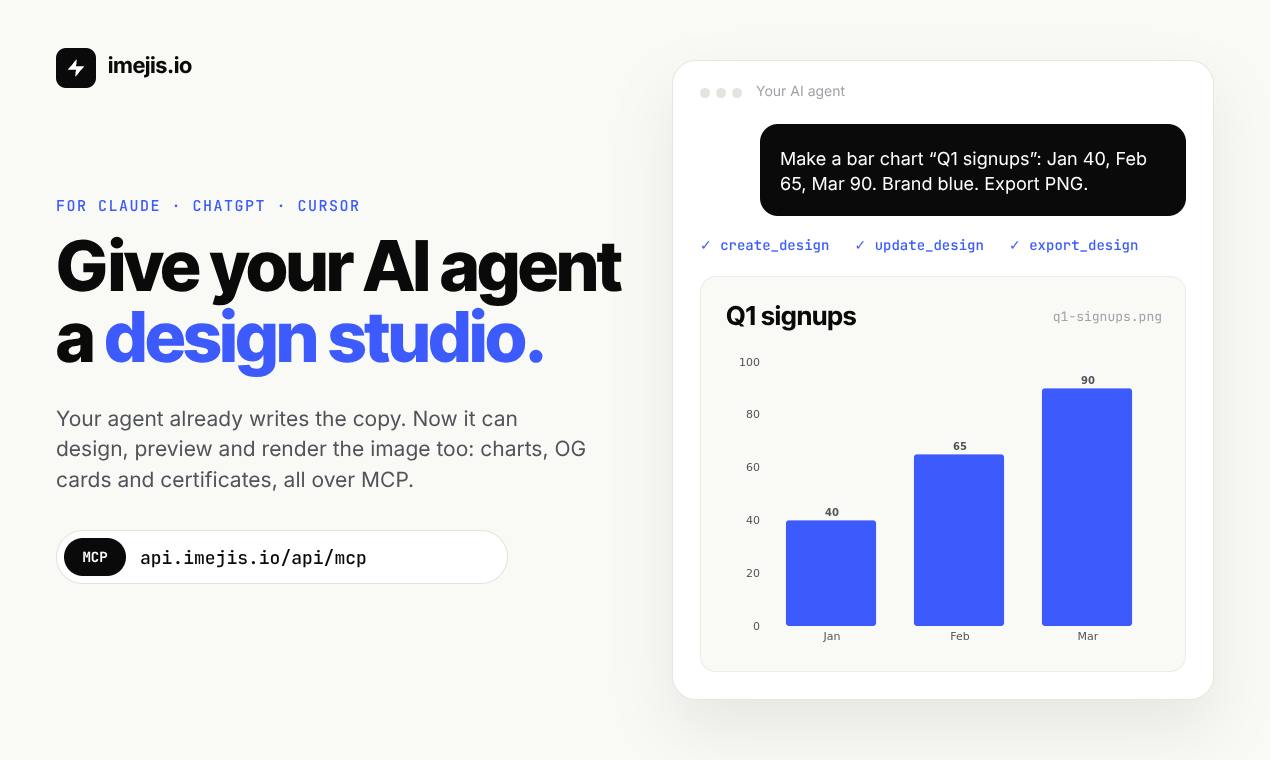
This tool, which launched on Product Hunt (ranked #13 in the Vercel Day category with 78 upvotes), positions itself as a "design studio for Agents." It uses MCP (Model Context Protocol) to give AI Agents like Claude, ChatGPT, and Cursor the ability to create, edit, preview, and render images — enabling Agents to handle the full pipeline from text to finished graphic, end to end.
The Core Pitch: Deterministic Rendering, Not a "Gacha Roll"
Imejis has one fundamental difference from mainstream generative image models: determinism.
When you generate images with diffusion models like Midjourney or DALL·E, even identical prompts produce different pixels every time. For brand marketing that demands consistency, this is a real problem — logos drift out of position, fonts go inconsistent, data visualizations get distorted. Imejis emphasizes "same input, same pixels," meaning a brand's typography, fonts, data, and layout stay stable and predictable.
This positioning matters. It pulls Imejis out of the "AI art tool" category entirely and places it in the realm of programmatic image generation — closer to template- and data-driven batch production of uniformly formatted graphics than to probabilistic sampling that hopes for the best. For marketing asset workflows that require scale and can't afford errors, this kind of determinism is exactly what's needed.
A note on Programmatic Image Generation: This technical approach predates the AI image boom and is already well established. Its core logic treats images as structured outputs composed of templates, variables, and rendering rules — not probabilistic pixel sampling. Tools like Vercel's
@vercel/oglibrary, Bannerbear, and Placid follow the same pattern: developers define templates in HTML/CSS, pass dynamic data via API, and a server-side headless browser (like Puppeteer) or Canvas engine renders the final image. This approach is naturally suited to batch production because the rendering process can be precisely controlled and replayed. Imejis wraps this capability in MCP, essentially plugging mature programmatic rendering into Agent workflows — without requiring developers to build their own rendering infrastructure from scratch.
What It Can Do: From OG Images to QR Codes
According to its official description, Imejis supports a broad range of graphic types:
- OG images: Social preview images for link sharing
- Social cards: Cards formatted for social media platforms
- Marketing graphics: Promotional visuals
- Charts: Data visualizations
- Certificates: Award and completion certificates
- QR codes: Scannable codes
These are exactly the asset types that content and engineering teams use frequently and often need to generate at scale. The product's logic can be summed up in one line: "Design once. Generate at scale." — define your template and styles once, then use variable injection and data-driven rendering to batch-produce hundreds or thousands of consistently formatted images.
MCP Integration: The Tool Interface for the Agent Era
Imejis's technical approach reflects a clear trend: building Agent-callable capabilities around MCP.
As the standard protocol connecting AI Agents to external tools, MCP is quickly becoming the key infrastructure for giving Agents the ability to act in the world. By packaging design capabilities as an MCP service, Imejis means developers don't need to assemble their own image rendering pipelines — Agents can call it directly within a conversation or workflow to produce visuals on demand. This also explains why it's listed under three tags — Design Tools, API, and Developer Tools — because it functions as both a design tool and an API service for developers and Agents.
In terms of product positioning, Imejis isn't targeting end-user designers. It's targeting developers building automated marketing workflows and the broader AI Agent ecosystem. As Agent capabilities continue to expand, "copy + visuals" as a single automated unit will become the standard for content marketing — and Imejis is trying to own the visual generation step.
A note on MCP: Model Context Protocol was proposed and open-sourced by Anthropic in late 2024, with the goal of standardizing how AI models communicate with external tools and data sources. Before MCP, every AI application had to write its own integration code for each tool separately — high maintenance overhead, low reusability. MCP is like the USB port for software: it defines a universal slot so Agents like Claude and ChatGPT can access file systems, databases, third-party APIs, and other external capabilities through a consistent interface. Developers simply wrap their service as an MCP Server, and any MCP-compatible Agent client can discover and call it immediately. Tools like Cursor and Claude Desktop already support MCP, making MCP-based service development the dominant integration pattern in the Agent ecosystem. Imejis's choice to use MCP as its core interface is essentially a bet that this protocol will become the de facto standard for the Agent tool layer.
A Few Things Worth Watching
Imejis currently offers a free-to-start plan, lowering the barrier to experimentation. Its value proposition is clear: in the wave of Agent automation, it fills the gap around visual consistency.
That said, as a product that just launched, its actual rendering quality, template flexibility, and maturity of integration with major Agent platforms all remain to be proven — there are currently only 2 reviews on Product Hunt, so the user feedback sample is still very small. For teams with high-volume image generation needs who care about brand consistency, it's worth adding to a watchlist for a while.
If generative models solve for creative variety, Imejis is betting on production determinism. In the specific context of marketing automation, the latter might be the more pressing need.
Related articles

AI Reverse-Engineers Monitor Firmware in 15 Minutes — Has the Hacking Barrier Been Flattened?
A security researcher used AI to reverse-engineer Dell monitor firmware in 15 minutes—entropy analysis, key extraction, MD5 verification—revealing encryption design flaws.

Mistral Voxtral 3: Real-Time Voice at 4 Cents per Minute, Challenging OpenAI
Mistral Voxtral 3 cuts real-time voice agent costs to 4 cents per minute, bundling three speech recognition models, a speech generation model, and a real-time voice toolkit, supporting 50+ languages and self-hosting. This article analyzes its pricing structure, sub-second response performance, and its strategic divergence from OpenAI and Gemini on data privacy versus out-of-the-box convenience.

WebMCP: Every Website as Its Own MCP Server, So AI Agents No Longer Rely on Screenshots
WebMCP lets websites expose tools via the document.modelcontext API, becoming directly callable MCP servers. This article explains its architecture, the Claude Code remote-debugging demo, Chrome's current support stage, and its impact on the agent ecosystem.