ImpactGate: A Merge Gate That Scores Structural Decay in AI-Generated Code
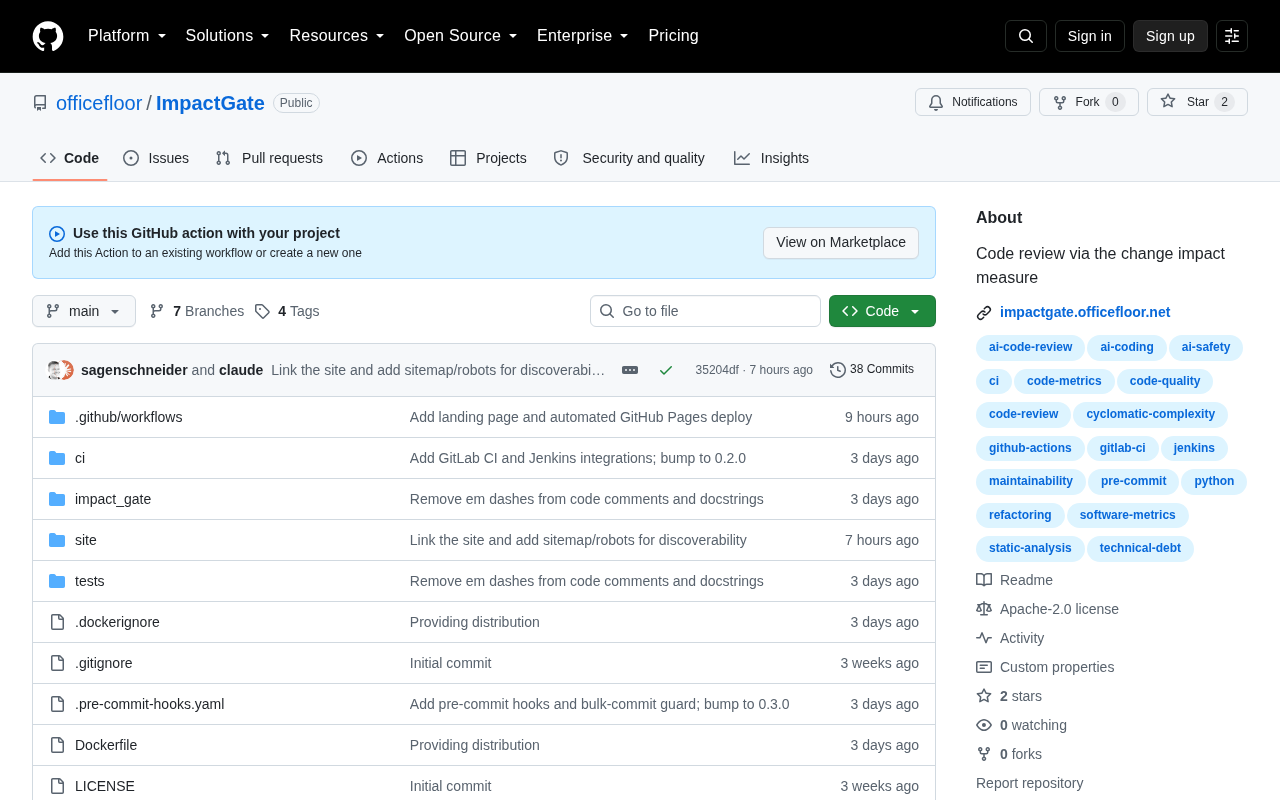
ImpactGate is a merge gate that scores and blocks structural decay introduced by AI-generated code.
As AI coding assistants like Copilot and Cursor become widespread, codebases face a new risk: AI-generated code that is functionally correct but quietly erodes structural health through duplicated logic, hidden coupling, and abstraction drift. ImpactGate is a merge gate tool that quantifies this structural decay before AI-generated code lands in the main branch, using a graduated scoring system to auto-approve, flag for review, or block changes. Its core value lies in translating the vague notion of "code health" into actionable engineering metrics. However, as an early-stage project with low community traction, it still faces significant challenges around the subjectivity of structural quality definitions, false positive rates, and integration with platforms like GitHub and GitLab.
Who Guards the Architecture When AI Writes the Code
Generative AI is entering software development pipelines at an unprecedented pace. Copilot, Cursor, and various coding agents produce massive volumes of code every day, with productivity gains that are clearly visible. But a growing concern is becoming harder to ignore: AI-generated code is often functionally correct, yet quietly erodes the structural health of the entire codebase.
ImpactGate is a proposed solution to this problem — a "merge gate" whose core mission is to quantify the structural decay introduced by AI and either block or flag code before it lands in the main branch.
A quick note: this article is based on a Hacker News submission with minimal traction at the time of writing (3 points, 0 comments), so source information is limited. What follows is largely an analytical take on this category of tooling and the problem it addresses.
What Is "Structural Decay"?
The concept of software "rot" is nothing new. Technical debt, rising cyclomatic complexity, increased module coupling, blurred abstraction layers — all of these fall under structural decay. The difference now is that in the past, these issues accumulated gradually under time pressure from human developers. Today, AI can generate code in seconds that appears reasonable on the surface but undermines architectural consistency.
Typical AI-introduced decay includes:
- Duplicated logic: AI tends to generate code inline rather than reusing existing abstractions, leaving similar logic scattered throughout the codebase.
- Inconsistent patterns: Within the same project, AI may apply completely different implementation styles across different files.
- Hidden coupling: To make a feature work quickly, AI often introduces direct cross-module dependencies that violate established boundaries.
- Abstraction drift: As large volumes of AI code flow in, a project's originally clean layered design gradually becomes murky.
None of these issues looks serious in isolation. Accumulated over time, however, they significantly degrade the maintainability of a codebase.
Cyclomatic Complexity is one of the most widely used quantitative metrics for code structural health, proposed by Thomas McCabe in 1976. It measures the number of linearly independent paths through a program's control flow graph — every additional branch, loop, or exception handler increases the score. The industry generally treats 10 as a warning threshold for a single function, with anything above 20 considered extremely difficult to maintain and test. A common issue with AI-generated code is the tendency to inline multiple conditional branches into a single function to deliver a feature in one completion, causing cyclomatic complexity to creep upward without triggering any compilation errors or functional test failures.
Technical Debt, a metaphor coined by Ward Cunningham in 1992, likens poor engineering decisions to financial debt: borrowing in the short term (taking shortcuts) speeds up delivery, but you pay higher "interest" (maintenance costs) over time. AI accelerates the accumulation of technical debt because models generate code without a holistic understanding of the codebase's history and architectural intent — each independent completion can inadvertently introduce new debt.
ImpactGate's Core Approach
ImpactGate positions itself as a "gate" rather than a "checker" — it intervenes at the merge stage, sitting at the same level as lint and unit tests in a traditional CI pipeline, but targeting a different dimension.
Scoring Rather Than Binary Pass/Fail
The name ImpactGate emphasizes an "impact score." Compared to a binary pass/fail, assigning a structural decay score to each change better fits real-world engineering needs:
- Changes with low scores are automatically approved;
- Changes with elevated scores trigger a human review;
- Changes that exceed a threshold are blocked outright.
This graduated approach avoids the "false positive" problem common with strict gates, and lets teams calibrate thresholds to their own tolerance levels.
Purpose-Built for the AI Era
Notably, ImpactGate explicitly targets "AI adds" — content added by AI. This suggests its scoring logic may go beyond generic code quality metrics to specifically recognize patterns characteristic of AI-generated code — such as copy-paste-style duplication, unusual abstraction jumps, or patterns inconsistent with the project's existing conventions.
Merge Gate is a key concept in modern CI/CD pipelines, referring to a set of automated checks that a code change must pass before it can be merged into the main branch. Common merge gates include: unit test pass rates, code coverage thresholds, static analysis (lint) with no errors, and security vulnerability scanning. Unlike "soft suggestions," gates have hard-blocking power — a Pull Request that fails a check cannot be merged. The core value of this mechanism is shifting quality assurance from post-hoc fixes to pre-merge prevention. Deeply integrated with platforms like GitHub Actions and GitLab CI, every commit automatically triggers the check pipeline. ImpactGate's addition of architectural health to the gate framework essentially introduces a third dimension alongside the existing checks for "functional correctness" and "code style": structural integrity.
Why This Category of Tooling Is Becoming Necessary
As AI coding assistants proliferate, a structural contradiction has emerged: code output speed has increased dramatically, but human review bandwidth has not kept pace. When a developer must review several times as much AI-generated code per day, manually policing architectural consistency becomes practically infeasible.
This creates demand for a new class of tools — embedding an "architecture gatekeeper" role directly in the automated pipeline. ImpactGate represents exactly that direction:
- Translating the abstract notion of "code health" into a quantifiable score;
- Moving the evaluation upstream to the merge stage to prevent problems before they occur;
- Specifically adapting to the behavioral patterns of AI-generated code.
This contradiction has a well-established research framework in software engineering: Conway's Law states that a system's architecture tends to mirror the communication structure of the organization that built it. The introduction of AI assistants breaks this assumption — there is a fundamental cognitive gap between the code producer (AI) and the architecture designer (human). AI has no context from the architectural decision-making process and doesn't understand the business rationale behind specific abstractions. Meanwhile, LeBlanc's Law — "later equals never" — becomes even more dangerous in the AI era: when the volume of new code flooding in grows by multiples each day, "later" can never catch up with "now," and structural debt accumulates exponentially. This is the fundamental motivation for embedding automated architectural assessment directly into the pipeline.
A Measured Take: The Limits of an Early-Stage Project
As an early-stage tool with limited community traction, ImpactGate faces challenges that shouldn't be understated.
Defining "decay" is itself contested. Structural quality is highly subjective, and different teams have vastly different ideas of what constitutes "good architecture." Whether a general-purpose scoring model can accurately reflect a specific project's values requires real-world validation.
False positives are costly. If a gate tool frequently blocks legitimate changes, teams will quickly find ways around it or simply turn it off. The precision and interpretability of the scoring will directly determine whether it can actually stick in practice.
Integration with the existing ecosystem. To function as an effective merge gate, it must integrate seamlessly into the PR workflows of platforms like GitHub and GitLab — a significant bar for a tool's maturity to clear.
Closing Thoughts
ImpactGate reflects a real and increasingly urgent industry question: in an era where AI participates in coding at scale, how do we preserve long-term software maintainability? Its approach of translating the fuzzy concept of "structural decay" into a scorable, blockable engineering metric points in the right direction.
That said, based on the information currently available, this remains an early-stage exploration. How accurately it can measure AI's architectural impact — and whether engineering teams will actually adopt it — are questions that still need far more real-world data to answer. For teams drowning in AI-generated code, this category of "architecture gatekeeper" tooling is well worth keeping an eye on.
Related articles

AI Agent Fundamentals: The Three Core Components — Brain, Memory, and Tools
A beginner's guide to AI Agents: covering the three core components (brain, memory, tools), four stages of LLM deployment, and why Agents matter for real business use cases.

Boycotting Software That Doesn't Support Linux: One Developer's Philosophy of Choice
A Linux-only developer shares his philosophy of boycotting non-Linux software — without sacrificing productivity — and explains how coding agents like Claude Code are closing the gap with commercial tools.
Why Do All AI-Generated Projects Look the Same? The Aesthetic Homogenization Problem in Vibe Coding
Why do vibe coding projects all use purple gradients and dark glassmorphism? We break down the technical roots of AI aesthetic homogenization and how to escape it.