Implant: Letting AI Coding Assistants Directly Call VS Code APIs

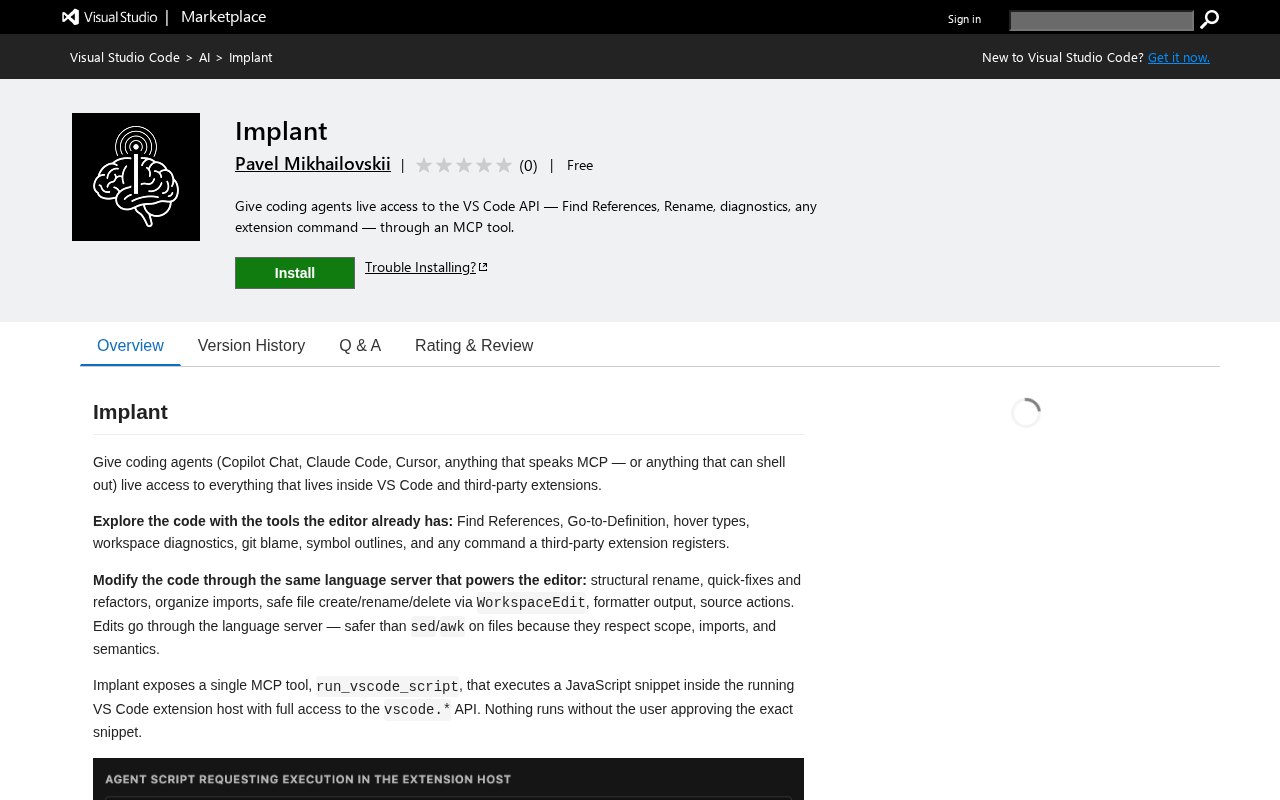
Implant is a VS Code extension that bridges AI coding agents with editor APIs like LSP for precise code operations.
Implant is an open-source VS Code extension that exposes the editor's internal APIs—including LSP-powered features like go-to-definition, safe renames, and diagnostics—directly to AI coding agents. Rather than having AI guess at code semantics from raw text, Implant lets agents leverage VS Code's existing understanding of code structure, significantly improving accuracy and reducing the need to reinvent analysis tools.
When Your Coding Assistant Truly "Lives Inside" Your Editor
As AI coding assistants rapidly gain popularity, developers have grown accustomed to letting large language models help write code, fix bugs, and refactor logic. However, most existing tools remain at the "text level" — AI generates code snippets, and developers manually copy-paste them, or interact with the editor through limited completion interfaces. Solutions that truly tap into the editor's internal capabilities remain rare.
A recently surfaced open-source project on Hacker News, Implant, aims to break through this limitation. It's a VS Code extension whose core goal is to expose the editor's rich APIs to coding agents, enabling AI to stop merely "looking at code through glass" and instead operate the editor just like a human developer would.
What Problem Does Implant Solve?
The "Capability Gap" Between AI and Editors
Modern IDEs provide extremely powerful programming interfaces: go-to-definition driven by the Language Server Protocol (LSP), find references, rename symbols, diagnostics, code completion, formatting, and more. These capabilities represent the editor's deep understanding of code semantics — precisely what pure text-based LLMs lack.
Current coding agents often need to "reinvent the wheel" — parsing files and guessing symbol meanings to understand code structure, which is both inefficient and error-prone. Implant's approach is straightforward: Since VS Code already has this semantic information through mechanisms like LSP, why not open these APIs directly to AI?
From "Generating Text" to "Operating the Editor"
As a VS Code extension, Implant acts as a bridge between AI agents and the editor's internal APIs. Through it, coding assistants can theoretically:
- Call LSP to obtain precise symbol definitions, type information, and reference relationships
- Trigger editor-level refactoring operations (such as safe renames)
- Read diagnostic information to understand real errors and warnings in the code
- Leverage the editor's project context rather than making inferences based solely on file content
This means every AI operation is built on editor-verified semantics rather than probability-based guessing.
Technical Positioning and Ecosystem Significance
Filling a Critical Gap in the AI Coding Agent Toolchain
Over the past year or two, infrastructure around AI coding agents has been rapidly taking shape. From standardized protocols like Model Context Protocol (MCP) to various tool-calling frameworks, the industry has been exploring how to let LLMs "perceive" and "operate" real development environments. Implant sits at the core of this trend — it transforms VS Code, an editor with a massive user base, into a "toolbox" that AI can call upon.
For teams building agents, the value of such extensions lies in reducing integration costs. There's no need to implement complex code semantic analysis from scratch — you can directly leverage the editor's existing capabilities to obtain high-quality contextual information.
The Possibilities Opened by Open Source
As an open-source project, Implant's greatest advantage is its extensibility and transparency. The developer community can freely customize which VS Code APIs to expose and how to organize the calling interfaces based on their agents' needs. This open model aligns with the current "Lego-ification" trend in AI toolchains — individual components can be freely combined to form solutions suited to different workflows.
You might not have noticed, but the project currently has relatively early-stage traction on Hacker News (5 points, 0 comments), indicating it's still in an early exploration phase. The actual maturity, stability, and documentation completeness of such projects remain to be observed.
Potential Challenges and Considerations
Security and Permission Boundaries
Exposing editor APIs to AI agents naturally raises security concerns. AI can read code, modify files, and execute refactoring — if these operations go out of control, they could cause code corruption or sensitive information leaks. Designing reasonable permission models, operation confirmation mechanisms, and rollback capabilities will be essential challenges these tools must address before reaching production environments.
Lack of Standardized Protocols
There's currently no unified standard for AI agent integration with editors. Implant uses a custom extension approach rather than a universal protocol. As standards like MCP gradually mature, such tools may need to choose between "proprietary integration" and "standard protocols," or redesign their architecture based on standard protocols.
Balancing User Experience
Letting AI deeply intervene in editor operations also requires striking a balance between automation and developer control. Are developers willing to let AI directly trigger renames and modify multiple references? This demands careful product-level design to prevent AI's "over-eagerness" from disrupting the human workflow.
Conclusion
Implant represents an important direction in the evolution of AI coding tools: moving from passive text generation to active editor operation. By opening VS Code's mature API capabilities to coding agents, it has the potential to significantly improve AI's accuracy in understanding and manipulating code.
Although the project is still in its early stages with limited traction, the problem it addresses — how to truly integrate AI into developers' tool environments — is precisely the direction the entire industry needs to keep pushing. For developers following the cutting edge of AI programming, open-source experiments like this are worth keeping an eye on — they may well be incubating the prototype of the next-generation intelligent programming paradigm.
Related articles

Uber Deploys ChatGPT Work Company-Wide: AI in the Workplace Enters the Scaled Implementation Phase
Uber deploys ChatGPT Work to 30,000+ employees, extending it from engineering to all roles. We analyze its expert-engineer pairing, end-to-end automation, and questions of AI control and power concentration—insights for scaling AI in the workplace.

Shift at Midnight Hands-On: When "ID Verification" Becomes Alien Hunting
Shift at Midnight blends ID verification with horror survival in a four-player co-op game. We break down its inspection mechanics and chaotic humor.

Zelensky Recounts the Outbreak of War: I Need Ammunition, Not a Ride
Zelensky recalls the first day of war in a YouTube interview: farewell to family, rejecting Biden's evacuation offer with "I need ammunition, not a ride," and how Bucha shaped his stance on compromise and peace talks.