Inbox Hero: Write Emails with Your Voice and Quarantine Scam Messages
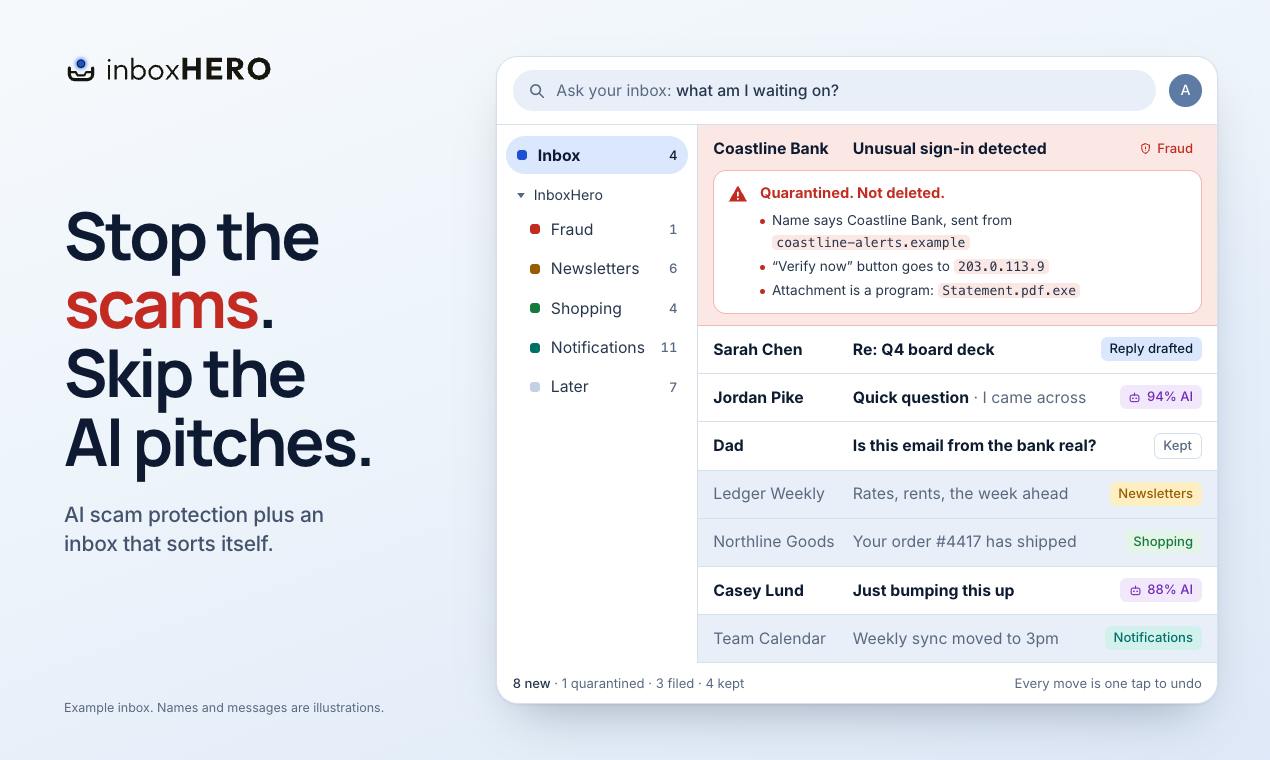
Inbox Hero drafts emails in your voice, quarantines scams, and detects AI writing—emphasizing human approval and controllable automation.
Inbox Hero is an AI tool on Product Hunt positioned as an "email co-pilot," developed by Michael Jones, with 64 votes and ranked 20th. Unlike mainstream one-click reply products, its core selling point is controllable automation: AI drafts replies based on the user's past style, but they must be reviewed and approved before sending. It quarantines suspicious scam emails instead of deleting them, showing the specific reasons they were flagged, and assigns each email an AI-writing score. It supports Gmail, Yahoo, iCloud, and AOL, focusing on reply efficiency, scam protection, and AI content identification.
In an era where AI writing tools are everywhere, most products teach you how to write "better" emails. But Inbox Hero, a new product on Product Hunt, takes the opposite approach—it doesn't write for you; instead, it drafts replies in your own voice, and nothing gets sent until you approve it.
This tool has received 64 votes on Product Hunt, ranking 20th, and was developed by Michael Jones. Its positioning is clear: it's not another AI email assistant, but an email co-pilot that respects your control.
Core Feature: The Draft Is Yours, and So Is the Decision
The most notable design philosophy of Inbox Hero is "human-AI collaboration" rather than "human replacement." It automatically generates reply drafts based on your past email style, but these drafts must be reviewed and approved by you before they're sent.
This forms a sharp contrast with many "one-click reply" tools on the market. The latter pursue maximum efficiency, while Inbox Hero pursues controllable automation—you still hold the final say, and AI just helps you get past the blank-page anxiety.
This design approach is especially important in email scenarios. Emails often involve business communication, client relationships, and personal matters, and a single inappropriate auto-reply could cause real damage. Inbox Hero minimizes risk with its "approve before sending" checkpoint.
"Human-in-the-loop" is a key pattern in AI product design: AI generates candidate outputs, humans review and make the final decision, and the system continues to learn or adjust based on human feedback. This pattern is especially important in high-risk scenarios like email, healthcare, and finance, because the cost of automated errors is often irreversible. The opposite is a "fully automated" process that maximizes throughput but shifts the cost of error correction onto the recipient. Inbox Hero's "approve before sending" essentially sets up a human confirmation checkpoint at the product level, leveraging AI's generation efficiency while preserving human judgment over tone, facts, and relationships—a classic example of controllable automation design.
Anti-Scam: Quarantine Rather Than Delete
Another highlight of Inbox Hero is its scam email handling mechanism. It doesn't directly delete suspicious emails; instead, it quarantines them in a separate area and shows the specific reason each email was flagged.
This is a very smart product decision. Directly deleting scam emails carries the risk of misjudgment—if the system misjudges a legitimate business email as a scam and deletes it, the user might never know what they missed. The quarantine mechanism both protects the tidiness of the inbox and preserves traceability.
Showing "why it was caught" is also commendable. It makes the AI's judgment process transparent, allowing users to learn the characteristics of scam emails rather than blindly relying on the system. This educational value is something many security tools overlook.
Email phishing is one of the most common entry points for cyberattacks. Attackers often impersonate trusted institutions to trick recipients into clicking malicious links or revealing credentials. Traditional spam filtering relies on sender blacklists, keyword rules, and content features, but modern scam emails increasingly use AI to generate highly customized, natural-sounding text that bypasses rule-based filters. Quarantine is a mature practice in security products: suspicious objects are moved to a controlled area—neither entering the main inbox nor being permanently destroyed—so administrators or users can review and restore them later. Compared to direct deletion, quarantine preserves the possibility of correcting misjudgments and also provides a basis for auditing and tracing, which is why it's widely adopted in both enterprise email gateways and personal security tools.
AI Detection: Scoring Email Origins
Inbox Hero also offers a feature that's very much of its time: assigning an AI-writing score to each email.
With AI-generated content becoming increasingly common, receiving an email written by AI is no longer novel. Inbox Hero tries to help users determine which emails were written by AI, and then categorize and organize the rest.
The use cases for this feature may be broader than you'd think. For example, in recruiting, HR can use it to quickly identify whether a candidate used AI to write their cover letter; in business partnerships, you can also use it to gauge the other party's sincerity and level of effort. Of course, AI detection itself has accuracy issues, and the actual effectiveness of this feature remains to be verified.
AI text detection tools typically determine whether text was generated by a large language model based on statistical features or machine learning models—for example, word frequency distribution, syntactic complexity, and perplexity. The principles behind these tools mean they can't be 100% accurate: on the one hand, non-native writers and polished formal prose are easily misjudged as AI-generated; on the other hand, once users rewrite AI output, detection difficulty rises significantly. OpenAI once pulled its AI text classifier due to accuracy issues, and academia has repeatedly pointed out systematic biases in detectors. Therefore, using AI-writing scores as a reference signal rather than a basis for judgment is the more reasonable approach—especially in high-stakes decision-making scenarios like recruiting and business, where conclusions should not be drawn from scores alone.
A Pragmatic Sample of an AI Product
Inbox Hero supports four major email providers: Gmail, Yahoo, iCloud, and AOL—a fairly mainstream coverage. In terms of positioning, it doesn't pursue the grand narrative of "fully automated email management," but instead focuses on three specific pain points: reply efficiency, scam protection, and AI content identification.
The data of 64 votes and 2 comments shows it's still in an early stage with limited visibility. But its product thinking is worth noting: in an era where AI capabilities are increasingly powerful, using AI with restraint and leaving control to users is itself a differentiated competitive advantage.
For knowledge workers who are drowning in emails every day but don't want to hand everything over to AI, Inbox Hero offers a compromise—AI drafts, you decide. This may be the form of AI assistant that most people truly need right now.
One-line Summary
Inbox Hero drafts emails in your voice, quarantines scams, and detects AI writing—emphasizing human approval and controllable automation.
Paragraph Summary
Inbox Hero is an AI tool on Product Hunt positioned as an "email co-pilot," developed by Michael Jones, with 64 votes and a rank of 20th. Unlike mainstream "one-click reply" products, its core selling point is controllable automation: AI drafts replies based on the user's past style, but they must be reviewed and approved by the user before sending. On the security side, it doesn't directly delete suspicious scam emails but quarantines them and shows the specific reasons they were flagged, balancing inbox tidiness with traceability. In addition, it assigns an AI-writing score to each email to help users identify AI-generated content, applicable to scenarios like recruiting and business. The product supports four major providers—Gmail, Yahoo, iCloud, and AOL—and focuses on three pain points: reply efficiency, scam protection, and AI content identification, rather than pursuing fully automated email management.
Related articles
Fear of AI Is Spreading: A Technologist's Confession
A Hacker News post 'I'm Scared of AI' sparks debate with 212 points and 247 comments, showing AI anxiety spreading from the public into the tech community itself.

Unkernel: Compiling the Linux Kernel to WebAssembly
The Unkernel project compiles a real Linux kernel to WebAssembly, making it possible to run a complete kernel in the browser. This article covers its technical principles, challenges, and prospects.
New Claude Sonnet Model Tested: Performance Approaches Opus with Less Thinking
Anthropic quietly tests a new Sonnet model in Claude Code—performance approaches Opus 5.5 with far fewer thinking tokens, plus Codex transfer optimization, xAI's low-level rewrite, Google Antigravity updates, and the AI science understanding gap.