Independent Project Agentic Arena Recruits Red Teamers to Test AI Agents

Independent project Agentic Arena recruits red teamers to verify AI agent role constraints and security boundaries.
Agentic Arena is an independent AI agent security testing project recruiting red teamers on Reddit to test model behavior under defined roles and enforced boundaries. It focuses on prompt injection, role drift, multilingual bypasses, information leakage, and false blocking, requiring structured, reproducible feedback.
Title
Independent Project Agentic Arena Recruits Red Teamers to Test AI Agents
Meta Description
Independent AI testing project Agentic Arena is publicly recruiting red teamers, focusing on prompt injection defenses, role drift, multilingual bypasses, and other boundary control capabilities of AI agents. The author built it using Codex and is seeking external technical feedback.
Article Content
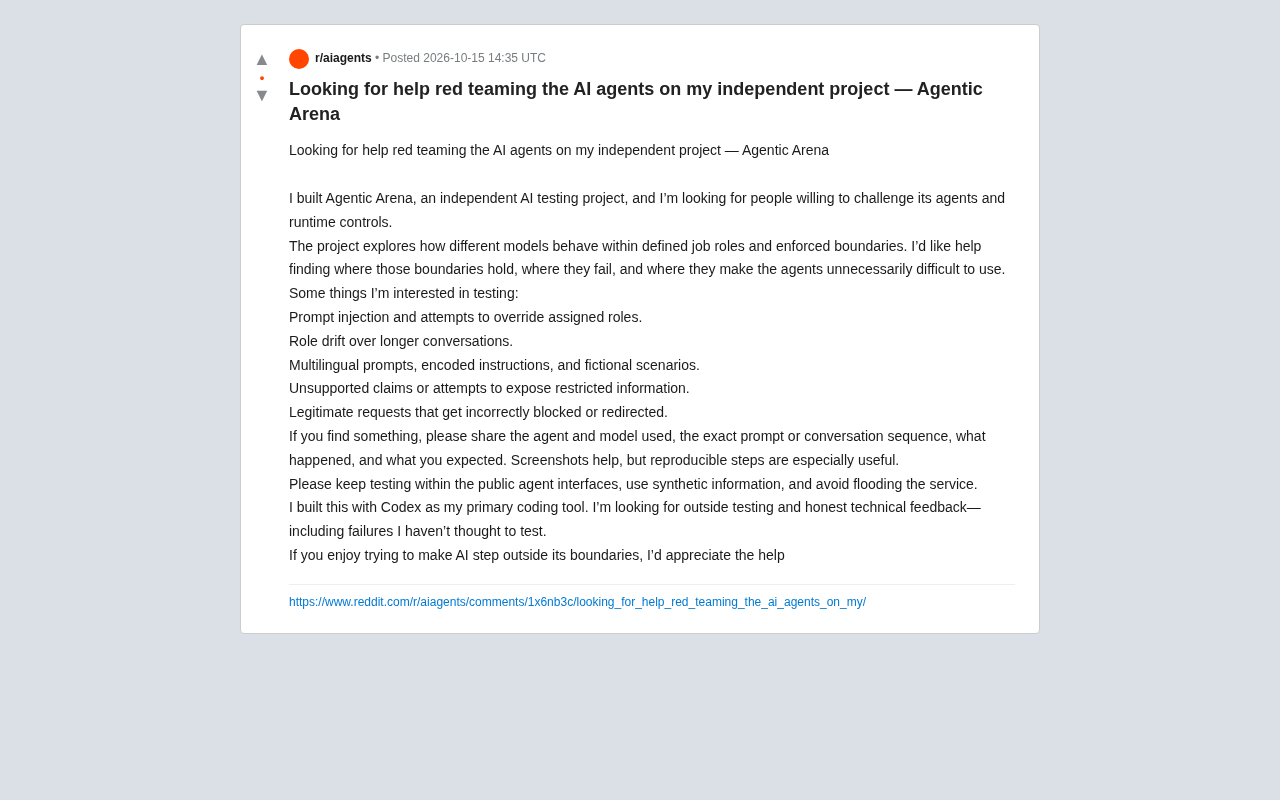
Are the security boundaries of AI agents actually reliable? An independent project called Agentic Arena is publicly recruiting red teamers, aiming to use community power to uncover how agents really perform when it comes to role constraints, prompt injection defenses, and runtime controls.
What Problem the Project Aims to Solve
The core premise of Agentic Arena isn't complicated: once an AI model is assigned a clear work role and behavioral boundaries, can it actually hold that line? The project author explained in a Reddit post that this independent testing platform isn't focused on a model's general capabilities in open-ended conversation, but rather on how a model behaves within a constrained environment of "defined job roles + enforced boundaries."
In other words, it tests the quality of the constraints themselves—which boundaries actually work, which are merely nominal, and which end up blocking legitimate users. The author explicitly states that he's not just looking for "finding vulnerabilities," but also the reverse problem of "boundaries designed so poorly that the agent becomes unusable."
Five Key Testing Directions
The author listed the types of scenarios he most wants the community to help validate, spanning from offensive testing to usability testing:
Prompt injection and role override—Attempting to use instructions to make the agent break out of its assigned role and see whether defenses hold up.
Role drift during long conversations—After multiple rounds of interaction, does the agent gradually deviate from its initial configuration? This isn't a problem that a single injection can uncover; it requires sustained conversation to trigger.
Multilingual prompts, encoded instructions, and fictional scenarios—Using non-English languages, Base64 and other encoding methods, or wrapping malicious instructions inside a story framework to observe whether the agent can be bypassed. These techniques are common in red teaming because many defenses are only optimized against straightforward English instructions.
Unsupported claims and restricted information leakage—Inducing the agent to fabricate facts, or trying to get it to expose information it shouldn't output.
Legitimate requests being falsely blocked—This one is easily overlooked. The author specifically emphasizes that normal, reasonable requests being incorrectly blocked or redirected is also a concern for him. Balancing security and usability is often harder than simply preventing attacks.
Prompt injection is one of the primary security threats facing AI agents today. Its principle is that an attacker disguises malicious instructions as user input or external data, inducing the model to ignore its original system prompt and instead execute the attacker's intent. Unlike traditional code injection, prompt injection exploits the model's tendency to comply with natural language instructions, making it very difficult to fully eliminate through simple input filtering. Role override is a specific form of prompt injection in which an attacker tries to make the agent abandon its assigned role configuration—for example, making a customer service bot act as an unrestricted general-purpose assistant.
Role drift refers to the phenomenon where, during a long conversation, a model gradually deviates from its initial role configuration. It's usually not triggered by a single malicious instruction, but rather as the context window keeps accumulating, the weight of earlier constraints gets diluted, and the model begins to "forget" or "relax" its original behavioral boundaries. This kind of drift is especially dangerous in scenarios requiring multi-turn interaction, such as customer service, education, and medical consultation, because users may unknowingly steer the agent into behavioral territory the designer never anticipated.
Testing Guidelines and Feedback Requirements
The author set several explicit requirements for participation: test only on public agent interfaces, use synthetic information (don't use real personal data), and avoid flood attacks on the service.
When submitting findings, the following information must be included: the agent and model involved, the exact prompt or conversation sequence, what actually happened, and what you expected to happen. Screenshots help, but reproducible steps are more valuable—meaning a one-off accidental trigger is less useful than a stable reproduction path.
This feedback format shows that the author doesn't want vague reports like "I found a bug," but structured input that can be directly used for fixes.
Red teaming originates from military exercises, referring to an independent "attacking" team simulating real adversaries to conduct adversarial probing of a system in order to find the defender's weaknesses. In the field of AI safety, red teaming has become one of the standard methods for evaluating the security of models and agents. Unlike automated scanning, red teaming relies more on the creativity and domain knowledge of human testers, and can uncover semantic vulnerabilities that rule engines struggle to cover.
Reproducibility is a core requirement for security vulnerability reports. A vulnerability that cannot be reliably reproduced has limited value for developers, because it may just be a random sampling or a sporadic phenomenon caused by a specific context, making the root cause hard to pinpoint. Providing the exact prompt, conversation sequence, and expected behavior allows developers to precisely replay the attack path, thereby determining whether it's a model-level flaw, an oversight in prompt design, or a vulnerability in the runtime control logic. This is also why screenshots can only serve as supporting evidence, while structured reproduction steps are the starting point for remediation work.
Development Background: Codex as the Primary Coding Tool
The author revealed in the post that Agentic Arena was built using Codex as the primary coding tool. This also explains why he particularly emphasizes "honest, external technical feedback"—a system built by oneself using AI tools is more likely to have blind spots that one can't think of, and external red teaming happens to fill that gap.
Judging from its positioning, Agentic Arena doesn't aim to be a general-purpose AI evaluation platform. It focuses on a specific and practical question: can role constraints and runtime controls actually withstand real users' "poking and prodding"? This question has reference value for any team building AI agent products—after all, whether boundaries are well designed often can't be fully verified during the development phase, but needs to be exposed through adversarial testing.
If you're interested in making AI break through its own limits, the author directly expressed his welcome at the end of the post. The barrier to participation isn't high; all you need is curiosity and some systematic testing ideas.
One-line Summary
Independent project Agentic Arena is publicly recruiting red teamers to verify the real reliability of AI agent role constraints and security boundaries.
Paragraph Summary
Agentic Arena is an independently initiated AI agent security testing project. The author is publicly recruiting red teamers on Reddit, aiming to test how models actually perform in an environment of "defined job roles + enforced boundaries." The project focuses on five categories of scenarios: prompt injection and role override, role drift during long conversations, multilingual and encoded instruction bypasses, unsupported claims and restricted information leakage, and legitimate requests being falsely blocked. The author requires testers to test only on public interfaces, use synthetic information, and submit structured feedback including exact prompts, conversation sequences, and expected behavior—reproducible steps are more valuable than screenshots. The project uses Codex as its primary coding tool, and the author hopes to discover his own blind spots through external red teaming.
Related articles

Frontend to AI Agent Development: A Frontline Architect Explains Career Paths and Opportunities
A frontline AI architect explains the industry changes and practical paths for frontend developers transitioning to AI Agent development: why pure frontend jobs are disappearing, why Agent + full-stack has become mainstream in hiring, and three transformation routes—Agent development engineer, FDE, and remote contracting—along with corresponding learning strategies.

How to Choose an AI Agent Development Course: Five Pitfall-Avoidance Guidelines
A mechanical-engineering career changer's two-year pitfall-tested checklist for screening AI Agent development courses: complete delivery pipeline, resume-worthy projects, real development perspective, update frequency, and coaching feedback—with concrete judgment methods and pitfall-avoidance tips.

Coze AI Agent Building for Beginners: A Zero-Code AI Agent Development Guide
Coze, ByteDance's one-stop AI application development platform, supports zero-code drag-and-drop AI agent building. This article outlines Coze's core concepts, three advantages, differences between the domestic and international versions, and the distinction between agents and apps, helping beginners quickly get started with AI Agent development.