Indian Salesperson Seeks n8n Automation Partners: Commission Split Model Draws Attention
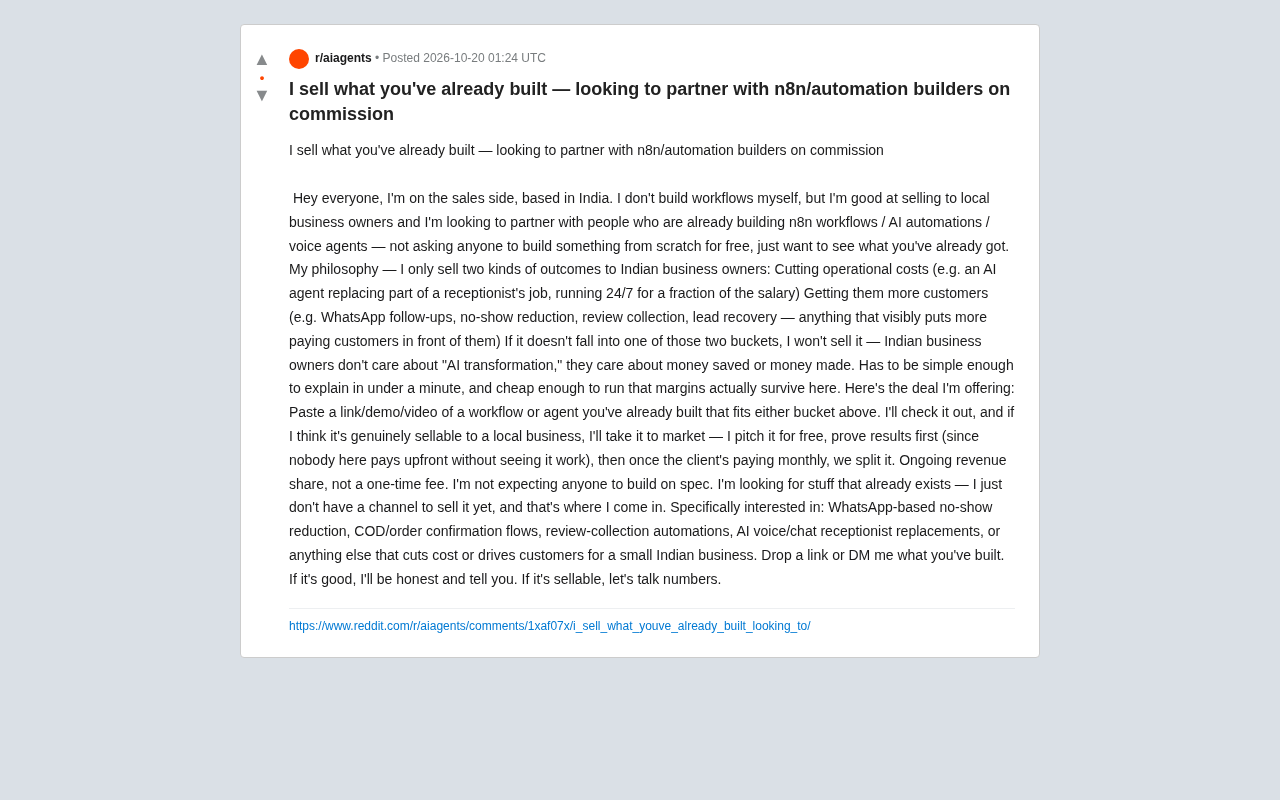
Indian salesperson sells ready-made n8n workflows on commission split, revealing AI automation's path to market.
The article discusses a Reddit post by an Indian salesperson seeking to partner with n8n/automation builders on a commission-split model to sell ready-made workflows, AI automations, and voice agents. His pragmatic pitch focuses only on solutions that save money or make money for SMBs, highlighting scenarios like WhatsApp automation and AI voice reception, and offering a referenceable path for automation solutions to enter price-sensitive SMB markets.
In an era where automation tools are increasingly widespread, how to turn technical capabilities into commercial value has become a pain point for many developers. Recently, a post on Reddit by an Indian salesperson sparked discussion: he is looking to partner with n8n/automation builders to sell ready-made workflow solutions on a commission-split model. The post not only reveals an emerging collaboration model but also reflects the logic behind how AI automation lands in the SMB market.
Collaboration Model: Ready-Made Solutions + Sales Channels
The poster makes it clear that he is not a developer but a sales specialist based in India who excels at pitching to local business owners. Rather than having developers build from scratch, he wants to find already-developed n8n workflows, AI automations, or voice agents that he can take to market. The process is clear: the developer provides a demo link or video, he assesses sellability, pitches for free, and once results are proven, they split revenue monthly. This model reduces the developer's market risk while leveraging the local salesperson's channel advantages.
n8n is an open-source workflow automation tool that uses a node-based visual editor, allowing users to connect different apps, APIs, and services by dragging and dropping nodes—completing data flows and task automation without writing much code. It supports self-hosting, so running costs are controllable, and it has an active community node ecosystem that can connect to common tools like WhatsApp, Google Sheets, and CRMs. Compared with SaaS products like Zapier, n8n has less billing pressure per workflow execution, making it suitable for building reusable, batch-deliverable automation solutions. For the collaboration model in this case, n8n workflows can be exported as JSON files, making them easy to demo, replicate, and deliver—this is precisely the technical prerequisite that makes "ready-made solutions + sales channels" viable.
Sales Philosophy: Only Sell "Save Money" or "Make Money"
This salesperson has a distinct sales philosophy: only pitch two outcomes to Indian business owners—lower operating costs or more customers. For example, replacing part of receptionist work with AI agents that run 24/7 at a fraction of salary costs; or directly boosting customer volume through WhatsApp follow-ups, reducing no-shows, collecting reviews, and lead recovery. He puts it bluntly: "Indian business owners don't care about 'AI transformation'—they only care about how much money they save or make." This pragmatic orientation is worth developers' consideration: no matter how advanced the technology, if it can't be translated into quantifiable business value, it will struggle to gain a foothold in price-sensitive markets.
Target Scenarios: WhatsApp Automation and Voice Agents
The post lists specific automation scenarios of interest: WhatsApp-based no-show reduction, COD/order confirmation flows, automated review collection, AI voice/chat receptionist replacement, and more. What these scenarios share is that they are directly tied to revenue or costs and are easy to explain to small business owners. For example, a clinic can automatically remind patients of appointments via WhatsApp, reducing revenue loss from no-shows; e-commerce sellers can automate order confirmations to lower return rates. These needs are particularly prominent in the Indian market because WhatsApp is the primary communication tool, and labor costs are relatively low but efficiency problems are significant.
WhatsApp Business API is Meta's official interface for businesses, allowing companies to programmatically send template messages, notifications, and conduct two-way conversations. Unlike the regular personal version of WhatsApp, the Business API requires business verification and message template review, and is billed by conversation type. By connecting this API through automation tools like n8n, you can automatically trigger flows such as appointment reminders, order confirmations, and review collection. Since WhatsApp has hundreds of millions of users in India and is the primary channel for business-to-consumer communication, automation solutions based on this interface enjoy high acceptance and explainability in the local market—which is why the post lists WhatsApp automation as the top scenario.
Implications for Developers: Productization and Channel Partnerships
For developers of automation tools like n8n, this post offers a new idea: instead of burying yourself in building general-purpose tools, it may be better to refine reusable workflows for specific vertical scenarios and find local sales partners. The post emphasizes "simple enough to explain in under a minute" and "low enough running costs to maintain margins," which requires developers to focus on productization and cost control in their design. At the same time, the commission-split model means developers don't need upfront marketing spend and can focus on the building work they're good at. This division of labor may accelerate the penetration of automation solutions into SMBs.
Revenue share (commission split) is a results-oriented collaboration model: the developer provides the product, the sales party handles customer acquisition and closing, and both parties share revenue according to an agreed ratio. Compared with one-time buyouts or upfront agency fees, this model reduces the sales party's upfront capital pressure and relieves developers of fixed marketing costs. In SaaS and automation services, common split ratios range from 10% to 30%, depending on the customer acquisition and after-sales responsibilities borne by the sales party. The key to this model lies in performance measurement and settlement transparency, typically requiring subscription management or payment-splitting tools to record each transaction and avoid reconciliation disputes in cross-regional collaborations.
Market Context and Potential Challenges
The Indian SMB market is price-sensitive but has strong demand. According to the poster's observations, many business owners are willing to pay for visible results but reluctant to take on upfront risk. Therefore, he adopts a "prove results first, then charge" strategy. For developers, this means providing reliable demos or pilot solutions. The challenges lie in ensuring automation solutions run stably across different businesses and in measuring results and splitting revenue fairly. In addition, trust and communication costs in cross-regional collaboration cannot be ignored.
Overall, this post reflects a key link in the AI automation implementation process: the bridge between technology supply and market demand. For developers with ready-made workflows, this collaboration model may be worth borrowing to open markets with the help of local sales forces.
One-line Summary
An Indian salesperson sells ready-made n8n workflows on a commission-split model, revealing a path for AI automation implementation.
Paragraph Summary
The article centers on a Reddit collaboration post by an Indian salesperson, exploring how AI automation tools can be turned into commercial value. The poster is not a developer but a sales specialist skilled at pitching to local business owners; he seeks to partner with n8n/automation builders to sell already-developed workflows, AI automations, or voice agents on a commission-split model. His sales philosophy is highly pragmatic: only pitch solutions that directly lower operating costs or increase customer revenue. The article analyzes specific scenarios such as WhatsApp automation and AI voice reception, and notes that this division of labor—"developers focus on building, sales handles channels"—offers a referenceable path for automation solutions to enter the price-sensitive SMB market, while also highlighting challenges such as stability, performance measurement, and cross-regional trust.
Related articles

LLaMA-Factory in Practice: A Complete No-Code Guide to Fine-Tuning Large Models
An introduction to LLaMA-Factory, the open-source fine-tuning tool: its 60.1K-star background, supported models and algorithms, local vs. cloud deployment, and CUDA setup steps.

Zeng Ming's Deep Retrospective: Why OpenAI May Not Be the Ultimate Winner — and Why the Corporate System Will Disappear
Zeng Ming's deep retrospective on the AI endgame: model companies are just infrastructure, OpenAI and Anthropic won't be the final winners; the next battle is the Agent entry point standard; the corporate system will disappear as AI restructures collaboration, and only mission-driven companies can survive the cycle.

OpenHands v1.28.0: OpenCode and PI Added as Built-in Agents, API Keys Requestable In-Conversation
OpenHands ships 5 releases in 21 days: v1.27.0 adds OpenCode and PI as built-in agents, v1.28.0 enables in-chat key requests. ACP integration, credential reuse, model list changes, and upgrade advice.