Inkling 2 Mini Hands-On: 26B Looped Transformer Beats Qwen 3.8 27B

26B looped-transformer open model Inkling 2 Mini beats Qwen 3.8 27B on local coding but lags in dialogue.
Thinking Machines' Inkling 2 Mini is an Apache 2.0 open-weight 26B model with a looped transformer architecture activating only 5.4B parameters per token. It scores 20.1 on Artificial Analysis's intelligence index, sitting on the Pareto frontier of intelligence vs. active parameters. It outperforms Qwen 3.8 27B on agentic coding and Three.js frontend generation (DeepSway 48.2%, SwayBenchPro 77.9%, BrowserComp 79%), supports text and image input with a 1M-token context, and runs at 125 tokens/s on an M5 Max MacBook Pro—quantized to 5.4GB it retains ~91.2% performance on 32GB of RAM. Weaknesses: multi-turn dialogue, complex instruction following, and knowledge-intensive tasks trail Qwen.
Thinking Machines' Inkling 2 Mini is sparking discussion in the open-source local model community. It's a 26B-parameter open-weight model built on a looped transformer architecture, trading blows with Qwen 3.8 27B across multiple benchmarks and hands-on tests—even overtaking it on agentic coding tasks—while maintaining surprisingly efficient local performance.
Looped Architecture: More Reasoning with Fewer Parameters
The core innovation of Inkling 2 Mini is its recurrent inference mechanism: when processing information, the model has its intermediate layers repeatedly participate in computation, effectively increasing the computational depth without adding parameters. According to Artificial Analysis's intelligence index, it scores 20.1, placing it on the Pareto frontier of "intelligence vs. active parameters."
Specifically, the model has 26B total parameters but activates only 5.4B per token, using inference loops to achieve higher computational efficiency. This design is especially friendly to memory-constrained devices—weights can stay resident in memory while inference compute overhead remains manageable.

The model is fully open-weight under the Apache 2.0 license, supports text and image input, and offers a 1M-token context window. The team also released a variable-loop research version to explore how additional inference rounds affect performance and interpretability.
MoE and Sparse Activation: The description "26B total parameters, only 5.4B activated per token" is characteristic of Mixture of Experts (MoE) sparse activation. MoE splits the feed-forward layers into multiple "expert" sub-networks, with a router dynamically selecting a small number of experts to compute per token. Thus total parameters determine model capacity and knowledge storage, while active parameters determine the compute cost of a single inference pass. This explains why it can keep 26B worth of weights resident on a 32GB device while maintaining high throughput—memory footprint depends on total parameters, speed depends on active parameters.
Looped Transformer: A standard Transformer computes each layer only once, with depth fixed by layer count. A looped structure reuses the same set of intermediate layers across multiple rounds during inference, effectively deepening the computational graph without changing parameter count. The cost is that serial loop steps add latency; the benefit is that the model can allocate more compute to difficult tokens, achieving an "on-demand thinking" effect—which is the origin of the phrase "effective computational depth."
Local Performance: Usable Speeds Even on a MacBook
According to the video creator's hands-on data, Inkling 2 Mini reaches 210 tokens/s on an M5 Ultra Max Studio and 125 tokens/s on an M5 Max MacBook Pro, with prefill speeds of 3620 tokens/s and 1750 tokens/s respectively. It also hits around 200 tokens/s on an RTX 5090.
More importantly is post-quantization deployability: the community has already quantized the model to 5.4GB and 8.9GB versions, reportedly retaining 91.2% and 96.8% of original performance respectively. This means a 32GB Mac can run it with Ollama, some report smooth operation on laptops, and there's even word of an iPhone version in development.
Quantization and GGUF: The 5.4GB / 8.9GB versions are post-training quantization (PTQ). The common format is GGUF, paired with runtimes like Ollama and llama.cpp for inference in mixed CPU/GPU environments. Quantization compresses weights from 16-bit floating point to 4-bit or 8-bit integers, reducing memory footprint to roughly 1/4 or 1/2 of the original, at the cost of precision loss—"retaining 91.2% / 96.8% performance" refers to this trade-off.
Prefill and Decode: tokens/s usually refers to decode (generation) speed, while prefill is the stage where the model processes the input prompt in one pass—compute-intensive with far higher throughput than per-token decoding. So the 3620 tokens/s prefill and 210 tokens/s decode figures aren't contradictory. In long-context scenarios, prefill speed is often the real bottleneck for time-to-first-token.
Coding and Frontend Capabilities: Overtaking Qwen on Agentic Tasks
In the video creator's World of AI Benchmark tests, Inkling 2 Mini outperformed Qwen 3.8 27B on multiple agentic coding tasks and performed better on search and tool calling. One frequently cited case: it built a native weather app 1.8x faster than Claude Sonnet 5.5, at 11x lower cost based on API pricing.
Benchmark Data
On major coding benchmarks, Inkling 2 Mini dominates Qwen 3.8 27B: DeepSway 48.2%, SwayBenchPro 77.9%, BrowserComp 79%. In Parallel's evaluation, it ranks first among open-weight models for combined efficiency and intelligence, ninth overall on intelligence with a score of 78.4, and a cost per correct answer of just $25.80.
Visual Generation Hands-On
The video showcases numerous 3GS (Three.js) frontend generation cases, which best illustrate the gap. In a "Call of Duty Zombies clone" comparison test, Inkling 2 Mini generated a playable version with multiple rounds and areas, while Qwen's output had serious bugs—tilted visuals, zombies clipping through, and unable to be killed.

Other notable generation results include: a 360-degree product viewer (both models generated 3D models, but Inkling's shoe shape was more accurate), an isometric room (curtains swaying in the wind, candles burning, fireplace glow—all implemented in code), a New York skyline SVG (balloons correctly positioned behind buildings rather than in front), and a bee pollination animation driven by a DeepSeekAd harness. In the video creator's own words, this level of detail "feels like it was generated by the latest model from a frontier lab"—but it's actually running locally.

Weaknesses and Limitations
Inkling 2 Mini doesn't lead across the board. In multi-turn dialogue and complex instruction following, it clearly trails Qwen 3.8 27B; Qwen also retains an edge on knowledge-intensive tasks. The video creator's assessment: Qwen has greater knowledge capacity, while Inkling relies on web search to close the gap—Parallel's evaluation also notes that web search is the single biggest source of accuracy improvement for this model.
Another caveat is testing methodology. Most comparisons in the video are based on the creator's custom benchmark tools and subjective visual judgments, and some conclusions (like "1.8x faster than Sonnet") come from a single source without third-party replication. The model's advantage in 3GS generation is fairly consistent across multiple test rounds, but the dialogue weakness is equally consistent.
Benchmark Methodology and Contamination Risk: Benchmark names like SwayBenchPro and BrowserComp aren't necessarily shared across evaluators, and custom benchmarks (like the creator's World of AI Benchmark) typically have small sample sizes and subjective visual scoring, making them susceptible to prompt and random seed effects. Open-weight models also carry the risk of training data contaminating benchmarks, so the comparability of single-point scores is limited.
Retrieval Augmentation: The article mentions the model relies on web search to compensate for knowledge gaps—this is the retrieval-augmented generation (RAG) approach: external retrieval results are spliced into context so the model answers based on evidence rather than relying on parametric memory. This can improve factual accuracy but introduces new variables like retrieval quality, latency, and tool-calling reliability—which also explains why it performs better on tool-calling and search tasks.
Getting Started and Who It's For
Model weights are published on Hugging Face, the community offers multiple quantization sizes, and uncensored versions are also circulating. For a quick trial, you can use Tinker for inference and fine-tuning, or AI Playground for fine-tuning and chat testing.
Who is it for? If you mainly do local agentic coding, frontend prototyping, and 3D interactive demos, and your hardware is in the 32GB memory range, Inkling 2 Mini is currently one of the best-balanced open-weight choices between efficiency and capability. If you rely more on long conversations, complex instruction chains, and knowledge Q&A, Qwen 3.8 27B remains the safer option.
The video creator's verdict is blunt: this may be the best open-weight local model currently accessible on most consumer devices—not the smartest on every benchmark, but the combination of speed, performance, efficiency, and accessibility makes it special. For US labs, after Meta's Llama series, the open-weight race finally has another competitive contender.
Related articles
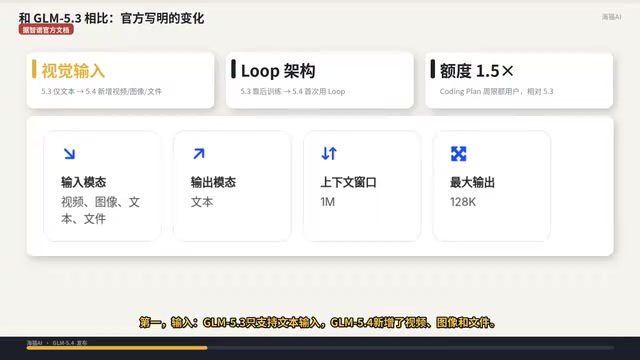
Zhipu GLM-5.4 Released: Loop Transformer Runs 28 Layers Twice
Zhipu releases GLM-5.4, the first Loop Transformer flagship: 28 layers run twice for 2-3T-equivalent intelligence, plus video and image input. API and open weights not yet released.

GLM-5.4 Coding Test 4.6x Slower? Unpacking the Loop Transformer Architecture
GLM-5.4 coding test took 431 minutes vs. competitor's 109, 4.6x more steps. We analyze its Loop Transformer architecture, KingBench4 score of 55.3, Max tier's 1.04M token cost, and tier selection advice.

Zhipu GLM-5.4 Quietly Released: A Debut for Loop Transformer Architecture
Zhipu GLM-5.4 quietly lands in coding plans: first Loop Transformer flagship with 750B params, 1M token context, AIM math up from 19.2 to 30.4, and native vision for coding from screenshots.