Inside the ML Engineer Coding Assessment at Top US Tech Companies: What's Tested and How to Prepare

A deep dive into what ML engineer online assessments at top US tech companies test and how to prepare.
A Reddit user shared their firsthand experience taking an ML engineer online assessment (OA) at a top US tech company. This article breaks down the composite OA modules—algorithms, ML fundamentals, and hands-on coding—along with how different ML role definitions shape the assessment, and offers a systematic preparation strategy for FAANG and Big Tech candidates.
A Real ML Engineer Coding Assessment Experience
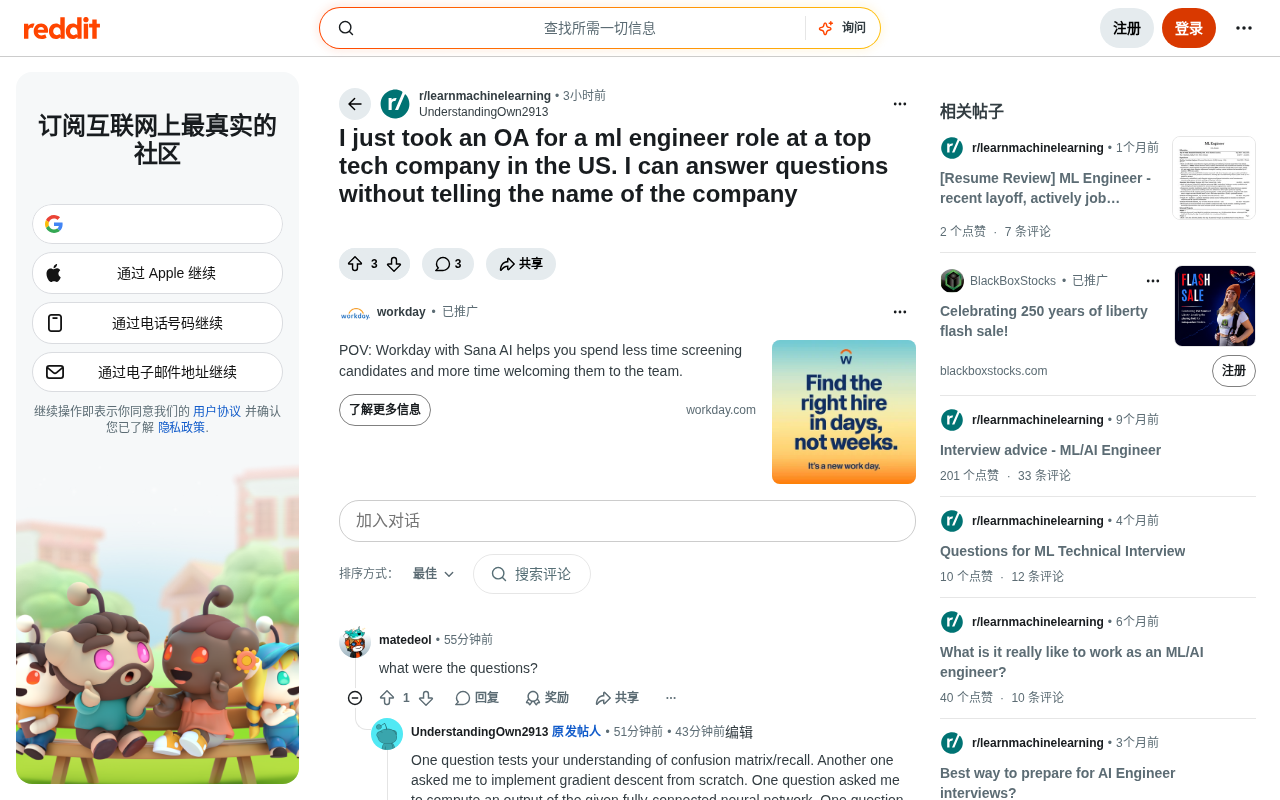
Recently, a job seeker who took an online assessment (OA) for a machine learning engineer (ML Engineer) role at a top US tech company shared their firsthand experience on Reddit. For confidentiality reasons, they didn't disclose the company's name, but expressed willingness to answer questions from netizens about the content and format of the assessment. The post quickly drew significant attention from job seekers preparing for algorithm and machine learning positions.
For many candidates hoping to join FAANG (Facebook/Meta, Amazon, Apple, Netflix, Google) or other leading tech companies, the online assessment is often the first—and most easily failed—hurdle in the hiring process. FAANG is an iconic acronym in the tech recruiting world; these five companies are renowned for their high compensation, technical challenges, and industry influence, attracting tens of thousands of engineers each year with acceptance rates generally below 1%-3%. Notably, as the industry landscape has evolved, this acronym has gradually expanded to FAANG+M (adding Microsoft) or variants like MANGA, and some practitioners now use "Big Tech" as a broader reference. Behind these companies' online assessment systems are dedicated Recruiting Science teams that continuously optimize question discrimination and predictive validity through data analysis, ensuring a statistical correlation exists between OA scores and candidates' actual on-the-job performance. Their hiring processes typically include: resume screening → online assessment (OA) → phone technical interview → onsite Loop interviews → HC (Hiring Committee) review → offer extension, and competition is extremely fierce. Truly understanding the logic behind the OA stage is critical to improving your pass rate.
What ML Engineer OAs Actually Test
It's Not Just About Grinding Problems
Many people assume that a machine learning engineer's assessment is no different from that of a regular software engineer (SDE)—just LeetCode-style data structure and algorithm problems. LeetCode is an online problem-solving platform with over 3,000 programming problems and has become the de facto standard for technical interview preparation at tech companies worldwide. Its problems are divided into three difficulty tiers—Easy, Medium, and Hard—with Medium being the mainstream difficulty level in interviews. This problem-grinding culture originated from the structured technical interview systems adopted by companies like Google in the 2000s. Although critics argue it tests problem-grinding proficiency more than real engineering ability, the system remains the industry mainstream in the short term due to the lack of a better scalable alternative.
Based on this job seeker's account and general industry experience, an ML engineer's OA is typically a composite assessment, generally covering the following modules:
- Algorithms and coding ability: Similar to traditional SDE assessments, testing classic problem types such as arrays, strings, dynamic programming, and graph theory, used to screen for basic coding skills.
- Machine learning fundamentals: Including conceptual multiple-choice questions on supervised/unsupervised learning, overfitting and regularization, evaluation metrics (such as Precision, Recall, F1, AUC), gradient descent optimization, and more.
- Practical ML coding tasks: Some companies require candidates to implement a simple model training pipeline during the assessment, or to complete feature engineering and preprocessing on given data.
Regarding ML theory knowledge, the reference framework is typically Stanford's CS229 and Andrew Ng's Machine Learning specialization courses. Core focus areas include: the Bias-Variance Tradeoff—the central tension between model complexity and generalization ability, whose mathematical essence decomposes the expected generalization error into three terms: bias squared (Bias²), variance (Variance), and irreducible noise (Irreducible Noise). High bias typically indicates underfitting, where the model fails to capture the true patterns in the data; high variance indicates overfitting, where the model is overly sensitive to noise in the training set. In practice, increasing model complexity (such as deepening neural network layers) typically reduces bias but increases variance; while regularization techniques like Dropout, Early Stopping, and data augmentation are common tools for reducing variance. Ensemble learning methods (such as Bagging to reduce variance and Boosting to reduce bias) are also common entry points in assessments for testing whether candidates truly understand this tradeoff. Regularization—L1 (Lasso) produces sparse solutions suitable for feature selection, while L2 (Ridge) shrinks weights and is suitable for preventing overfitting; Evaluation metrics—in class-imbalanced scenarios, Accuracy is misleading, and the Precision-Recall curve and AUC-ROC are more reliable performance measurement tools; Gradient descent variants—the convergence characteristics and applicable scenarios of SGD, Mini-batch GD, Adam, and RMSprop. These concepts may appear as multiple-choice questions or be implicitly tested in coding tasks to see whether candidates understand their engineering implications.
Different Job Definitions, Vastly Different Focus Areas
You may not have noticed that the term "ML engineer" carries vastly different meanings across companies. This role is actually a job family covering multiple sub-directions: Applied ML Engineer (integrating ML models into products, focused on engineering deployment), Research Scientist/Engineer (focused on algorithm innovation, requiring solid mathematical foundations, usually requiring a PhD), ML Infrastructure/Platform Engineer (building training platforms, feature engineering systems, and model serving frameworks, focused on distributed systems), and MLOps Engineer (focused on model deployment, monitoring, and continuous training pipelines, valuing hands-on experience with Kubernetes, Docker, and cloud platforms).
MLOps (Machine Learning Operations) is an engineering field that has risen in recent years alongside the scaled deployment of ML systems, blending DevOps' continuous integration/continuous deployment (CI/CD) concepts with the data and model lifecycle management needs specific to ML. Unlike traditional software, ML systems face unique challenges such as "data drift" (where the input data distribution changes over time) and "concept drift" (where the relationship between target variables and features changes), and therefore require continuous monitoring of model performance and triggering of retraining pipelines. The mainstream MLOps tech stack includes: MLflow (experiment tracking and model registry), Kubeflow (Kubernetes-based ML workflow orchestration), Airflow (data pipeline scheduling), Feature Store (feature sharing and reuse platforms, with representative products like Feast and Tecton), and managed services from various cloud vendors (AWS SageMaker, Google Vertex AI, Azure ML). Demand for jobs in this field exploded between 2022 and 2024, and the focus of related OAs has gradually shifted toward system design ability rather than pure algorithm problems.
Research-oriented positions emphasize mathematical derivation and paper comprehension; engineering-deployment-oriented positions place greater emphasis on system design and distributed training ability. This also explains why, even for the same ML role, different candidates may receive vastly different OA content.
Why Such Shares Are So Popular
Information Asymmetry Is the Biggest Pain Point in Job Hunting
Tech companies' hiring processes are typically highly confidential, and candidates find it difficult to obtain accurate information about question types before the actual assessment. This information gap makes anonymous experience sharing extremely valuable—it helps later candidates set reasonable expectations and avoid going off track in their preparation direction.
However, it's worth noting that such Reddit posts constitute single-source personal experience and lack cross-verification from multiple parties. The content of assessments varies considerably in randomness across different companies and batches, so readers should treat them as a reference perspective rather than a definitive answer. Steadily building a solid foundation is always more reliable than trying to predict specific questions.
The Boundaries Under NDA
This job seeker's choice not to name the company is actually complying with the non-disclosure agreements (NDAs) present in most tech companies' assessments. NDAs in tech company recruiting typically appear in the form of assessment platform terms of use or standalone agreements, which candidates must click to acknowledge before starting the test. From a legal standpoint, the enforceability of NDAs varies by jurisdiction—most US states recognize the validity of such agreements, and breaches may result in civil litigation. In practice, however, it is extremely rare for companies to pursue legal action against ordinary job seekers who aren't competitors; the NDA serves more as a deterrent. Discussions of assessment questions on Reddit form a gray area: experienced job seekers intentionally blur question details, describing only the question category and focus area to avoid potential legal risk. This cautious attitude itself reflects the industry's emphasis on protecting assessment content.
How to Efficiently Prepare for the ML Engineer Assessment
Build a Three-in-One Knowledge System
Based on the composite nature of ML engineer OAs, candidates are advised to prepare systematically across three dimensions:
- Coding ability: Continuously practice medium-difficulty LeetCode problems, focusing on high-frequency topics, and ensure you can write logically clear, bug-free code within time limits.
- ML theory fundamentals: Systematically review classic machine learning textbooks, and be able to clearly articulate core concepts such as the bias-variance tradeoff, regularization principles, and the pros and cons of common algorithms.
- Hands-on practical ability: Master NumPy, Pandas, and Scikit-learn, and be able to quickly build a complete pipeline from data cleaning to model evaluation.
Regarding the practical toolchain, NumPy provides high-performance multi-dimensional array operations, whose vectorized operations are tens to hundreds of times faster than pure Python loops, and it forms the underlying foundation of all ML frameworks; Pandas is designed for structured data processing, supporting ETL operations such as data cleaning, merging, and aggregation; while Scikit-learn implements a complete Pipeline from preprocessing (StandardScaler, OneHotEncoder) to model training to evaluation (cross_val_score, GridSearchCV). In the deep learning direction, PyTorch (mainstream in academia) and TensorFlow/Keras (widely deployed in industry) are the core frameworks. Practical coding tasks in assessments are usually completed in a Jupyter Notebook environment, requiring candidates to complete the full loop of feature engineering, model training, and result interpretation within a time limit.
Simulate the Real Assessment Environment
Online assessments usually have strict time limits, and performance under pressure is often less stable than usual. Online assessments are hosted on third-party platforms such as HackerRank, Codility, CoderPad, and LeetCode's enterprise version, which provide code execution sandboxes, automated scoring, and multi-layered anti-cheating monitoring. Modern anti-cheating systems are quite sophisticated: in addition to camera recording and tab-switching detection, some platforms have introduced mouse behavior analysis (detecting whether candidates frequently switch out of the window to copy-paste code), code similarity detection (comparing against historical submissions to identify plagiarism patterns), and AI-driven anomalous behavior flagging systems. HackerRank's enterprise version also offers a "code playback" feature, allowing hiring teams to replay the candidate's answering process keystroke by keystroke to verify the coherence of their thought logic. For ML coding problems, some platforms already support direct embedding of Jupyter Notebook environments, allowing candidates to complete the full workflow from data exploration to model training to result visualization within the browser.
It's advisable to conduct timed simulation training during preparation to develop the ability to maintain code quality under pressure. At the same time, familiarize yourself in advance with the interfaces of common online judging platforms—including supported programming language versions, code editor features, and test case formats—to avoid wasting valuable answering time due to unfamiliarity with the tools.
Conclusion
The ML engineer assessment at top tech companies is a test of comprehensive ability: solid programming fundamentals, systematic machine learning knowledge, and the ability to translate theory into engineering practice are all indispensable. This Reddit job seeker's share opens a window into what a real assessment looks like, but like all personal experiences, its value lies in providing a reference rather than a precise guide.
For job seekers aspiring to join top AI teams, rather than hoping to predict the exact questions, it's better to steadily build a complete knowledge system and hands-on experience—this is the fundamental strategy for remaining invincible against any changes.
Key Takeaways
Related articles

Apple HomeView Hands-On Review: Is the $300 Smart Home Hub Worth It?
Apple HomeView hands-on: a $300 smart home hub with facial recognition for quick account switching, but no App Store or voice recognition. Is the wall-mounted version worth it? Should you buy the first generation?

Meta Muse Wonder Launch: What It Means for Meta's Return to the Frontier AI Race
Meta releases Muse Wonder and WonderFull, benchmarks reach the frontier, community feedback is polarized. An in-depth look at Meta's return to the frontier AI race, its personal agent strategy, and Zuckerberg's different path.

Apple Home Smart Home Lineup Leaked: LG and Schneider Team Up, UWB Door Lock on Board
Apple Home ecosystem gains new LG and Schneider devices: UWB smart lock with proximity unlock, 2.5K dual-camera doorbell, privacy indoor camera, and AirPods-like seamless pairing.