Instagram Stories Now Supports Editing Within 15 Minutes of Posting, Preserving Engagement Data

Instagram Stories adds 15-minute post-publish editing that preserves engagement data.
Instagram head Adam Mosseri announced that users can edit text, music, stickers, and drawings within 15 minutes of sharing a Story without losing existing views, likes, or replies. Previously, users could only delete and repost, wiping engagement data. The feature was first spotted by reverse engineer Alessandro Paluzzi in April and later officially confirmed. Analysts say the 15-minute window lowers the psychological barrier to posting and is especially valuable for high-frequency creators and brand accounts, though the feature may roll out in phases with unclear coverage.
Feature Overview: Miss the Window and It's Locked
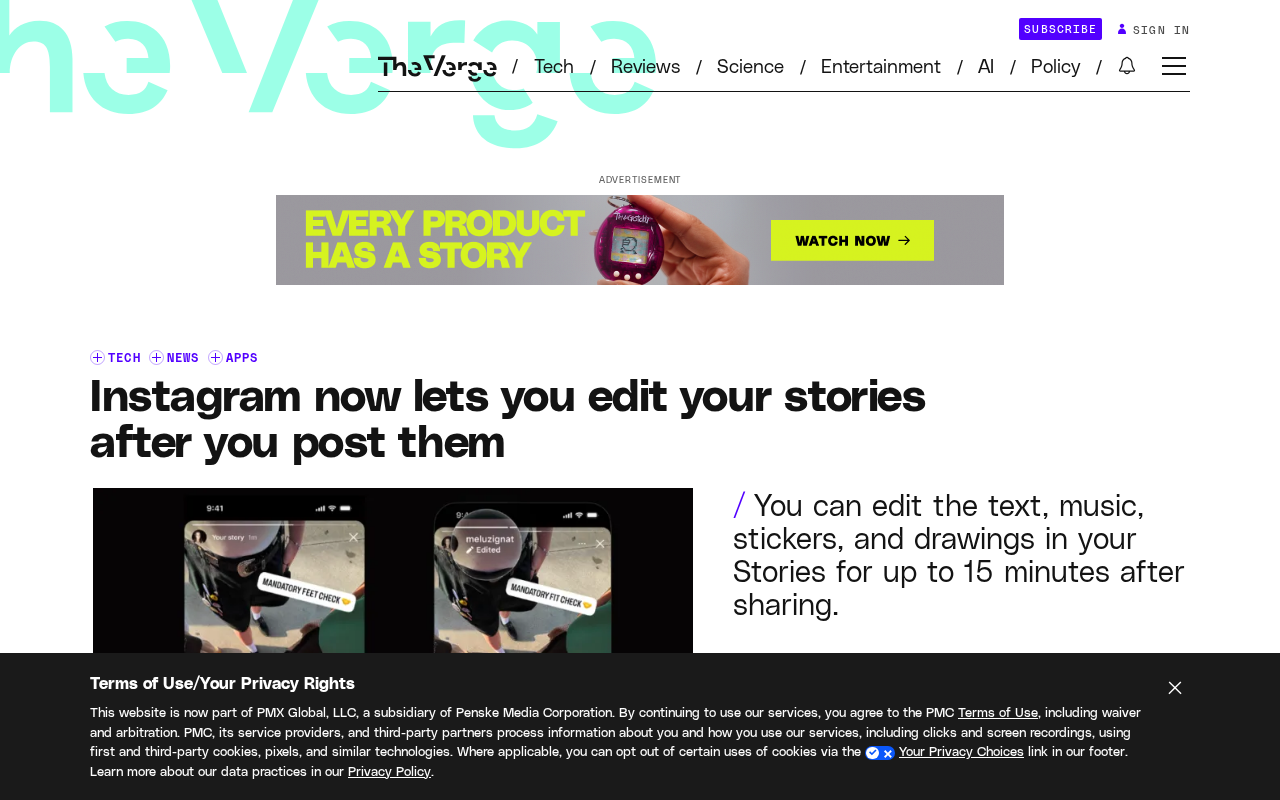
Instagram head Adam Mosseri announced that users can now edit text, music, stickers, and drawings within 15 minutes of sharing a Story, without losing existing views, likes, or replies. Previously, users who wanted to modify a published Story had to delete and repost it, wiping out all engagement data.
This update directly addresses a long-standing pain point: users who notice a typo, a poorly placed sticker, or a wrong music choice after posting had only two options—keep the flaw or sacrifice the data.
Feature Details: What Can and Cannot Be Changed
According to Mosseri's demo, the editable elements are concentrated in the visual and audio layers:
- Text: Modify wording, font, color, or position
- Music: Swap tracks or adjust segments
- Stickers: Replace, move, or delete stickers
- Drawings: Modify hand-drawn doodles
The 15-minute window means editing applies only to the "just posted" scenario, not long-term content management. After the time limit, the Story is locked and can no longer be modified.
Story engagement data includes Views, Likes, and Replies, which are core metrics creators use to evaluate content performance. Views count unique viewers, while likes and replies reflect active engagement. Deleting and reposting a Story generates a new content ID, and the original engagement data cannot be migrated, causing a data gap. The editing feature preserves the original content ID, so view, like, and reply data carry over—crucial for creators and brands that rely on data feedback to adjust their content.
Multi-Source Cross-Validation: From Reverse Engineering to Official Launch
The way this feature surfaced is worth noting. According to reverse engineer Alessandro Paluzzi, who first spotted Instagram developing the feature in April by analyzing the app's code to predict its form. Mosseri later officially announced the rollout through official channels.
Two independent sources—the reverse engineering community and the official announcement—corroborate each other, confirming the feature's existence and core logic. Paluzzi's early discovery also indicates that Instagram went through months of testing from development to official launch.
Reverse engineering refers to the technical practice of inferring undisclosed features by analyzing an app's installation package, code, or network requests. Alessandro Paluzzi is a well-known mobile app reverse engineer who has long uncovered hidden features in beta versions of apps like Instagram and WhatsApp. His leaks are typically based on static analysis of APK or IPA files, allowing him to discover unannounced features weeks to months in advance. Although such findings are not official sources, they are often treated by tech media as reliable forward-looking signals due to their clear technical basis.
Industry Analysis: Stories Competition Enters the "Error Tolerance" Phase
The Stories format was pioneered by Snapchat, and after Instagram popularized it, competition long focused on filters, sticker ecosystems, and creation tools. This update shifts attention to post-publish error tolerance, which is backed by clear user behavior logic:
Stories have a lifecycle of only 24 hours, and users post frequently and decide quickly, so the error rate is naturally higher. Allowing edits within 15 minutes effectively lowers the psychological barrier to posting—users no longer need to preview repeatedly to confirm, and can post first and adjust later. This directly helps increase posting frequency and user retention.
One detail worth noting: preserving engagement data is the core value of this feature. For creators and businesses, Story views and replies are key indicators of content effectiveness, and deleting and reposting means a data gap. The launch of the editing feature decouples "modification" from "data loss."
It is currently unclear whether the feature covers all regions and account types; Instagram typically adopts a phased rollout strategy.
Stories is a time-limited ephemeral feature launched by Snapchat in 2013, where content automatically disappears 24 hours after posting and supports images, short videos, and doodle overlays. Instagram launched an almost identical feature in 2016 and quickly overtook Snapchat thanks to its larger user base, making Stories a standard feature across social platforms. Unlike traditional permanent posts, Stories emphasize immediacy and low-pressure sharing; users watch and move on, with engagement mainly through views, replies, and emoji reactions. This design naturally encourages high-frequency posting and also makes post-publish errors the norm.
Usage Tips: Operation Priorities Within the Editing Window
For users who post Stories frequently, it is recommended to quickly check the following after posting: whether there are typos in the text, whether the music matches the scene, and whether stickers obscure key visuals. The 15-minute window is enough to complete a round of corrections, but don't procrastinate—once the time is up, the flaws remain until the Story expires.
For brand accounts, the editing feature is especially valuable: if a tag error or unclear link prompt is discovered after posting, it can be corrected immediately without affecting the engagement data already accumulated.
Related articles

AI and Mathematicians Collaborate to Prove the Riemann Hypothesis? The Controversy Behind 1.7 Billion Lines of Lean Code
AI and mathematician Levent Alpoge used 17 million lines of Lean code to prove the Riemann Hypothesis? An AnyGeometry definition sparked controversy, yet an independent audit says the logic holds. This article explains the Riemann Hypothesis, the Yes machine controversy, and the real impact on RSA encryption.

PeppermintOS Launches Void Edition: A Lightweight Experience Without SystemD or XLibre
PeppermintOS launches PepVoid based on Void Linux, featuring XFCE and XLibre with a non-SystemD architecture. This article covers installation, software center experience, preinstalled software, and technical verification for users interested in a lightweight non-SystemD distribution.

Clojure Native Apps: Letting AI Reshape Software at Runtime
Explore how Clojure enables native apps to be reprogrammed at runtime by developers or AI, drawing on Emacs' extensibility, and analyzing REPL-driven development, AI collaboration, and challenges.