Intel OEP + Embodied Intelligence Kit: Bringing AI Into the Real World

Intel's conference charts a path from cloud AI models to real-world edge productivity across industries and robotics.
At Intel's Technology Innovation and Industry Ecosystem Conference, Industry AI and Physical AI emerged as the two core themes. OEP pushes AI to the edge across manufacturing, healthcare, and retail — with one medical solution reportedly boosting staff efficiency by 20%. On the Physical AI front, Intel's CPU/GPU/NPU heterogeneous architecture integrates big-brain and little-brain functions in robots, backed by a new out-of-the-box embodied intelligence dev kit. The overarching message: as large model capabilities mature, the competitive focus is shifting from model performance to efficient, low-cost deployment in real physical environments.
At Intel's Technology Innovation and Industry Ecosystem Conference, a 15,000-square-meter exhibition floor turned the abstract idea of "putting AI into reality" into tangible products and solutions. From factory floors to hospital wards, from retail stores to autonomously moving robots, the conference sent a clear signal: AI is evolving from cloud-based models into a genuine productivity tool embedded across specific industries.
Two threads stood out throughout the event — Industry AI and Physical AI. The former tackles how AI enters diverse industries; the latter focuses on how AI truly enters the physical world to drive autonomous robotic action.
Industry AI: From Proof-of-Concept to Deployable Edge Solutions
Intel placed significant emphasis on OEP (Open Edge Platform), whose core value lies in converting proof-of-concept evaluations into deployable, production-ready edge AI solutions. The underlying logic is worth noting: many AI capabilities have historically stalled at the demo or cloud service stage, running into complexity and scalability challenges when it comes to real deployment. OEP's mission is to push AI from the cloud toward the edge, embedding it into specific, real-world scenarios.
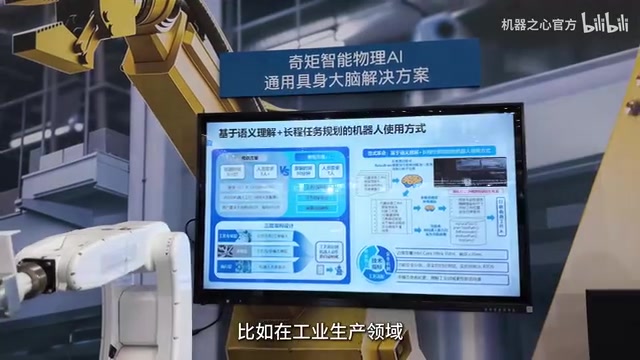
In industrial manufacturing, partners built applications on this platform including flexible grinding and intelligent welding — a single robot can switch between multiple tasks, a flexibility that clearly delivers value for the manufacturing sector. Healthcare provided an even more striking example: Intel, in collaboration with Shanghai Fourth People's Hospital and MaxHub, introduced a medical solution capable of intelligently generating case records and assisting with data entry, reportedly boosting healthcare staff efficiency by around 20%.
The exhibition floor also featured several down-to-earth applications. An AI-powered self-service health kiosk measures height, weight, body fat percentage, muscle mass, and more, then generates a risk assessment. A retail AI kit effectively acts as an "AI store inspector" — monitoring hygiene, checking whether staff are following procedures, and alerting managers in real time when shelves need restocking.
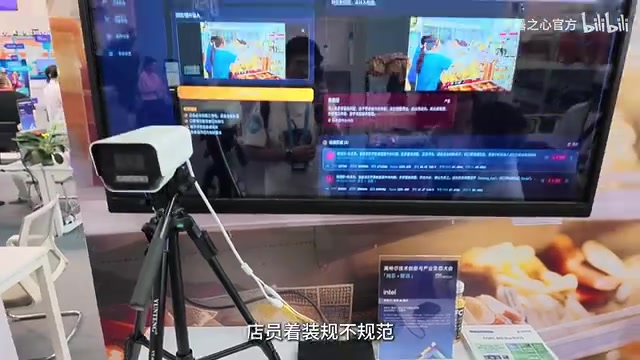
Rounding out the lineup with products for campus management and education, Industry AI as a whole shared a common characteristic: AI is no longer a flashy add-on, but a tool embedded in concrete business workflows to solve real efficiency problems. This is precisely the core competitive advantage of edge AI over cloud AI — low latency, local data processing, and proximity to the point of operation.
Edge AI Explained: Edge AI refers to running AI inference locally on devices close to where data is generated, rather than sending it to a remote cloud data center. Compared to cloud AI, its three key advantages are: (1) Low latency — local processing eliminates round-trip delays, compressing response times from hundreds of milliseconds down to single digits, which is critical for industrial control and real-time inspection; (2) Data privacy — sensitive information such as medical images and factory production data never needs to leave the premises; (3) Offline availability — operations continue uninterrupted even when network connectivity is lost. The core engineering challenge for platforms like OEP is efficiently running AI models originally designed for the cloud on edge hardware constrained by compute, power, and cost — while providing standardized deployment interfaces to reduce integration overhead for industry customers.
Physical AI: Big Brain Meets Little Brain to Make Robots Move
If Industry AI is about embedding AI into business processes, Physical AI is about embedding AI into the physical world. Intel offered a vivid analogy on-site: for a robot to act truly autonomously, a "big brain" responsible for thinking isn't enough — it also needs a "little brain" capable of real-time body control.
CPU, GPU, and NPU: Each Playing Its Part
Intel has now integrated the "big brain" and "little brain" into a unified architecture — CPU, GPU, and NPU each handle distinct tasks such as AI inference, environmental perception, task planning, and motion control. This heterogeneous computing division of labor fundamentally addresses robots' dual demands for real-time responsiveness and intelligence: sufficient compute power for perception and decision-making, combined with deterministic real-time control for execution.
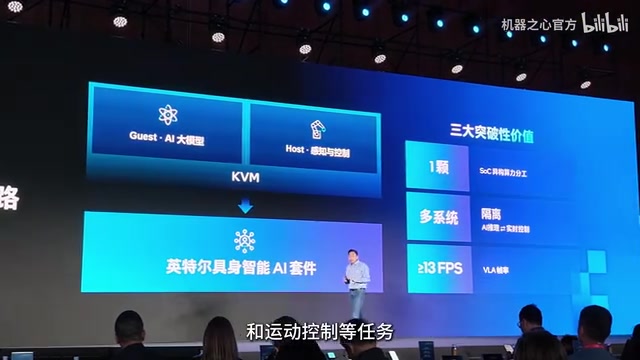
To lower the barrier to entry, Intel officially launched an embodied intelligence development kit designed to be "ready out of the box," with software frameworks, tools, and reference code all included. For developers, this means no need to build the hardware and software stack from scratch — they can move faster from concept to actual robotic product. This is a critical enabler for scaling embodied intelligence broadly.
NPU Explained: An NPU (Neural Processing Unit) is a chip module purpose-built to accelerate AI inference. Unlike CPUs and GPUs, its circuit architecture is deeply optimized for the matrix multiplications and convolution operations that sit at the heart of neural networks, enabling tasks like image recognition and voice processing at extremely low power consumption. In robotic applications, the three processor types divide responsibilities as follows: the NPU handles high-frequency, low-power perceptual inference (e.g., real-time object detection); the GPU manages environment modeling and path planning, which require massive parallel computation; and the CPU handles task scheduling, logic control, and general-purpose computing. The essence of this heterogeneous computing architecture is a "right tool for the right job" approach — meeting both intelligence and real-time requirements within tight power and size constraints, rather than forcing a single processor to cover every scenario.
From Song and Dance to Getting the Job Done
The evolution of robot "Xiaoying" (小鹰) is illustrative: last year it was singing and dancing on stage; this year, it's doing actual work. Equipped with Intel processors in its torso, the robot integrates big-brain and little-brain functions, enabling it to precisely hand a development kit to a guest in an open environment — a seemingly simple action that requires the seamless coordination of perception, planning, and motion control.
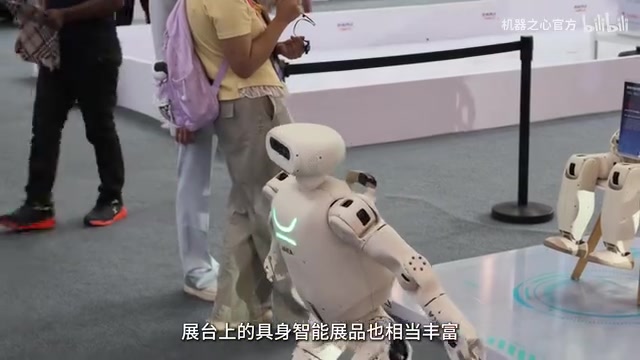
Another adorable robot on the show floor is built around Intel Core processors, features 27 degrees of freedom, and can move fluidly within a very small space while performing lightweight tasks. Also worth highlighting is the smart cabin system Airbox, which perceives the interior and exterior environment in real time, identifies risks proactively, and delivers personalized services based on user identity and habits.
Degrees of Freedom Explained: In robotics, Degrees of Freedom (DoF) refers to the number of independent axes along which a mechanical structure can move — directly determining a robot's agility and task capability. The human arm from shoulder to fingertips has approximately 27 degrees of freedom, so a 27-DoF robot theoretically approaches the dexterity of the human hand. However, the higher the DoF, the more exponentially complex the motion control becomes — the position, velocity, and torque of every joint must be coordinated in real time, placing extreme demands on processor responsiveness. This is precisely why the embodied intelligence field widely treats "big brain and little brain integration" as the key technical path: the big brain (high-compute AI chip) handles intent and planning, while the little brain (real-time control chip) translates that intent into precise commands for every joint. Neither can function without the other.
The Critical Leap from Model to Productivity
After touring the full exhibition, the most visceral takeaway was this: AI is entering more and more real-world scenarios. From the OEP Open Edge Platform to the Core computing platform for physical AI, what Intel demonstrated was a clear, coherent path — taking AI's capabilities from raw models and transforming them, step by step, into deployable productivity.
The underlying industry logic is equally compelling. As large model capabilities continue to mature, the competitive battleground is shifting from "how powerful is the model itself" to "how efficiently and cost-effectively can AI be deployed into real-world scenarios." Edge computing and heterogeneous compute are precisely the foundational infrastructure enabling this shift. Whether it's a robotic arm switching roles on a factory floor or a robot autonomously handing over an object, both point in the same direction: AI's true value must ultimately be realized in the physical world.
Related articles

Gaussian Process Bandit Optimization: Exploration Strategies and Inference Regret Guarantees
Cumulative regret guarantees in Bayesian optimization fail to reflect final recommendation quality. This article examines a new study that provides inference regret guarantees for Gaussian process bandit optimization through exploration query strategies and fill distance analysis, validated on hyperparameter optimization and control tasks.

The Most Detailed Codex Guide on Bilibili: From Installation to Real-World Practice
The most detailed Codex guide on Bilibili: from app store installation to daily work mode configuration, with a real coffee shop project demonstrating file organization, data extraction, dashboard creation, and other practical tasks. Learn to use Plan Mode and desktop pets to leverage Codex efficiently.

Appearance Compensation in Volume Rendering: Why RGB Accuracy Cannot Guarantee Density Correctness
Volume rendering research reveals that volumetric data perfectly reproducing external RGB views may still contain density errors: appearance compensation can double central density and keep external rays unchanged even when L2 error exceeds 14.52%. Density recovery depends on appearance capacity, spatial resolution, and measurement design.