Intero Biosystems Wins Disrupt 2026 Startup Battlefield

Intero Biosystems beat 200 startups to win TechCrunch Disrupt 2026 Startup Battlefield and its $100,000 prize.
In the Startup Battlefield finals at TechCrunch Disrupt 2026, Intero Biosystems defeated the other 199 finalists to win the $100,000 grand prize. The competition has long been a key showcase for early-stage startups, with its brand effect, media exposure, and investor access widely seen as worth far more than the prize money. TechCrunch has so far disclosed only the result and prize amount, not Intero's technology or product details; its name suggests a biosystems or life sciences focus. The win continues a recent trend of rising biotech and hard-tech representation, signaling that beyond the generative AI boom, the intersection of life sciences and engineering keeps producing noteworthy teams. The title is just a starting point—the real test is converting it into funding, partnerships, and hiring.
In the Startup Battlefield finals at TechCrunch Disrupt 2026, Intero Biosystems emerged from a field of 200 participating startups to take home the $100,000 grand prize.
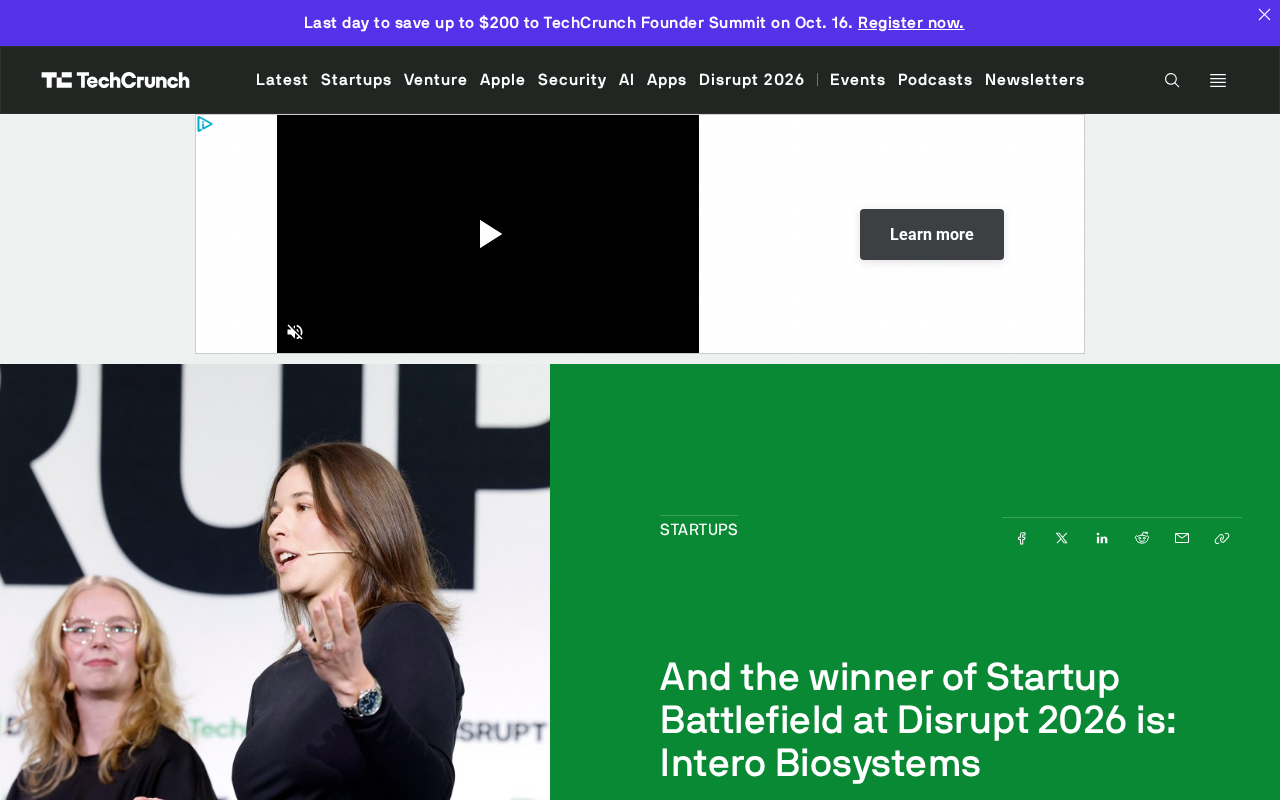
A Startup Knockout: 200 In, 1 Out
TechCrunch Disrupt's Startup Battlefield has long been one of the most closely watched showcases for early-stage startups worldwide. According to TechCrunch, Intero Biosystems beat out the remaining 199 finalists to become this year's overall champion.
The number itself says a lot about the intensity of the competition: 200 companies on the same stage, and only one walks away with the $100,000 prize and the industry attention that comes with it. For an early-stage team, the money matters not just as cash, but for the media exposure, investor access, and hiring credibility it brings.
What is Startup Battlefield?
Startup Battlefield is the flagship startup competition at the TechCrunch Disrupt conference. Founded in 2007, it is regarded as one of the world's best-known showcases for early-stage startups. Competing companies must pass through multiple rounds of screening to reach the on-stage pitch, where they present to a panel of prominent investors, founders, and technology executives, and take live questions.
The competition's alumni include Dropbox, Cloudflare, Mint, Fitbit, and Trello, which is why its role in the venture world is closer to a "high-intensity endorsement mechanism": making the cut alone signals a certain screening threshold, and winning often directly translates into media coverage, inbound investor interest, and a recruiting advantage. Judging criteria typically cover team background, technical differentiation, market size, business model, and live presentation—not technical sophistication alone.
Why Intero Biosystems Won
In currently available public information, TechCrunch has only disclosed the winning result and the prize amount, without detailing Intero Biosystems' technology approach or product specifics. Still, the "Biosystems" in the company name suggests its business is related to biological systems, life sciences, or bioengineering—continuing a recent trend of rising biotech and hard-tech representation in Startup Battlefield finals.
You may not have noticed, but biotech startups tend to face longer R&D cycles and higher funding thresholds. Earning recognition on a stage like this at an early stage usually means the company has a clear narrative around technical differentiation or its clinical/commercialization path. Specific judging details will have to wait for follow-up TechCrunch coverage.
Why do biotech startups attract more attention in early-stage competitions?
Biotech and life sciences startups typically share several structural traits: R&D cycles measured in years, multiple stages of laboratory validation and clinical trials, complex regulatory pathways, and capital needs that often far exceed those of software companies at the same stage. Because of this, such companies find it hard to persuade judges with a product prototype alone in early pitches—they rely more on a combination of a clear scientific hypothesis, a differentiated technical path, and a commercialization narrative.
When a biosystems company can win a startup competition known for rapid iteration, the signal it sends is usually not "we have a mature product" but "our scientific direction, team credentials, and stage goals have earned preliminary recognition from professional investors." This kind of early endorsement is especially critical for subsequently unlocking seed funding and connecting with research institutions or industry partners.
The Value Beyond the $100,000 Prize
Startup Battlefield's prize money is not particularly large by venture standards, but its brand effect is widely viewed as far exceeding the $100,000 itself. Historically, teams that have competed and won often receive a flurry of investor contacts within weeks of the event, and some go on to close seed or even Series A rounds.
For Intero Biosystems, the real test is whether it can convert this exposure into actual fundraising progress, partnerships, and talent recruitment. The champion title is a starting point, not the finish line.
The Biotech Track Keeps Heating Up
Looking at the finalist lists from recent Disrupt editions, AI, climate tech, and biotech form the three main pillars. Intero Biosystems' win once again confirms that biosystems-related technology is drawing more attention from mainstream venture circles.
For readers following early-stage tech investment, this result offers a window: beyond the generative AI boom, the intersection of life sciences and engineering continues to produce teams worth betting on.
Background Notes
Note on sources
This article's statements about the competition results, the number of participating companies, and the prize amount are all based on TechCrunch's public reporting. As of this writing, TechCrunch has not disclosed Intero Biosystems' specific technology approach, founding team background, funding stage, or business model details. The inference in this article that the company is "related to biological systems, life sciences, or bioengineering" is a reasonable guess based on the literal meaning of the company name, not a confirmed fact. Readers who wish to use this result for investment or research judgments should defer to follow-up TechCrunch reporting and official company disclosures, and avoid treating speculative content as established fact.
One-line Summary
Intero Biosystems beat 200 startups to win the TechCrunch Disrupt 2026 Startup Battlefield and its $100,000 prize.
Paragraph Summary
In the Startup Battlefield finals at TechCrunch Disrupt 2026, Intero Biosystems defeated the other 199 finalists to win the $100,000 grand prize. The article notes that the competition has long been a major showcase for early-stage startups worldwide, and its brand effect, media exposure, and investor access are widely seen as worth far more than the prize money itself. TechCrunch has so far disclosed only the winning result and prize amount, without detailing Intero Biosystems' technology or product; based on its name, the company appears to be in biosystems or life sciences. The article argues this continues a recent trend of rising biotech and hard-tech representation in the finals, and signals that beyond the generative AI boom, the intersection of life sciences and engineering keeps producing noteworthy teams. The champion title is only a starting point—the real test is whether it translates into funding, partnerships, and talent recruitment.
Related articles

Free Unlimited Claude Code Solution: Agnes AI + CC Switch Setup Guide
No paid subscription needed — pair the free AI platform Agnes AI with the open-source tool CC Switch to provide a backend for Claude Code, enabling unlimited free calls to text, image, and video models. This guide covers the full setup, test results, and usage boundaries.

A Complete Zero-Cost Guide to Getting Started with Claude Code for Beginners in China
A beginner's guide to Claude Code for users in China: two installation methods (command line and IDE plugin), full configuration steps for replacing the official API with the free domestic LongCat model, and a hands-on demo of building a small tool with natural language, plus tips.

When the NSA Gets Involved: The AI Supply Chain Crisis Behind Open-Source CVEs and API Key Hijacking
Multiple open-source projects disclosed severe CVEs in one day, PHP flaws alarmed the FBI, and Railway and OpenCode were breached with API keys stolen. This article breaks down the vulnerability window, AI-accelerated exploitation, and the AI supply chain crisis behind the API key black market, with a developer defense checklist.