iOS Built-in Ads Spark Outrage: Why Apple Is Pushing Its Own Services Through the OS

Apple's in-OS service promotions are angering users and exposing the tension between its brand promise and services ambitions.
Apple's repeated in-system promotions for subscriptions like Apple Music, iCloud+, and Apple TV+ have been widely labeled "persistent ads" by users, sparking a viral Hacker News thread with nearly 300 comments. The core tension: Apple's brand has long rested on an implicit promise that premium prices buy a cleaner, less intrusive experience — and OS-level promotions that can't be fully dismissed shatter that expectation. The commercial logic is clear: with hardware growth slowing, Apple's high-margin services segment has become its most important growth driver, making its billion-device install base the cheapest acquisition channel available. Apple's long-standing identity as a privacy champion and critic of ad-driven business models makes the backlash especially sharp. The episode offers the entire tech industry a cautionary data point on how fast user trust erodes when the OS itself becomes a promotional channel.
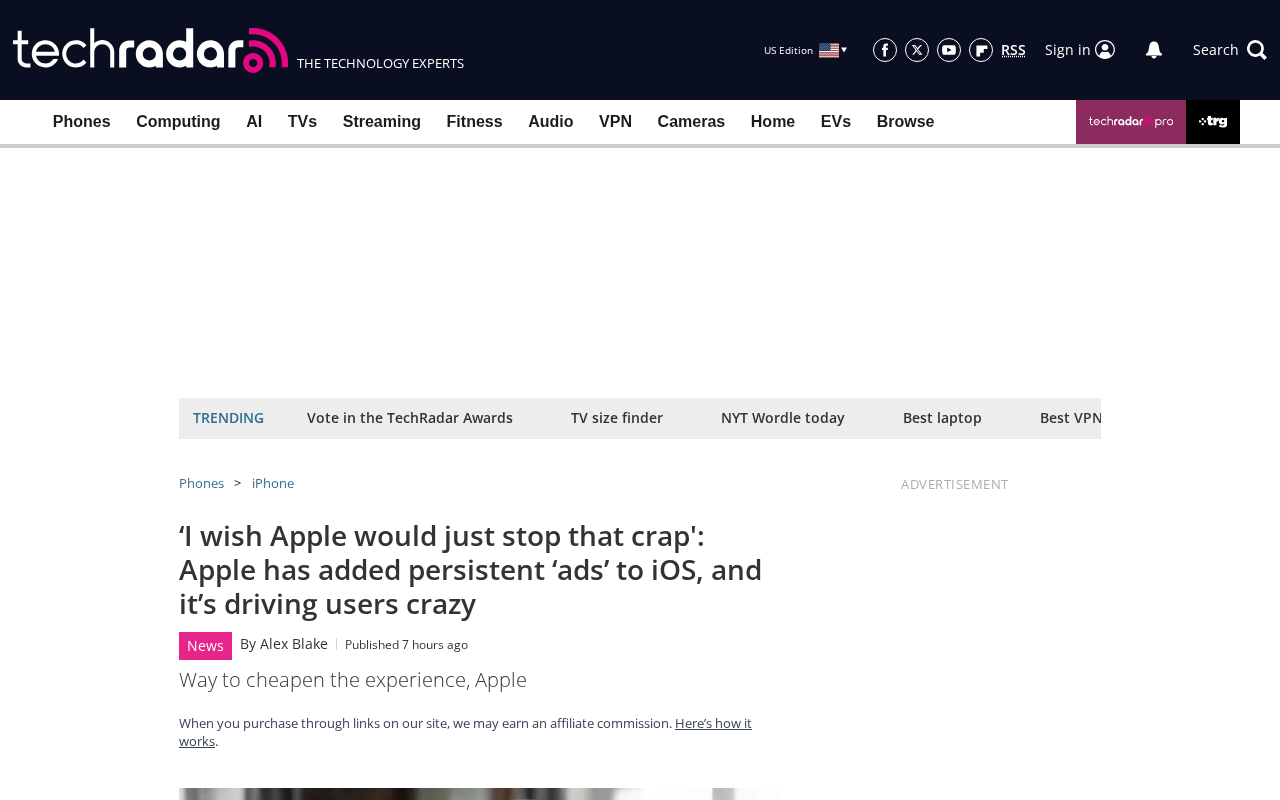
Apple has long marketed itself on the promise of a clean, restrained user experience — but a recent TechRadar report has put the company squarely in the hot seat. The piece, bluntly titled "Apple has added persistent 'ads' to iOS and it's driving users mad," climbed to the top of Hacker News, racking up 373 upvotes and 277 comments. The level of engagement speaks for itself.
What's Actually Happening: "Persistent Ads" Inside the OS
These so-called "persistent ads" aren't traditional third-party banners or pop-ups. They're Apple's own repeated promotions for its services — Apple Music, iCloud+, Apple TV+, Apple Arcade — surfacing inside Settings menus, system dialogs, and prominent spots within apps.
The operative word here is "persistent." A one-time feature introduction is forgivable. But when these prompts keep reappearing with no reliable way to shut them off for good, the experience crosses a line — from helpful nudge to outright harassment. The original article used notably blunt language: "I really wish Apple would stop doing this kind of crap." Beneath that frustration lies something more substantive: a long-time paying customer's sense that the brand has broken an implicit promise.
Why This Hits a Nerve With Apple Users
Much of Apple's hardware premium rests on an unspoken deal: you pay more, you get a cleaner, less intrusive experience. When a pricey iPhone starts pushing paid subscriptions at the OS level, that deal feels broken.
The Hacker News thread bears this out — it's not an isolated complaint. Across nearly 300 comments, developers and power users alike noted that Apple's growing revenue pressure in its services segment has been quietly reshaping its product philosophy. With hardware sales growth slowing, services have become the fastest-growing line on Apple's income statement. And promoting subscriptions to the billion-plus devices already in users' hands is the cheapest customer acquisition channel imaginable.
In other words, these "ads" likely aren't a design oversight — they're a deliberate business strategy. The discomfort users feel is, at its core, the friction between Apple's shifting business model and the expectations it spent decades cultivating.
The financial stakes are hard to overstate. In fiscal year 2024, Apple's Services segment generated over $96 billion in revenue, with gross margins around 75% — far ahead of the roughly 37% margin on hardware. iPhone sales growth has been slowing since around 2016, and the global smartphone market has largely plateaued. Against this backdrop, Wall Street analysts and institutional investors now scrutinize Apple's services growth even more closely than its hardware numbers; services revenue expectations directly influence the company's valuation. That capital market pressure creates a structural incentive for Apple to push subscriptions more aggressively through its product interfaces — not because of any individual product manager's misjudgment, but as the inevitable downstream effect of financial targets flowing into UI decisions.
"Ads" or "Promotions"? A Definitional Debate
It's worth drawing a distinction: what Apple is pushing is technically its own first-party service promotion, not ad inventory sold to external advertisers. Some commenters in the thread acknowledged as much. But from a user's perspective, the label barely matters. If something is unsolicited, recurring, and hard to dismiss permanently, the subjective experience is indistinguishable from advertising.
This is exactly what makes these disputes hard to resolve cleanly. Apple can claim it's simply "informing users about available features." But user tolerance depends on frequency, controllability, and whether prior dismissals are respected. When a prompt keeps reappearing after you've tapped "Maybe Later," even a well-intentioned feature introduction starts to feel manipulative.
The Tension Between Privacy Narrative and Commercial Reality
For years, Apple has built "privacy" and "user-first design" into its core brand narrative — even weaponizing that story against competitors' ad-driven business models. That's precisely why the backlash hits harder when Apple itself does this: many see it as a glaring double standard.
This tension isn't unique to Apple. It's a challenge facing every major tech platform that relies on subscription revenue: how do you balance growth with user trust? Push too little, and conversion rates suffer. Push too hard, and you burn through the brand equity that took decades to build. Apple's current approach clearly strikes a significant portion of its user base as tilting too far toward the former.
Apple's track record on this front is telling. The App Tracking Transparency (ATT) framework, launched in 2021, required all third-party apps to obtain explicit user consent before tracking behavior — a move that devastated ad-dependent companies like Meta, which publicly stated the policy cost it over $10 billion in annual revenue. Apple cited user privacy protection as justification for limiting competitors' ad capabilities, while simultaneously building a closed service ecosystem across the App Store, Apple Arcade, and beyond. This "my ads aren't really ads" logic is precisely the double standard critics have long pointed to. EU regulators have already launched investigations questioning whether Apple gives its own services preferential treatment under its own privacy rules.
What This Means for Users and the Industry
For everyday users, the practical workaround is to dig through system settings and disable as many notification and recommendation options as possible — though these toggles tend to be scattered and rarely comprehensive. More fundamentally, public pushback and voting with their feet remain the only feedback mechanisms that actually move companies like Apple.
For the broader industry, this episode is a revealing case study: when hardware growth peaks and software and services become the profit engine, can the operating system — the last genuinely clean canvas — remain free of commercial pressure? Apple's choices here, given its role as the experience benchmark, have a way of setting the tone for the entire industry.
The hundreds of comments on Hacker News signal something real: user tolerance for OS-level intrusions is eroding. That's a warning for every platform company. An operating system is the interface users interact with hundreds of times a day. Any commercial friction introduced at that layer gets amplified into a direct withdrawal from the bank of brand trust.
Related articles

The Chaotic Aesthetics of Apple's HomeView Ad: A Marketing Code Only Parents Can Read
Apple's HomeView smart display ad ditches minimalist style for chaotic family mornings to win over parents. We analyze why it confuses most viewers but resonates instantly with families — and the trade-offs and risks of Apple's targeted marketing.

Cerebras CEO Pushes Back on AI Doomerism: Stop Spreading Panic
Cerebras CEO Andrew Feldman publicly pushes back on AI doomerism at TechCrunch Disrupt, arguing excessive risk focus drowns out AI's real opportunities.

Retooling in Minutes: Industrial Next Redefines Factory Robot Flexibility
Industrial Next aims to let factory robots retool in minutes instead of weeks, automating complex delicate tasks and advancing flexible manufacturing and small-batch production.