iPhone 18 Pro Variable Aperture: The Next Must-Have in Mobile Imaging

iPhone 18 Pro Max's variable aperture marks mobile photography's shift from stacking pixels to controlling light.
Using the iPhone 18 Pro Max's f/1.48–f/4.0 variable aperture as a starting point, the article discusses how competition in mobile imaging is shifting from "stacking pixels" to "controlling light." Variable aperture itself isn't new—Samsung, Nokia, and Honor have all tried it—but in the past it was a nice-to-have selling point. As main camera sensors approach 1 inch, the shallow-depth-of-field problem caused by a fixed wide aperture is amplified: the Oppo Find X9 Ultra's 1/1.1-inch main camera with a fixed f/1.5 aperture makes close-ups or group photos prone to "a sharp nose but blurry ears," a physical optical limitation that algorithms struggle to fully compensate for. Variable aperture deepens depth of field by stopping down, while also giving professional users active decision-making power over light intake and depth of field. The article argues that it is becoming a necessity in the era of large sensors, and is a correction that returns mobile imaging to its optical essence.
Title
iPhone 18 Pro Variable Aperture: The Next Must-Have in Mobile Imaging
Meta Description
The iPhone 18 Pro Max features a variable aperture that switches freely between f/1.48 and f/4.0. This article explains why, in the era of large sensors, variable aperture has gone from a gimmick to a necessity in mobile imaging, and what it actually means for low-light performance and depth-of-field control.
Article Content
The competition in mobile photography is shifting from "stacking pixels" to "controlling light." The variable aperture on the iPhone 18 Pro Max may look like just another spec upgrade, but it points to a more fundamental question: as sensors get larger, how can phones avoid the awkwardness of "backgrounds so blurred you can't make out the subject"?
What Exactly Is a Variable Aperture
According to the YouTube video, the iPhone 18 Pro Max's 48-megapixel, 1.28-inch main camera has an aperture that can switch between f/1.48 and f/4.0, while retaining several intermediate steps. This means the same lens can both pull in massive amounts of light at a wide aperture and stop down to gain deeper depth of field.
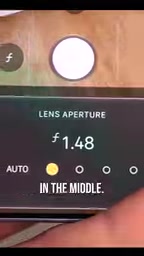
Variable aperture itself isn't new. The video candidly notes that Samsung, Nokia, and Honor have all tried this technology to varying degrees over the past decade. What's really changed is this: it used to be a nice-to-have selling point, but now it's becoming a necessity in the era of large sensors.
Aperture value (f-number) and depth of field: The aperture value = lens focal length ÷ effective aperture diameter, so f/1.48 has a larger opening and lets in more light than f/4.0. Adjacent full stops (such as f/1.4→f/2.0) differ by a factor of two in light intake, which is why "stopping down a few stops" noticeably affects exposure.
Depth of field refers to the range of depth in an image that appears sharp. It's determined jointly by aperture, focal length, focus distance, and sensor size: the larger the aperture, the longer the focal length, the closer the focus distance, and the larger the sensor, the shallower the depth of field. The main camera on a phone typically has an equivalent focal length of only around 24mm, and in the past it achieved a "pan-focus" effect through a small sensor and small aperture; once you switch to a 1-inch-class large sensor and an f/1.5 wide aperture, shallow depth of field suddenly becomes apparent.
Variable aperture changes the aperture diameter through movable blades or a mechanical structure. It has long been common in camera lenses, but achieving multiple steps of switching in a phone module only a few millimeters thick without sacrificing image quality places very high demands on structural precision and reliability, which is why for a long time it appeared only on a handful of models.
The Sweetness and Trouble of Large Sensors
The larger the sensor, the more photons it captures per unit of time, and the better the foundation for night shots and dynamic range. But the laws of physics don't only give benefits. The video uses the Oppo Find X9 Ultra as an example: its main camera sensor reaches 1/1.1 inch, one of the largest on the market, with a fixed aperture of f/1.5.

The result is extremely shallow depth of field. When shooting close-ups or group photos, it's easy to end up with "a sharp nose but blurry ears." This isn't something algorithms can fully compensate for, because it's a physical limitation at the optical level—the larger the sensor and the larger the aperture, the more severe the falloff outside the focal plane.

A variable aperture is precisely the solution: stop down the aperture, deepen the depth of field, and bring more of the subject into the sharp range. For portraits or documentary scenes where you want "the entire face to be sharp," this is more reliable than any post-processing fix.
Labels such as 1.28-inch and 1/1.1-inch refer to the diagonal length of the sensor's photosensitive area. The smaller the denominator, the larger the sensor: 1/1.1 inch is roughly equal to 0.91 inch, noticeably larger than the common 1/1.3 inch or 1/1.56 inch. The larger the sensor, the more photons each pixel can receive, and the better the theoretical dynamic range and low-light signal-to-noise ratio, but the lens module, focusing travel, and body thickness will also increase accordingly.
The boundaries of computational photography: Multi-frame stacking, semantic segmentation, and depth estimation can simulate blur and to some extent "recover" sharp areas, but they cannot conjure out-of-focus information that the optical system has already discarded. When the subject's edges and the background are already physically aliased, algorithms can only guess, which easily produces broken edges or a "plastic" look. This is exactly why purely optical approaches like variable aperture are being taken seriously again.
Professional Control and Low-Light Capability Are Actually Two Sides of the Same Coin
The video emphasizes that what variable aperture gives professional users is not just depth-of-field control, but also the active decision-making power over light intake. If you want to capture an atmosphere with a background melting like butter, open it all the way; if you want to preserve environmental information and make the whole frame readable, stop down a few stops.

That said, the f/1.48 maximum aperture directly strengthens the iPhone 18 Pro Max's extreme low-light performance. The video mentions an interesting comparison: under conditions of nighttime 4K video, even while walking and shooting on the move, the 18 Pro Max can hold its own against the Find X9 Ultra, which has a stronger on-paper optical spec. This shows that the interplay among maximum aperture, sensor size, and computational photography is redefining "whose night shots are stronger."
Why It Really Matters Only Now
Putting this thread together, the logic becomes clear: the main camera sensor size on phones is still moving upward, and the side effects of a fixed wide aperture are amplified as sensors get larger. Variable aperture has shifted from an "optional feature" to a "necessary outlet" because it simultaneously solves two contradictions brought by large sensors—depth of field that is too shallow, and the trade-off between low-light performance and controllability.
For ordinary users, the most direct benefit is that photos are more "stable": no more worrying that a casual shot will blur the subject. For advanced users, this is finally a capability that allows serious optical decisions to be made on a phone. This step by the iPhone 18 Pro Max is less a spec race than a correction that returns mobile imaging to its optical essence.
The "optical return" of mobile imaging: Over the past decade, progress in mobile photography has mainly come from three things—larger sensors, stronger chip computing power, and more aggressive algorithms. But when the main camera approaches 1 inch and the aperture approaches f/1.4, physical limits begin to constrain the experience in turn: close-ups blur easily, group photos are hard to keep fully sharp, and video focus breathing becomes obvious. Variable aperture provides a fallback that doesn't depend on computing power, letting phones switch between "atmospheric portraits" and "fully sharp documentary shots."
This also explains why it matters only now: it's not that the technology suddenly became feasible, but that after the spread of large sensors, the cost of not having a variable aperture has become hard to accept. For manufacturers, this is a lesson that must be learned beyond stacking hardware; for users, it means the criteria for evaluating phone photography are shifting from "pixels and algorithms" to "optical controllability."
One-line Summary
iPhone 18 Pro Max's variable aperture marks mobile photography's shift from stacking pixels to controlling light.
Paragraph Summary
Using the iPhone 18 Pro Max's f/1.48–f/4.0 variable aperture as a starting point, the article discusses how competition in mobile imaging is shifting from "stacking pixels" to "controlling light." Variable aperture itself isn't new—Samsung, Nokia, and Honor have all tried it—but in the past it was a nice-to-have selling point. As main camera sensors approach 1 inch, the shallow-depth-of-field problem caused by a fixed wide aperture is amplified: the Oppo Find X9 Ultra's 1/1.1-inch main camera with a fixed f/1.5 aperture makes close-ups or group photos prone to "a sharp nose but blurry ears," a physical optical limitation that algorithms struggle to fully compensate for. Variable aperture deepens depth of field by stopping down, while also giving professional users active decision-making power over light intake and depth of field. The article argues that it is becoming a necessity in the era of large sensors, and is a correction that returns mobile imaging to its optical essence.
Related articles

Free Unlimited Claude Code Solution: Agnes AI + CC Switch Setup Guide
No paid subscription needed — pair the free AI platform Agnes AI with the open-source tool CC Switch to provide a backend for Claude Code, enabling unlimited free calls to text, image, and video models. This guide covers the full setup, test results, and usage boundaries.

A Complete Zero-Cost Guide to Getting Started with Claude Code for Beginners in China
A beginner's guide to Claude Code for users in China: two installation methods (command line and IDE plugin), full configuration steps for replacing the official API with the free domestic LongCat model, and a hands-on demo of building a small tool with natural language, plus tips.

When the NSA Gets Involved: The AI Supply Chain Crisis Behind Open-Source CVEs and API Key Hijacking
Multiple open-source projects disclosed severe CVEs in one day, PHP flaws alarmed the FBI, and Railway and OpenCode were breached with API keys stolen. This article breaks down the vulnerability window, AI-accelerated exploitation, and the AI supply chain crisis behind the API key black market, with a developer defense checklist.