iPhone Duo Crackgate: YouTuber Teardown Reveals Hinge Defect

Apple's first foldable iPhone Duo has seen concentrated screen cracking at the hinge after launch, dubbed "Crackgate."
Shortly after Apple's first foldable phone, the iPhone Duo, went on sale, many users reported rapid screen cracking at the hinge crease, sometimes within hours, dubbed "crackgate." A YouTuber's teardown found tiny hinge gaps that may let foreign objects enter and squeeze the screen, plus a thin buffer layer that fails to distribute stress—likely sacrificing durability for thinness. Apple has not responded, community dissatisfaction is rising, and some users want returns or are delaying purchases. The incident raises new doubts about foldable reliability and highlights hinge design and screen protection as core engineering challenges.
Title
iPhone Duo Crackgate: YouTuber Teardown Reveals Hinge Defect
Meta Description
Apple's iPhone Duo foldable phone has been hit by Crackgate, with users reporting rapid screen cracking at the hinge. A YouTuber's teardown found a hinge design flaw or foreign object intrusion causing stress concentration. The incident has sparked community debate, Apple has not responded, and foldable reliability is once again under scrutiny.
Article Content
Shortly after Apple's first foldable phone, the iPhone Duo, went on sale, social networks and the Reddit community were flooded with complaints: screens were developing cracks at the hinge, and some users said the phone broke within just a few hours of unboxing. Netizens dubbed the phenomenon "crackgate." One YouTuber, through teardown analysis, believes the root cause lies in a hinge design defect.
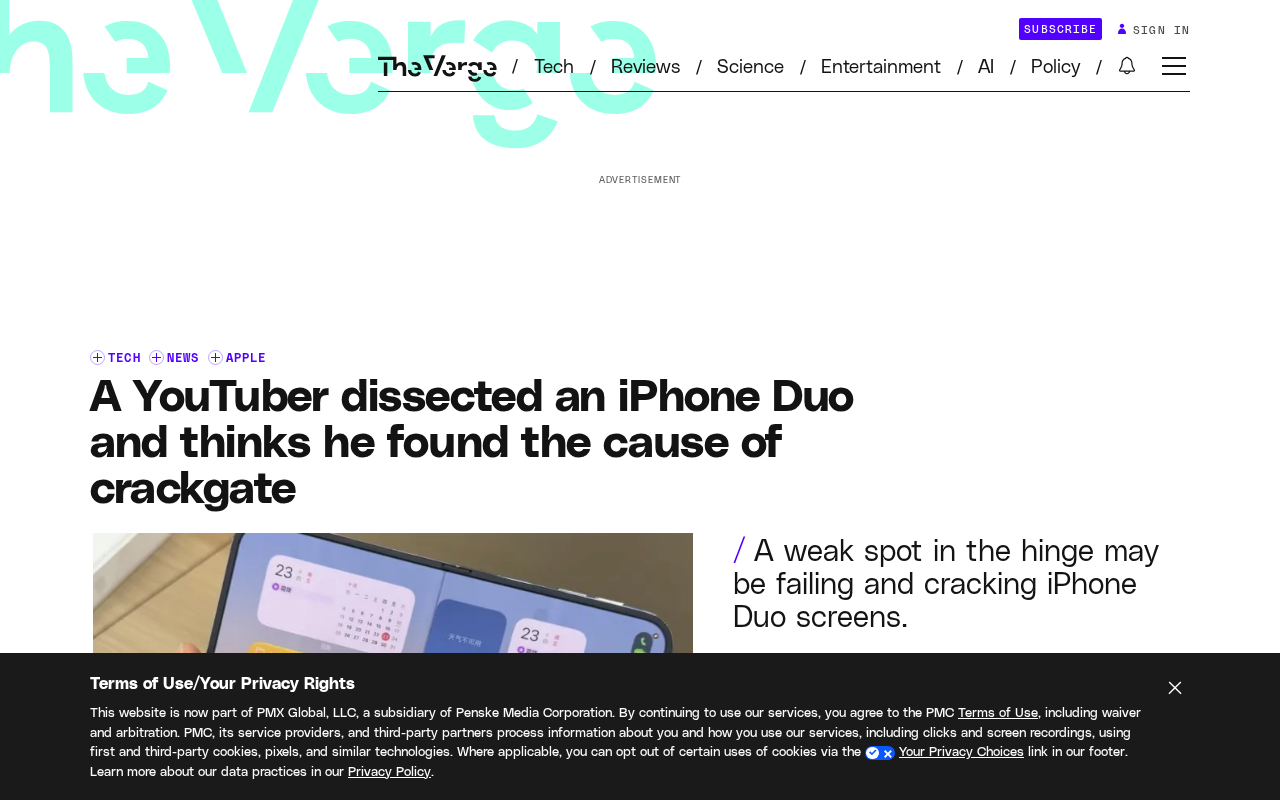
Crackgate Incident Recap
According to user reports on the Reddit iPhone Duo subreddit and social media, the foldable screen failures occurred extremely quickly and violently. Some users described that during normal opening and closing, the hinge seemed to "catch something," followed by a distinct cracking sound and cracks appearing on the screen. All reports point to the same location: the screen crease area near the hinge. This consistency suggests the problem is not accidental but a systemic defect in design or manufacturing.
Although Apple has not officially responded, community discussion has already pointed to the hinge's mechanical structure. Photos and videos uploaded by users show cracks starting from one side of the hinge and gradually extending across the entire folding area. Some users said that before the phone became completely unusable, the hinge would first make abnormal noises or jam.
The reason foldable phone screens can bend lies primarily in their cover materials and structure. Traditional bar phones use glass covers, while foldables typically use transparent polyimide (CPI) film or ultra-thin flexible glass (UTG) as the cover. CPI offers excellent flexibility but is inferior to glass in hardness and scratch resistance; UTG achieves bendability through chemical thinning, but its edges are prone to micro-cracks. Whichever solution is used, the folding area is where stress is most concentrated, and repeated opening and closing subjects the material to cyclic fatigue. When the hinge applies uneven pressure to the screen or foreign objects enter the folding gap, local stress may far exceed the material's tolerance, causing cracks to initiate and propagate from the crease. This is why the cracks reported by users are almost all concentrated in the crease area near the hinge—this location is both a weak point due to material fatigue and the most mechanically complex stress zone.
YouTuber Teardown Findings: Hinge Foreign Objects or Design Defect
The YouTuber showed the iPhone Duo teardown process in detail in the video. He noticed that there are tiny gaps inside the hinge that may allow dust or debris to enter, thereby squeezing the screen during opening and closing. More critically, a certain component of the hinge may apply uneven pressure to the screen during folding, causing fatigue fracture of the flexible screen's polyimide layer.
The teardown also showed that the buffer layer between the screen and the hinge is relatively thin and fails to effectively distribute stress. The YouTuber speculated that this may be a compromise made in pursuit of thinness and lightness, at the expense of durability. His conclusion matches the user-reported phenomenon of "cracking after hinge jamming," but has not yet been officially confirmed by Apple.
The hinge is one of the most precise mechanical components of a foldable phone, and its design directly determines the screen's bending radius and stress distribution. Mainstream hinge solutions include water-drop and U-shaped designs, with the goal of allowing the screen to form a larger bending radius during folding to reduce material strain. The hinge interior typically contains multiple sets of gears, linkages, and damping structures that must work together with high precision. If the hinge has gaps, it may not only allow dust and debris to enter but also produce unexpected displacement during opening and closing, applying shear force to the screen. In addition, the hinge's buffer layer (such as foam or elastomer) is responsible for absorbing and distributing stress, and its thickness and material selection must balance thinness and durability. A buffer layer that is too thin weakens stress distribution capability, causing the flexible screen to directly bear localized compression from hinge components and accelerating fatigue fracture of the polyimide layer. These engineering details are precisely the focus of teardown analysis.
Chain Reaction Among Users and the Community
Crackgate quickly escalated, triggering a new round of doubts about foldable screen reliability. In the iPhone Duo subreddit, many users said they would delay purchases or request returns. Some users shared their experiences communicating with Apple customer service, saying repair costs were high and the inspection process was described as "human damage."
On social media, a large number of discussions gathered under the hashtag #crackgate, and some tech bloggers called on Apple to launch an investigation. One detail to note: not all users encountered the problem, but the concentration of failure reports is enough to raise alarm.
Apple's Silence and Industry Impact
As of publication, Apple has not issued a public statement on Crackgate. Such silence is not uncommon in past product controversies, but it may exacerbate user dissatisfaction. The foldable phone market is in a growth phase, and if the iPhone Duo's failures are confirmed to be a widespread defect, it will affect consumer confidence in foldable technology.
From an industry perspective, hinge design is a core difficulty for foldable phones. Manufacturers such as Samsung and Huawei also encountered similar problems in early products, but gradually optimized through structural improvements. As Apple's first foldable product, the iPhone Duo clearly has shortcomings in durability validation.
Since Samsung's Galaxy Fold launched in 2019, foldable phones have gone through multiple rounds of reliability iteration. Early products frequently failed due to issues such as foreign objects entering the hinge and peeling of the screen protective layer, prompting manufacturers to improve hinge sealing, add buffer structures, and optimize bending radius. Samsung's subsequent UTG cover and enhanced hinge design significantly improved durability, while Huawei adopted a water-drop hinge to reduce creases and stress. These experiences show that foldable reliability depends heavily on the coordinated design of hinge and screen, rather than a single component. As a latecomer, Apple's first product experiencing concentrated failures in durability validation shows that the engineering threshold for foldables remains high. The industry generally believes that maturing foldables requires multiple generations of product iteration and accumulated real-world usage feedback, and it is difficult for any manufacturer to completely avoid such risks in its first product.
Summary and Outlook
The Crackgate incident reveals the engineering challenges of foldable phones in hinges and screen protection. The YouTuber's teardown provides valuable clues, but the final conclusion must await an official investigation. For potential buyers, it is advisable to wait for later batches or for adjustments to Apple's repair policy. Foldables still need time to mature, and this setback for the iPhone Duo may push for stricter quality control.
One-line Summary
Apple's first foldable iPhone Duo has seen concentrated screen cracking at the hinge after launch, dubbed "Crackgate."
Paragraph Summary
Shortly after Apple's first foldable phone, the iPhone Duo, went on sale, a large number of users reported rapid screen cracking at the hinge crease, sometimes breaking within hours, dubbed "crackgate." A YouTuber's teardown found tiny gaps inside the hinge that may allow foreign objects to enter and squeeze the screen, while the buffer layer between the screen and hinge is thin and fails to effectively distribute stress—speculatively sacrificing durability for thinness. Apple has not officially responded, community dissatisfaction is rising, and some users are requesting returns or delaying purchases. The incident has triggered a new round of doubts about foldable reliability, may affect consumer confidence in foldable technology, and highlights that hinge design and screen protection remain core engineering challenges for foldable phones.
Related articles

The LLM Price War: Why Did OpenAI and Anthropic Cut Prices by 80%?
OpenAI and Anthropic cut LLM prices by up to 80% in months. This article analyzes the competition, technology costs, business model shifts, and industry impact behind the price war.
iFixit Teardown of iPhone Duo: Uncovering Foldable Screen Crease and Hinge Flaws
iFixit tears down the iPhone Duo, revealing crease-hiding technology and hinge design, giving a 5/10 repairability score, and analyzing screen and hinge damage causes and impacts on users.

Long Computers, Short AI Infrastructure: One Investor's Contrarian Logic
An investor on Hacker News argues for being long computers but short the AI infrastructure boom. We unpack why technological certainty and capex returns are two different things.