Is an AI Master's Worth It for Non-CS Engineers? Quantic vs OMSCS Deep Comparison
A practical guide comparing Quantic and OMSCS AI master's programs for non-CS engineers seeking AI transition.
This article analyzes whether non-CS engineers should pursue an AI master's degree, comparing Quantic's AI Engineering program ($6K with scholarship) against Georgia Tech's OMSCS. It examines degree recognition, programming prerequisites, and cost-effectiveness, concluding that domain expertise combined with applied AI skills creates more value than pure CS credentials for engineers in traditional industries.
Introduction: The AI Transition Dilemma for Engineers
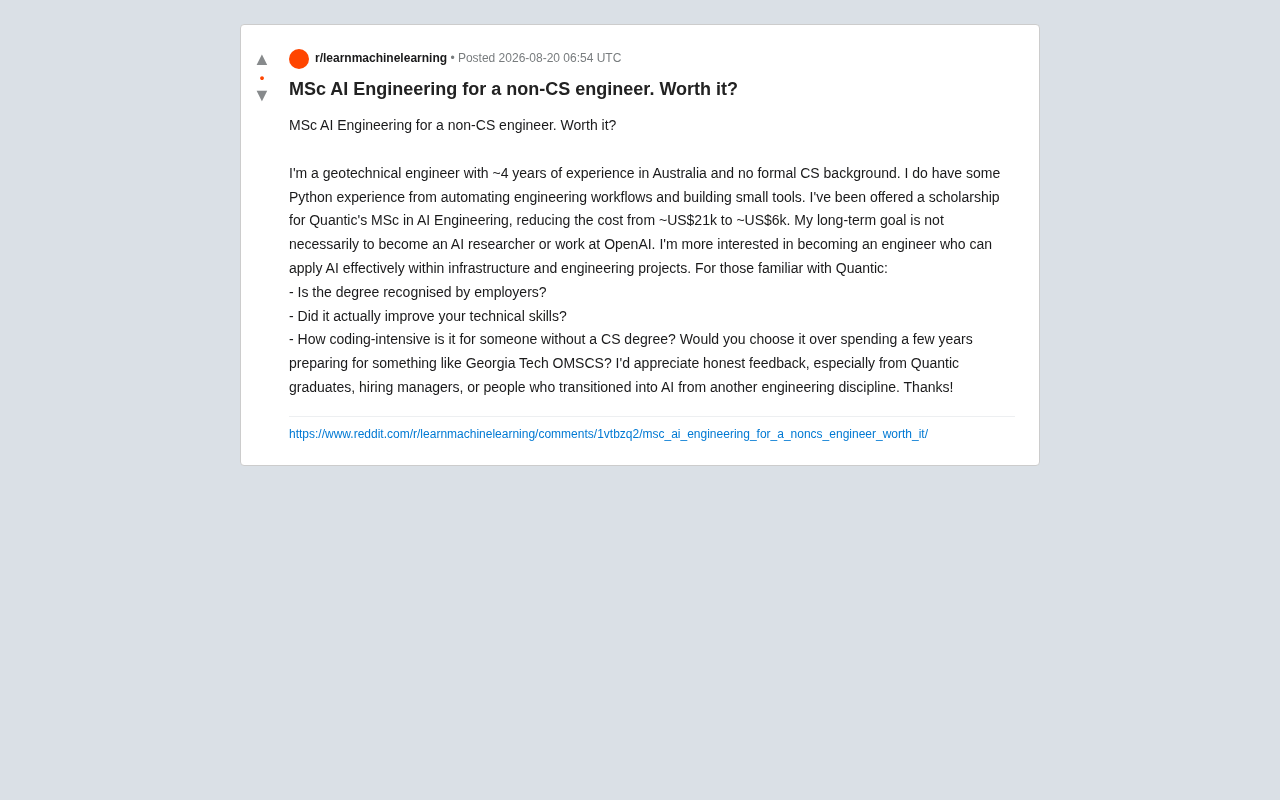
A geotechnical engineer with about 4 years of experience in Australia recently posed a highly representative question on Reddit: as an engineer without a formal computer science (CS) background, is it worth pursuing an AI engineering master's degree?
Geotechnical Engineering is a major branch of civil engineering that primarily studies the mechanical properties of soil and rock and their applications in engineering, involving foundation design, slope stability analysis, tunnel engineering, and more. In recent years, AI technology has been rapidly penetrating the geotechnical engineering field: from using machine learning to predict soil parameters and stratigraphic distribution, to analyzing construction site images through computer vision for automatic geological defect detection, to using deep learning models to predict landslide risks and excavation deformation. As a global leader in mining and infrastructure investment, Australia has an increasingly urgent demand for interdisciplinary professionals who can integrate AI technology into engineering practice.
He has a Quantic AI Engineering Master's scholarship in hand, which would reduce tuition from approximately $21,000 to $6,000. His goal isn't to become an AI researcher or join a top lab like OpenAI, but rather to become an engineer who can effectively apply AI in infrastructure and engineering projects.
Behind this question lies a real dilemma facing a large number of traditional industry engineers today: as the AI wave sweeps across all industries, how should non-CS professionals build their AI capability framework? This article provides an in-depth analysis from multiple dimensions including degree recognition, program comparison, and programming barriers.
The Value of Quantic's AI Engineering Master's: Recognition and Quality
The Reality of Degree Recognition
Quantic is an online business/engineering school known for its mobile-first learning model, flexibility, and relatively low cost. Quantic School of Business and Technology was founded in 2016, formerly known as Smartly Institute, and is an online higher education institution accredited by DEAC (Distance Education Accrediting Commission). Its standout feature is a "mobile-first" micro-lesson learning model—breaking course content into compact interactive modules that students can complete mostly on their phones. It's worth noting that DEAC accreditation differs from traditional regional accreditation (such as SACSCOC, HLC, etc.) in terms of recognition level within the U.S. higher education system. Some employers and academic institutions may have reservations about DEAC-accredited degrees, which should be factored into any assessment of degree value.
For the core question non-CS engineers care most about—"will employers recognize it"—a rational perspective is needed.
For engineers who already have stable careers and industry experience, the "brand endorsement" function of a master's degree is actually relatively secondary. Employers care more about whether you can implement AI technology in real engineering scenarios. In other words, if your goal is to apply AI in geotechnical engineering and infrastructure, capability demonstration (project portfolio) is often more convincing than the degree itself.
By contrast, if the goal is to transition entirely into pure AI/software engineering roles, Quantic's academic reputation and alumni network do fall short compared to traditional prestigious institutions (like Georgia Tech's OMSCS).
Cost-Effectiveness Analysis at $6,000
From a return-on-investment perspective, the $6,000 scholarship price is genuinely attractive. Compared to traditional master's programs costing tens of thousands of dollars, this cost is closer to "premium online course" pricing. The key question is—do you need the "degree" as a formality, or do you simply need the "knowledge and skills" themselves.
Quantic vs. Georgia Tech OMSCS: Core Comparison
The original poster specifically compared Quantic with Georgia Tech's OMSCS (Online Master of Science in Computer Science), which is a crucial decision point.
OMSCS Advantages and Challenges
Georgia Institute of Technology's OMSCS program launched in 2014 as the world's first large-scale online computer science master's degree offered by a top research university, developed in collaboration with Udacity and AT&T. With total tuition of approximately $7,000, it provides a degree of equal value to the on-campus program, earning it the reputation as a "game-changer" in online education. OMSCS currently has over 12,000 enrolled students and offers multiple specialization tracks including Machine Learning, Computational Perception & Robotics, and Interactive Intelligence. The program's core advantage lies in Georgia Tech's CS department consistently ranking in the top ten nationally, with its degree enjoying extremely high recognition in Silicon Valley and the global tech industry.
However, its barriers are also higher:
- Strict CS foundation requirements: Courses assume students have a solid computer science foundation, including data structures, algorithms, discrete mathematics, etc. These are the core theoretical pillars of computer science—data structures determine how to efficiently organize and store data, algorithms determine how to efficiently solve problems, and discrete mathematics provides the mathematical foundation for logical reasoning and formal proofs.
- Long preparation period: As the original poster noted, it may take "several years of preparation" to reach the level needed for admission and successful course completion.
- High study intensity: Known for rigor and high attrition rates, presenting a significant challenge for working professionals.
Quantic's Different Positioning
Quantic's AI Engineering program is more application-oriented, with programming intensity and theoretical depth typically lower than traditional CS programs like OMSCS. For engineers without CS backgrounds, the entry barrier is more accessible, but this also means technical depth may be limited.
The core trade-off is: Do you want to quickly acquire an applicable AI toolkit (Quantic), or are you willing to invest several years building systematic CS/AI theoretical foundations (OMSCS)?
Programming Adaptability for Non-CS Engineers
The original poster already has experience automating engineering workflows and building small tools with Python, which is an extremely valuable starting point.
Python has become the "lingua franca" of AI and data science not just because of its concise syntax and gentle learning curve, but because of the vast scientific computing and machine learning ecosystem behind it. For engineers who already have Python automation experience, the leap from script writing to AI application development is far smaller than learning to code from scratch.
For practical AI engineering applications, the required programming capabilities mainly focus on:
- Python programming and common libraries: NumPy provides efficient multidimensional array operations and serves as the underlying dependency for virtually all scientific computing libraries; Pandas is the standard tool for tabular data processing and analysis, with its DataFrame structure enabling engineers to quickly perform data cleaning and exploratory analysis; PyTorch (developed by Meta, known for dynamic computation graphs and research-friendliness) and TensorFlow (developed by Google, known for its mature production deployment ecosystem) are the two mainstream deep learning frameworks. Additionally, scikit-learn provides rich implementations of traditional machine learning algorithms, while Hugging Face's Transformers library makes calling pretrained models extremely convenient.
- Data processing and analysis capabilities
- Model invocation and API integration (especially for application development in the LLM era)
- Basic software engineering practices
What you might not have noticed is that in the current AI application development field, "applied AI" and "research AI" require vastly different skill sets. Research AI focuses on advancing algorithmic frontiers—practitioners need deep mathematical foundations including linear algebra, probability theory, optimization theory, and information theory, with daily work involving designing new model architectures, writing academic papers, and achieving new SOTA (State of the Art) on benchmark datasets. Applied AI (AI Engineering) focuses on deploying existing AI technology into specific business scenarios, with core skills including data pipeline construction (ETL processes), model selection and fine-tuning, API orchestration and integration, MLOps (Machine Learning Operations), and deep understanding of the business domain.
Especially in the LLM era, the emergence of application-layer technologies like RAG (Retrieval-Augmented Generation), Prompt Engineering, and Agent frameworks has significantly lowered the entry barrier for "applied AI," while actually increasing requirements for engineering integration capabilities and domain knowledge. To deploy AI in infrastructure projects, what's needed more is data processing, model fine-tuning, and engineering integration capabilities—not deriving neural network mathematics from scratch. From this perspective, Quantic's application orientation may better suit the practical needs of non-CS engineers.
Practical Advice: Three Paths for Engineers' AI Transition
Clarify Goals First, Then Choose a Path
For traditional industry engineers with clear application scenarios, consider the following three approaches:
Option One: Accept the Quantic scholarship. If $6,000 is within your budget and you need a formal degree to enhance your resume, this is a low-risk choice. The key is to proactively build an AI project portfolio related to geotechnical/infrastructure work during your studies.
Option Two: Self-study + project-driven approach. Leverage your existing Python foundation, systematically learn through quality resources like Coursera, fast.ai, and DeepLearning.AI, while seeking AI application entry points in your actual work. This path is more cost-effective but requires stronger self-discipline.
fast.ai and DeepLearning.AI are two highly influential educational platforms in the AI self-study space, but with fundamentally different teaching philosophies. fast.ai, founded by Jeremy Howard and Rachel Thomas, advocates a "top-down" learning approach—first letting students build working models using high-level APIs, then gradually diving into underlying principles. This approach is particularly suitable for learners with engineering backgrounds but lacking mathematical theory foundations. DeepLearning.AI, founded by Andrew Ng, offers a more systematic curriculum, from the Machine Learning Specialization to the Deep Learning Specialization to the MLOps Specialization, forming a complete learning pathway from basics to advanced topics. These courses on Coursera provide certification, and while they don't carry the same academic weight as formal degrees, they've gained wide acceptance in industry—many hiring managers view them as strong evidence of a candidate's self-drive and continuous learning ability.
Option Three: Long-term investment in OMSCS. If you want to completely transition into the AI/software field or pursue higher degree prestige, taking time to prepare for OMSCS is a more solid choice.
Domain Intersection Is the True Competitive Moat
The most important point to emphasize is: a geotechnical engineer who understands AI is more valuable in the infrastructure sector than a pure AI engineer. The true competitive advantage for non-CS engineers isn't competing with CS graduates on algorithm depth, but deeply combining AI capabilities with years of domain knowledge.
McKinsey Global Institute and multiple consulting firms have consistently reported that the biggest gap in the AI talent market isn't pure algorithm researchers, but "T-shaped professionals" who can deploy AI solutions in specific vertical industries—composite specialists with both domain depth and AI technical breadth. Taking the infrastructure and construction engineering industry as an example, application scenarios like BIM (Building Information Modeling) combined with AI, intelligent safety monitoring for construction, and Predictive Maintenance are highly dependent on domain knowledge. Pure CS-background AI engineers often struggle to accurately define problems, understand data meanings, and evaluate the engineering reasonableness of model outputs. This means an engineer with 4 years of practical geotechnical experience who also masters AI application skills may be far more scarce and irreplaceable in the talent market than a freshly graduated CS master's student.
Regardless of which learning path you choose, whether you can create impactful AI application cases in real engineering projects is what ultimately determines career advancement.
Conclusion
Quantic's AI Engineering Master's is a barrier-friendly, cost-effective choice for non-CS engineers with application-oriented goals, especially with a scholarship. But it's neither the only path nor a universal key.
What's truly worth investing in is building demonstrable AI application capabilities around your unique domain advantages. A degree is a bonus, but cross-domain practical ability is the scarcest competitive edge for engineers in this era.
Key Takeaways
Related articles

Bilibili's Hit Dify Tutorial: A Practical Guide to Building 20+ AI Apps from Scratch
A distilled guide to Bilibili's top-rated Dify tutorial: Windows + Docker deployment, MySQL connection, five app types, model integration strategy, and publishing.

Agent Skills Beginner's Guide: From Concepts to Multi-Agent Collaboration in Practice
A comprehensive guide to Agent Skills: core concepts, components, the importance of Description, standardization, beginner learning paths, and multi-agent collaboration.

One Neuron Detects Both Cats and Cars? We Reproduced It and Found a New Explanation
The cat-car neuron reinterpreted: researcher Cammarata argues it distinguishes pointy from round, not cats from cars. We reproduced the experiment and found the new explanation holds on most inputs—but cars are the exception. The interpretability debate continues on language models.