Is Anthropic's IPO Worth Buying? Three Alternatives Explained
Anthropic reportedly IPO-ing at $1.5T—strong fundamentals but stretched valuation; indirect ownership may be safer.
The article analyzes Anthropic's rumored $1.5 trillion IPO: ~80% of revenue comes from enterprise usage-based pricing, nearly half via major clouds, with steep growth. About 90% of book losses stem from fair value changes on convertible instruments (accounting, not cash), but off-balance-sheet compute commitments far exceed annual revenue, implying financing pressure. At ~22x P/S, the valuation is well above Alphabet and Amazon; Damodaran's estimate nearly matches the IPO price but rests on aggressive assumptions. Three alternatives: indirect ownership via Amazon (~8% exposure) or Alphabet (~6%), or holding QQQ for passive inclusion—noting large unprofitable firms tend to underperform post-IPO.
Anthropic's IPO: Worth Buying? Three Alternatives Explained
Rumors of Anthropic's IPO are stirring up the capital markets. According to an analysis by the YouTube channel Entropiq, the company behind Claude may go public at a valuation of roughly $1.5 trillion, potentially raising a record-breaking amount. But the question is: at that price, is it really worth buying?
How Good Is Anthropic's Business, Really?
Let's start with the fundamentals. Anthropic's revenue structure isn't what most people imagine—"driven by individual subscriptions." According to the video's analysis, consumer subscriptions (Pro, Max, etc.) contribute only about 20% of revenue, while the remaining 80% comes from enterprise usage-based pricing—like an electricity bill, the more you use, the more you pay. Nearly half of that revenue flows through the three major cloud platforms: Amazon, Google, and Microsoft.
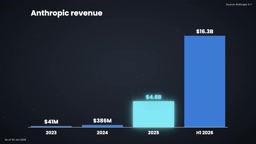
The growth curve is remarkably steep: revenue was just $41 million in 2023, rose to $386 million in 2024, reached $4.6 billion in 2025 (the original narration says "$460 million," but context and screenshots suggest it should be in the $4.6 billion range), and in the first half of 2026 alone it recorded $1.63 billion—more than triple the full year of 2025. The number of enterprise customers paying over $100,000 per month has also climbed sharply.
On losses, we need to break things down. The headline loss figure looks scary, but about 90% comes from fair value changes on convertible instruments—that's accounting treatment, not actual cash draining away. Stripping out these paper items, the real operating loss is limited in scale, and the company still holds $131.7 million in cash and short-term investments.
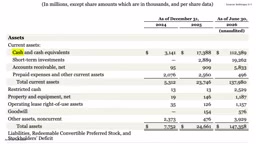
However, the real concern is off-balance-sheet. Anthropic's committed compute procurement obligations far exceed its 12-month revenue. For example, a ten-year agreement with Amazon Web Services requires a minimum spend of $110 billion—if you don't use enough, you still have to make up the difference. This means the company will need to keep raising capital; if growth stalls or financing conditions tighten, pressure will emerge quickly.
Price-to-sales (P/S) ratio is the ratio of market capitalization to annualized revenue, commonly used to value high-growth companies that aren't yet profitable, because profit metrics are often distorted for such companies. Its limitation is that it completely ignores cost structure and profit margins—the same 20x P/S means very different things for a company with 80% gross margin versus one with 30% gross margin. For AI model companies, inference costs and compute expenses significantly erode gross margin, so when comparing P/S ratios across companies, you need to consider gross margin, growth rate, and the path to future profitability together; looking at the multiple alone can lead to misleading conclusions.
Fair value changes on convertible instruments refer to the book gains or losses arising from remeasuring hybrid securities such as convertible bonds and convertible preferred stock at market value at the end of an accounting period. These instruments embed conversion rights, and their valuation is highly sensitive to stock price expectations, volatility, and interest rates, so each reporting period may produce "losses" or "gains" in the billions—but the company hasn't actually paid or received cash. This is why, when analyzing high-growth tech companies, investors typically focus more on operating cash flow and adjusted operating loss rather than GAAP net income. Note, however, that these instruments will ultimately dilute existing shareholders' equity—the paper losses are not without cost.
Compute procurement commitments are common clauses when AI companies sign long-term contracts with cloud providers, typically specifying a minimum spend or minimum purchase volume, with shortfalls still requiring payment. They are off-balance-sheet commitments for accounting purposes, not recorded as liabilities on the balance sheet, but they are essentially close to fixed expenses and lock in cash flow for years to come. For investors, judging the risk of such commitments comes down to two things: first, the multiple of the total commitment relative to current revenue and cash reserves; second, how well the contract term matches revenue growth. If revenue growth slows, these commitments can quickly turn from "growth guarantees" into "financial shackles."
Is a $1.5 Trillion Valuation Expensive?
The video did a simple calculation: based on annualized revenue of about $6.72 billion as of October 2026, a $1.5 trillion valuation corresponds to roughly 22x price-to-sales. For reference, Alphabet is about 7.5x, and Amazon just 3.6x.
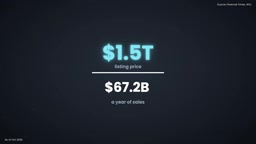
Anthropic's growth is far higher than these two giants, so a premium is reasonable—but does 22x already price in the future? NYU valuation expert Aswath Damodaran puts the value at about $1.48 trillion, almost exactly in line with the IPO price, but he himself admits this figure rests on fairly aggressive assumptions—requiring Anthropic to grow revenue to about 15x its current level within a decade. His conclusion is blunt: if the price after listing is clearly above that level, he won't buy.
There's another often-overlooked data point: scholar Jay Ritter, who has studied IPOs for decades, found that large unprofitable companies on average underperform the market by about 2.7% to 3.4% in the first three years after going public. A good company doesn't equal a good stock—the purchase price matters.
Alternatives: Three Paths to Anthropic Without Buying Directly
If you're bullish on Anthropic but don't want to chase the price on IPO day, the video offers several alternatives.
Path 1: Indirect ownership through Amazon. Amazon's stake in Anthropic is worth about $23.87 billion; based on its market cap of roughly $2.9 trillion, for every $100 of Amazon you buy, about $8 actually corresponds to Anthropic exposure—plus you get AWS, the world's largest cloud business.

Path 2: Indirect ownership through Alphabet. Google's parent company holds about 14% of Anthropic, worth about $210 billion at a $1.5 trillion valuation—roughly 6% of Alphabet's market cap. Buying Alphabet means owning search, YouTube, and Google Cloud all at once.
Path 3: Do nothing. Nasdaq's new rules allow large IPOs to be included in the Nasdaq 100 index just 15 trading days after listing (SpaceX is a precedent). If you already hold an ETF like QQQ, Anthropic will likely enter your portfolio automatically within weeks.
The Nasdaq 100's fast-track inclusion rule is an important change to the index methodology: previously, large new listings typically had to wait months for inclusion; the new rule allows large IPOs ranked near the top by market cap to join the index about 15 trading days after listing. Because ETFs tracking the index (like QQQ) are enormous, inclusion triggers forced buying by passive funds, providing short-term support for the new stock's price. This also means investors holding broad-based tech ETFs will "passively" gain exposure to hot IPOs without having to chase the price on the first day of trading.
Editorial View
A caveat: the above content comes mainly from a single YouTube channel's analysis, and some data (such as discrepancies between narrated and captioned revenue figures) should be verified against Anthropic's official prospectus. But the core logic is worth considering: Anthropic is undoubtedly a high-quality company—its revenue growth, enterprise customer stickiness, and cloud ecosystem ties all form a moat. However, a $1.5 trillion valuation has already priced in the most optimistic scenario, and combined with the ongoing financing needs created by massive compute commitments, the risk-reward of buying on IPO day isn't attractive.
For investors bullish on AI's long-term trend, indirect ownership through Amazon or Alphabet offers both exposure to Anthropic's growth and the cash flow of mature businesses as a buffer—perhaps a more prudent choice. As for whether to participate in the IPO, it depends on your tolerance for "paying for the best-case scenario."
One-line Summary
Anthropic is reportedly IPO-ing at a $1.5 trillion valuation—strong fundamentals but a stretched valuation; indirect ownership may be safer.
Paragraph Summary
The article analyzes Anthropic's rumored $1.5 trillion IPO: about 80% of revenue comes from enterprise usage-based pricing, nearly half flowing through the three major cloud platforms, with steep growth; roughly 90% of book losses come from fair value changes on convertible instruments—an accounting matter—but off-balance-sheet compute commitments far exceed annual revenue, implying ongoing financing pressure. Based on 2026 annualized revenue, the valuation corresponds to about 22x price-to-sales, far above Alphabet and Amazon; Damodaran's valuation is nearly in line with the IPO price but relies on aggressive assumptions. The article also offers three alternatives: indirect ownership through Amazon (~8% exposure), Alphabet (~6% exposure), or holding QQQ to wait for passive inclusion—and notes that large unprofitable companies on average underperform the market in their first three years after listing.
Related articles

No Coding Required: He Shipped an App Store App by 'Cutting Features' and Nitpicking with AI
A game designer with zero frontend/backend skills shipped a dual-platform App Store app with AI—not via one-click generation, but by cutting scope and nitpicking like a demanding client.

What Is Harness Engineering? From Concept Origins to Enterprise-Level Agent Implementation
What is Harness Engineering? This article traces the concept's origins and analyzes enterprise-level Agent requirements for tool call fault tolerance, data security, tenant isolation, and memory gaps.
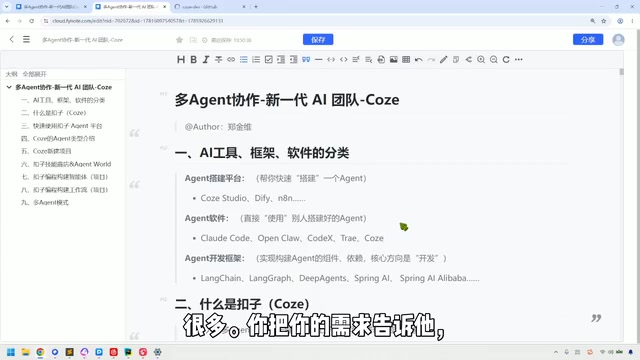
Coze in Practice: A Three-Tier Agent Classification and a Multi-Agent Collaboration Guide
A Bilibili tutorial breaks down the multi-agent collaboration toolchain into three categories: building platforms like Coze Studio and Dify, Agent software like Claude Code, and development frameworks like LangChain—plus a Coze demo of industry templates, three-platform interoperability, local Agent integration, and the trade-offs of credit consumption.