Is DeepSeek Really the OpenAI of Yesteryear? A Five-Point Comparison
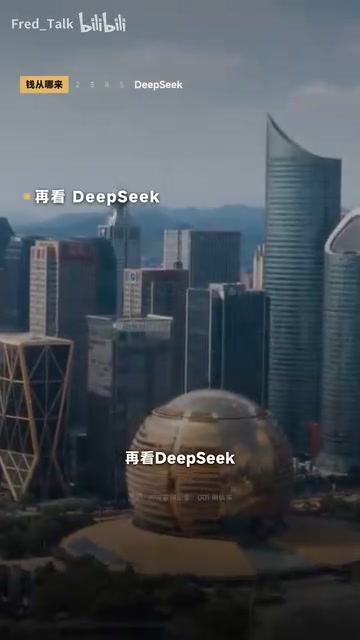
DeepSeek shares the original mission of 2015 OpenAI, but its steering wheel is in one person's hands.
The article compares DeepSeek with OpenAI at its 2015 founding across five dimensions: funding sources, degree of open source, commercialization path, control structure, and compute investment. It concludes DeepSeek is only half right—it resembles OpenAI's original announcement of not prioritizing profit and publishing research, but not its steering wheel: OpenAI's control lies with a nonprofit foundation, while DeepSeek's voting rights are concentrated in a partnership managed by Liang Wenfeng. OpenAI's flagship models remain closed, with revenue over $20 billion and ad experiments; DeepSeek opens weights under MIT, charges thin margins on its API, and is still losing money. The real test, the author argues, comes after an IPO: when shareholders demand returns and 160,000 chips need to pay back, whether the strongest model stays at the front door will determine if DeepSeek is truly the OpenAI of yesteryear.
One-Sentence Conclusion: The Mission Is Similar, But the Steering Wheel Is Different
When OpenAI was founded in 2015, its announcement was crystal clear: it would not be driven by profit, and it would encourage researchers to publish their results, sharing papers and code with the world. Today? Its most powerful models are locked away on its own servers, and it has started testing ads in ChatGPT. Instead, it is DeepSeekAd—whose name doesn't even contain "Open"—that lets anyone download its strongest model. Even Altman himself has said that on the issue of open source, he personally believes OpenAI has ended up on the wrong side of history.
So has DeepSeek really become the OpenAI of yesteryear? Bilibili creator Fred ("Don't watch the excitement, watch the underlying logic") breaks it down into five points for a side-by-side comparison—money, open source, commercialization, control, and compute. My judgment: it's only half right. What's similar is that 2015 announcement; what's different is the steering wheel.
Point One: Where the Money Comes From Determines Whose Orders You Follow
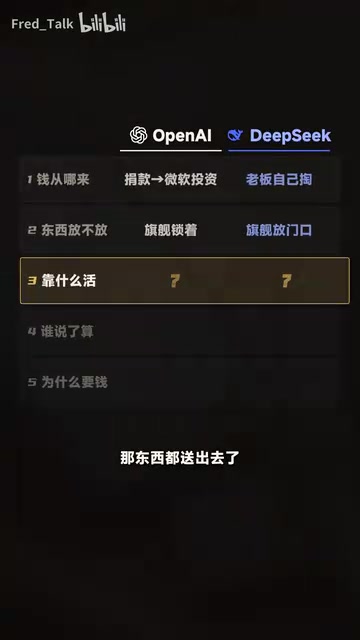
In 2015, Musk, Altman, and others pledged $1 billion to OpenAI. But a pledge isn't the same as money in the bank—OpenAI later disclosed that Musk actually donated less than $45 million, and everyone else combined gave just over $90 million. Building large models costs money for every GPU and every kilowatt-hour of electricity; donations simply can't sustain it. So in 2019, OpenAI set up a for-profit company under the research institute, and that same year Microsoft invested $1 billion.
DeepSeek was founded by Liang Wenfeng in 2023. It didn't seek venture capital—the money came from his own quant fund, High-Flyer. It didn't seek external compute either; High-Flyer had already built a compute cluster years earlier at a cost of 1 billion yuan. Liang Wenfeng has said that VCs want to commercialize as quickly as possible, but they wanted to prioritize research, so it was hard to take money from VCs. Not being in a hurry to answer to investors, but first answering to research—that really does look a lot like that 2015 announcement.
Point Two: Do You Release What You Build?
Once OpenAI's money came in, it started closing things off. GPT-2 in 2019 cited fears of misuse and released only a smaller version first, with the full version coming months later; by GPT-3, it simply offered an API and no download at all. Last August, OpenAI opened up language model weights for the first time since GPT-2, but its most powerful flagship is still locked down to this day.
On DeepSeek's side, R1 and the latest V4.1 weights use the MIT license—anyone can download, modify, and use them commercially. Papers are public, and the inference framework is open source too. Only the training data was withheld by both companies. Put simply: one locks its flagship inside its product, the other puts its flagship at the front door.
The MIT license is an extremely permissive open-source license that allows anyone to freely use, copy, modify, merge, publish, distribute, sublicense, and even sell copies of the software, with the only requirement being to retain the copyright and license notices. For model weights, adopting the MIT license means enterprises can integrate them directly into commercial products without disclosing their own code or paying licensing fees—a sharp contrast to "viral" licenses like the GPL. By choosing MIT rather than a custom restrictive agreement, DeepSeek effectively hands the decision of "can it be used commercially" entirely to downstream users. This is also why its open-source posture is considered more thorough than many "open-weight but commercially restricted" models.
Point Three: What Do You Live On—Scale First or Depth First?
With ChatGPT, subscriptions start at $20 a month, and the free version in the US has begun testing ads. DeepSeek's app is free, has no ads, and mainly makes money through its API. Liang Wenfeng has said their prices are only slightly above cost.
The scale gap is obvious: OpenAI's annual revenue exceeded $20 billion by the end of last year; DeepSeek reportedly earned about 475 million yuan in the first seven months of this year and is still losing money. One is scaling the business first, the other is deepening the research first.
API billing by token is the most mainstream model for commercializing large models: when developers call a model API, they pay based on the amount of text (number of tokens) for input and output, usually priced per million tokens. The advantage of this model is pay-as-you-go access with a low barrier to entry, making it suitable for small and medium developers and enterprise integration; the disadvantage is transparent unit pricing and fierce competition, making it hard to build the stable cash flow of a subscription model. DeepSeek's choice to price "slightly above cost" means it treats the API as a way to cover compute expenses rather than as a profit center—fundamentally different from OpenAI's path of building a high-margin revenue structure through ChatGPT subscriptions and ads.
Point Four (Most Critical): Who Calls the Shots?
On October 17, 2023, less than a year after ChatGPT launched, OpenAI's board suddenly announced that Altman was leaving the CEO role—the founder was removed by his own board. Why could the board fire him? Because the nonprofit part had always controlled the company. The uproar lasted more than ten days, and Altman returned. After the 2025 restructuring, the foundation holds about 26% and Microsoft about 27%, but the right to appoint and remove company directors remains with the foundation. So OpenAI's steering wheel has never been in one person's hands.
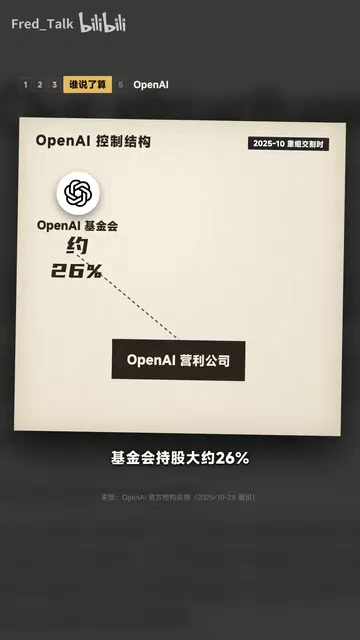
Now look at DeepSeek. In June this year, this company that had said it was "hard to get money from VCs" raised about 51 billion in its first financing round, and in October there was talk of another round of about 100 billion. Is this following OpenAI's old path? The key isn't how much money there is, but who calls the shots after the money comes in. In the first round, Liang Wenfeng himself put in about 20 billion and Tencent about 10 billion, but apart from the National AI Industry Investment Fund, the other investors' money went into a partnership managed by Liang Wenfeng, with no voting rights. The money came in, but the voting rights didn't come with it.
Control by a nonprofit foundation is a special corporate governance structure: a nonprofit entity holds control over a for-profit subsidiary, and the for-profit part can distribute profits to investors, but ultimate decision-making power remains with the foundation. This is the same "capped-profit" model OpenAI adopted when it set up its for-profit subsidiary in 2019: investor returns are capped, and direction is controlled by the nonprofit board. After the 2025 restructuring, the foundation holds about 26% but still holds the power to appoint and remove directors—a clear reflection of this structure. Its original design intent was to prevent short-term return pressure from capital distorting the research mission, but the cost is frequent governance conflicts—the 2023 Altman firing incident was a concentrated outbreak of this tension.
Point Five: Compute, and the Threshold of Going Public
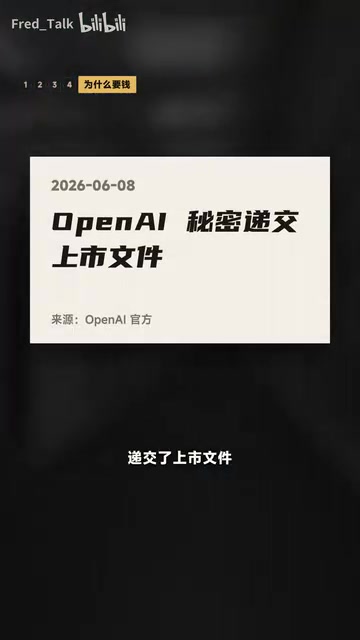
Why do both companies need so much money? The answer is compute. Altman has written on his blog that investment in AI will rise exponentially. In March this year, OpenAI secured $122 billion in committed capital in a single round, and Stargate plans to invest the first $500 billion over four years to build data centers. On DeepSeek's side, Bloomberg reported that it plans to deploy at least 160,000 Huawei Ascend 950 chips—the original source material wrote "Shengteng," which should be "Ascend." So both companies have reached the threshold of going public: OpenAI confidentially filed for a listing in June this year, and in September Altman said it wouldn't go public this year; DeepSeek was also reported to have hired CITIC Securities to prepare for a listing.
Here is my speculation: DeepSeek's real test isn't today, but after it goes public. OpenAI was most open precisely when it had little money and no investors. As the money grew bigger, the doors closed one by one. After DeepSeek goes public and has shareholders, and with 160,000 chips to pay back, whether the strongest model is still placed at the front door at that point will show whether it really resembles the OpenAI of yesteryear.
And having the steering wheel in one person's hands has its upside—whether to drive is up to that one person—and its risk: whether to drive is up to that one person alone.
Huawei Ascend 950 is a model in Huawei's Ascend series of AI accelerator chips, part of a domestic compute alternative, mainly used for large-scale model training and inference. Against the backdrop of US export controls on high-end GPUs, Ascend chips are seen as one of the domestic alternatives to Nvidia products, but their software ecosystem (CANN) still lags behind Nvidia's CUDA in maturity, and migration and tuning costs are higher. DeepSeek's plan to deploy at least 160,000 Ascend 950 chips represents both an expansion of compute scale and a need for its tech stack to deeply adapt to domestic chips, which will affect training efficiency, model iteration speed, and the long-term cost structure of compute.
Having "Open" in the Name Doesn't Count—Who Holds the Steering Wheel Does
Back to the opening question: Is DeepSeek the real OpenAI? I think it's only half right. What's similar is that 2015 announcement—not being in a hurry to make money, and releasing what you build; what's different is the steering wheel: OpenAI's steering wheel is in the hands of a foundation, while DeepSeek's is in the hands of one person, Liang Wenfeng.
So the question really worth watching isn't whether it's open source today, but whether, after going public and after shareholders demand returns, the strongest model will still be placed at the front door.
Related articles

9 AI Subscription Plans Compared: The Real Cost Per 100M Tokens Revealed
Bilibili creator tests 9 AI subscription plans from Volcano, Alibaba, Tencent, Baidu, Zhipu, Xiaomi, MiniMax and more, converting them all to real cost per 100M tokens, breaking down fixed-quota vs. three-tier coefficient billing and how caching, time-of-day discounts, and window limits affect actual quota.

Vibe Coding for Beginners: Expressing Intent Instead of Handwriting Code
What is Vibe Coding? A 137-episode Bilibili course defines it: the core is expressing intent, not writing code. This article analyzes Vibe Coding's productivity logic, target audience, and entry expectations to help beginners decide if it's worth learning.

LangChain Beginner's Guide: An Agent Development Roadmap from LangGraph to Deep Agents
Clarify the encapsulation relationship among LangChain, LangGraph, and Deep Agents, and master the learning path and selection logic for agent development frameworks—suitable for beginners in large model development.