Is Fable 5.2 the Strongest Model? A Creator's Hands-On Comparison and Model Selection Advice

A creator's hands-on test finds Fable 5.2 the strongest but not his workhorse; models should be routed by task complexity.
After testing multiple large models, a tech content creator judges Fable 5.2 the strongest he has used, though he lacks sufficient evidence to prove Opus 55 weaker. He still relies on Opus 55 daily, uses Sonnet for simple front-end tasks, Haiku for ultra-low-cost scenarios, and Fable 5.2 for code review, architecture judgment, and contract analysis. Despite a higher per-token price, Fable 5.2 consumes fewer tokens per task, making it more cost-efficient overall per benchmarks. Key insight: capability ceiling and usage frequency are different things—route by task complexity, treat benchmarks as reference only, and run your own comparative tests.
Is Fable 5.2 the Strongest Model? A Creator's Hands-On Comparison and Model Selection Advice
After hands-on testing of multiple large models, a tech content creator offered his verdict: Fable 5.2 is the strongest model he has used to date, but "strongest" does not mean "use it for everything." He still relies on Opus 55 as his daily workhorse and switches to Fable 5.2 only in specific scenarios. This seemingly contradictory approach actually reveals the real logic behind model selection today—not finding a single optimal solution, but routing tasks by complexity tier.
The Verdict Up Front: Strongest Model, but Not Necessarily the Workhorse
According to the analysis on his YouTube channel, he states plainly that "in my view it is simply the best model out there right now," and he found no evidence suggesting Opus 55 is stronger. He acknowledges that his usage of Opus 55 has not been extensive enough to assert that it always solves problems better, but overall he finds Fable 5.2 to be more competent.
At the same time, he stresses that this does not justify "using it exclusively, forever." The strongest model tends to be the most expensive, and the truly rational approach is to deploy it where it is needed most.
The Counterintuitive Cost Efficiency: Expensive, Yet Cheaper
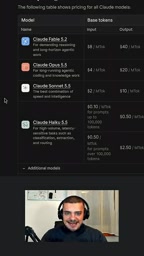
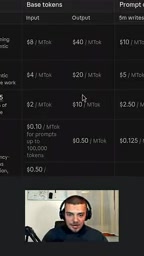
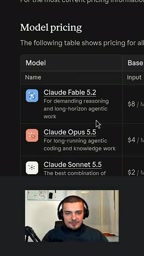
Fable 5.2 has a higher per-token price, and the creator does not shy away from this. But he points out that benchmarks show it consumes fewer tokens to solve the same task, making it more cost-efficient overall.
This highlights a notable pitfall in model selection: choosing models by unit price often underestimates the value of strong models. If the number of interaction rounds and total token count needed to complete a task drops significantly, a higher unit price does not mean a higher total cost. Of course, the creator also acknowledges that this judgment is based mainly on benchmark data, and actual business differences still need to be verified independently.
Benchmarks are a common means of evaluating model capabilities, typically designed by third-party organizations or model vendors as standardized task sets (such as code generation, mathematical reasoning, reading comprehension, etc.), using unified metrics (accuracy, pass rate, token consumption, etc.) to compare different models side by side. Common benchmarks include MMLU, HumanEval, SWE-bench, and others. Their limitations are that task distributions often diverge from real business scenarios, models may overfit to specific question types, and settings such as prompts and temperature parameters during evaluation can significantly affect results. Therefore, the creator's emphasis that benchmark data is "for reference only" and that teams should run their own comparative tests on their own tasks is a reasonable reminder.
His Actual Tiered Usage: Four Models, Each with a Role
The creator shared his daily model routing strategy, which is the most actionable part of the entire discussion:
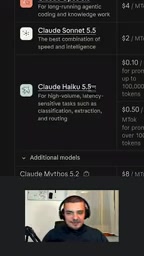
- Opus 55: Still the primary driver, handling most day-to-day work
- Sonnet: Handles relatively simple tasks, such as front-end work
- Haiku: Used when extremely low cost and cost-effectiveness are the priority
- Fable 5.2: Used for code review, architectural judgment, contract clause analysis, and other scenarios requiring big-picture thinking and high complexity
The core of this tiered approach is reserving the "expensive model" for tasks where "getting it wrong causes major problems," while delegating routine execution to more economical models.
Model routing / cascade is a cost optimization strategy: requests are graded by difficulty, simple tasks go to lightweight, cheap models, and complex or high-risk tasks escalate to flagship models. Implementation can be manual rules (such as presets by task type) or automatic judgment by a router model. The theoretical basis is that task difficulty distribution typically follows a long tail—most requests do not need the strongest model. Tiered routing can significantly reduce average cost while keeping quality loss manageable, but it also introduces the risk of routing misjudgments: mistakenly escalating a simple task wastes cost, while mistakenly downgrading a complex task can cause quality problems. The creator's four-model division of labor is essentially a manual version of tiered routing.
The Three Task Types Best Suited to Fable 5.2
The creator specifically listed several scenarios where he proactively consults Fable 5.2:
Code review and security checks. When you need someone to tell you "is this code safe, are there any obvious problems," Fable 5.2 is the right choice. He also candidly notes that having the model hunt for vulnerabilities may not work well, but overall review is fine.
Architectural soundness judgment. He will ask directly: from an architectural standpoint, is this reasonable? Are there any obvious design flaws? These questions require not local patching ability but a grasp of the overall structure.
Contract and clause reading. When reading contracts and deciding how to handle certain clauses, he also turns to Fable 5.2. This is a typical "high-complexity, requires holistic understanding" task.
In his words, Fable 5.2 is more like "an architect you can consult on big-picture or extremely high-complexity issues."
Code review and vulnerability discovery place fundamentally different demands on model capabilities. Code review focuses on pattern recognition of overall readability, logical consistency, potential defects, and security risks; the model only needs to understand context and give a judgment, making it an "understanding + evaluation" task. Vulnerability discovery requires the model to actively construct attack paths and find deep boundary conditions, often demanding precise code execution reasoning and adversarial thinking—areas where current models remain limited in reliability. The creator's observation that Fable 5.2 is suited to the former but not the latter aligns with widespread industry observation: large models perform relatively well in static review but still have clear shortcomings in systematic vulnerability discovery.
Takeaways for Developers
The value of this discussion is not in providing a "who is strongest" ranking, but in demonstrating a transferable approach to model selection:
First, capability ceiling and usage frequency are two different things. The strongest model is usually the most expensive, and making it the default workhorse is not necessarily economical—but at key decision points its value is amplified.
Second, switch models by task complexity rather than by habit. Front-end work and simple scripts go to lightweight models, while architecture review and contract analysis call on the flagship model. This routing controls both quality and cost.
Third, benchmark data is only a reference. The creator himself admits that his usage of Opus 55 has not been sufficient to draw absolute comparison conclusions. For teams, the most reliable approach remains running a round of comparative testing on their own real tasks.
It should be noted that all the above judgments come from a single creator's subjective experience and public benchmarks, not rigorous side-by-side evaluation. Whether Fable 5.2 is truly "the strongest" may have different answers depending on task type.
Related articles

Gemini 4 Neon Review: Benchmark Scores Rival Carbon, API Pricing and Quota Breakdown
Google Gemini 4 Neon is now live, benchmark scores closely tracking Carbon, API pricing 3/15 at twice Hydrogen's rate. This article compiles Bilibili creator testing: Neon can replace 90% of Carbon scenarios, AntiGravity quota consumption is only one-third of Carbon, plus subscription channel restrictions and 2API ban risks.

Gemini 4 Helium Coming Soon? Signals of Google Loosening Subscription Restrictions
Google team member hints releases will continue; community speculates Gemini 4 Helium (Flash Lite) may be next. Subscription ban controversy gets a response as product lead says "Soon," suggesting restrictions may be lifted. This article covers Gemini developments, OpenAI Coding Agent and risk management, Doubao real-time audio-video API, and compute business dynamics.

AI-Assisted React Development in Practice: Optimizing a Video App and Handling Errors
A 14-year veteran developer demonstrates AI-assisted React video app optimization: compressing video from 80MB to 5MB (~94%) via ImageKit, plus reliable error handling and retry mechanisms. Includes planning, code understanding, and verification methods for working with AI.