Is Kimi K3 Really Cheap? Real-World Testing Reveals the Hidden Cost of Token Consumption

Kimi K3's cheap token price masks high actual costs when complex tasks consume massive tokens without results.
A Reddit developer found that switching from Anthropic's Opus 5 to the cheaper Kimi K3 for a complex bug fix actually wasted more money—consuming 7% of their quota with no results. This case illustrates why Total Cost of Task, not unit token price, is the true measure of LLM cost-effectiveness. Developers should adopt tiered model selection, monitor token usage in real-time, and evaluate models by end-to-end task completion efficiency.
Low Unit Price ≠ Low Cost
In the ongoing price war among large language models, the Kimi series has always been known for its highly competitive pricing. When Kimi K3 was released, its low token unit price once again became a hot topic among developers. However, a real-world experience shared by a Reddit user threw cold water on the excitement: a cheap per-token price doesn't necessarily mean low actual usage costs.
This developer was originally using Anthropic's Opus 5 to fix a complex bug, but while watching the token consumption rapidly climb on Cursor's usage monitoring page, he decided to stop. Cursor is a programming IDE deeply integrated with AI capabilities based on VS Code, allowing developers to flexibly switch between multiple large language models while providing a real-time usage monitoring panel that makes token consumption crystal clear. Concerned about costs, he stopped midway and switched to the supposedly cheaper Kimi K3 to continue debugging. The result was unexpected—after consuming nearly 7% of his quota, he still hadn't gotten any meaningful results.
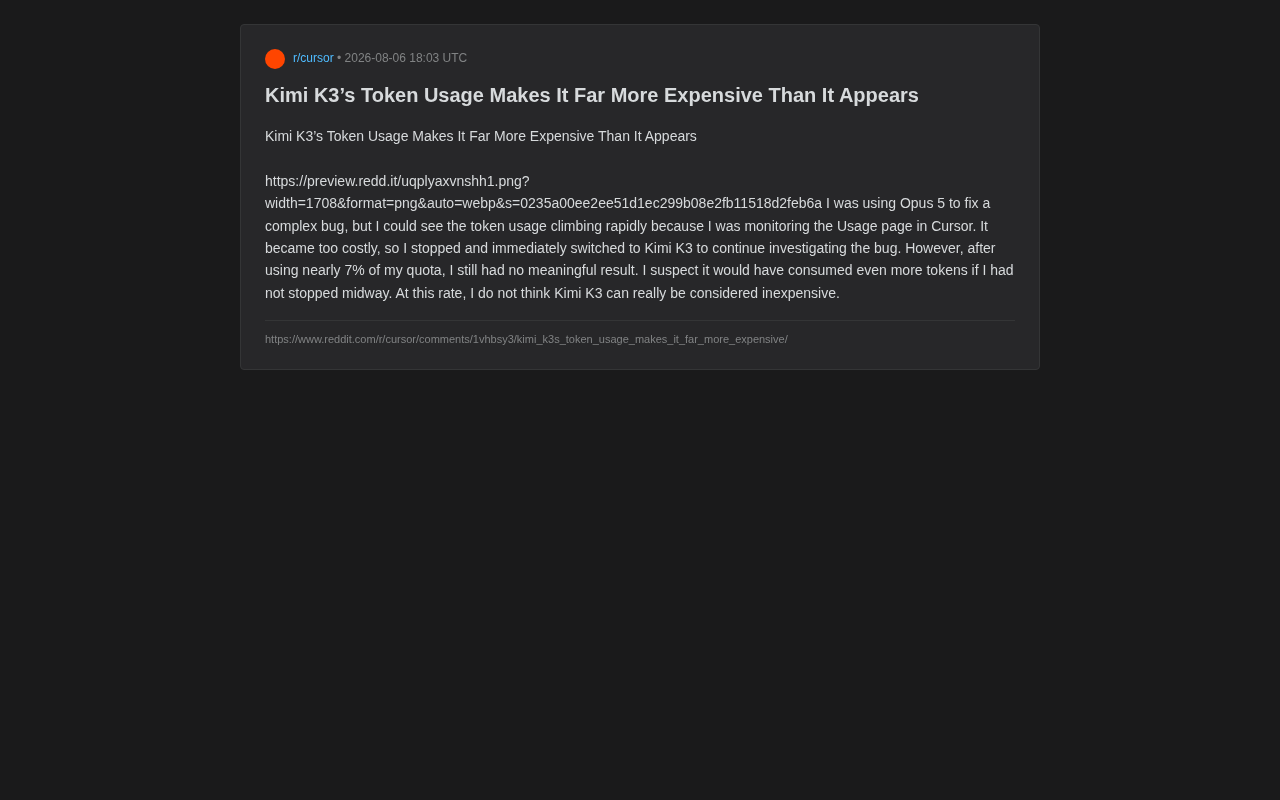
He stated bluntly in his post: "If I hadn't stopped midway, it probably would have consumed even more tokens. At this rate, I don't think Kimi K3 can really be considered cheap."
Why "Cheap" Models Can Actually Be More Expensive
This case reveals a core issue that's frequently overlooked in LLM usage: The correct metric for evaluating model cost isn't the unit token price, but the Total Cost of Task.
Total Cost of Task is a results-oriented cost evaluation framework. It includes not only direct API call fees but also the developer's time cost waiting for model responses, rework costs from incorrect results, and the cumulative context retransmission costs across multi-turn conversations. In enterprise-level AI applications, this metric is gradually replacing simple unit price comparisons as the core basis for technology selection.
Unit Price × Consumption = True Cost
To understand this formula, you first need to understand the basic mechanics of token billing. A token is the fundamental unit by which large language models process text—typically one English word corresponds to 1-2 tokens, and one Chinese character corresponds to 1-3 tokens. LLM billing is usually split between input tokens (prompts and context sent by the user) and output tokens (responses generated by the model), with output token prices typically being several times higher than input tokens. In programming assistance scenarios, because large amounts of code context need to be sent, input token consumption often far exceeds users' intuitive expectations.
The actual cost of a model is determined by two factors: the price per token, and the total number of tokens required to complete a task. A model with a cheap unit price that requires repeated trial-and-error and generates massive amounts of redundant reasoning may ultimately cost far more than a model with a higher unit price that gets it right the first time.
In this user's experience, Opus 5, while expensive per token, likely has stronger reasoning efficiency and problem-locating ability; whereas Kimi K3, despite its low unit price, consumed massive amounts of tokens on the same complex bug with no output. It's worth understanding the positioning difference between the two: Kimi K3 is the latest model from Moonshot AI, marketed for its extremely low token pricing and long context window, positioned as a high-value general-purpose model; Anthropic's Opus series is the flagship product in the Claude model family, representing the strongest reasoning and programming capabilities at the highest price point. The pricing difference between them can be several times or even more than tenfold—which is precisely what motivated the developer to try switching. However, when "solving the problem" is used as the benchmark, the cheap model actually became the expensive choice.
Complex Tasks Amplify Efficiency Differences
You might not have noticed, but the user was facing a "complex bug." For simple tasks, the token consumption differences between models may not be significant; but in complex scenarios requiring deep reasoning and multi-turn context understanding, the capability gap between models gets dramatically amplified.
Weaker models often require:
- More rounds of back-and-forth conversation
- Longer Chain of Thought reasoning
- Repeatedly re-reading and re-analyzing large amounts of context
- Generating numerous attempts that ultimately prove ineffective
Chain of Thought is a technique that has large language models show intermediate reasoning steps. In complex problems, models generate large amounts of intermediate thinking process tokens. While these reasoning steps help improve the accuracy of the final answer, they also significantly increase token consumption. Some reasoning-enhanced models (such as DeepSeekAd-R1, Kimi K3, etc.) generate very long chains of thought, where the reasoning process tokens can sometimes be dozens of times the length of the final answer. When these lengthy reasoning chains ultimately fail to lead to the correct answer, all those tokens become pure waste—this is a major source of "hidden costs."
All of these translate into real token expenses. Therefore, in complex programming tasks, a model's "value for money" must be evaluated holistically in conjunction with its actual problem-solving ability.
Implications for Developer Model Selection
This real-world case has universal reference value for developers using AI programming tools.
Build Task-Based Cost Awareness
Don't make decisions solely by staring at the per-million-token price on pricing tables. A more reasonable approach is to compare the end-to-end cost of different models completing the same type of task in your actual workflow. Sometimes, paying a bit more per token for a stronger model can actually save total costs by reducing trial-and-error and context repetition.
Specifically, developers can establish a simple cost tracking mechanism: record the task type, model used, tokens consumed, and whether the problem was ultimately solved for each AI-assisted programming session. After accumulating sufficient data, you'll clearly see the true cost-effectiveness of different models across different task types, rather than being misled by marketing-promoted unit prices.
Make Good Use of Usage Monitoring Tools
This user was able to identify the problem and make a judgment in time precisely because he was consistently watching Cursor's usage monitoring page. Real-time monitoring of token consumption is an excellent habit—it helps you cut losses before costs spiral out of control, avoiding continued investment in the wrong model.
Beyond Cursor's built-in monitoring panel, many API management platforms (such as Helicone, LangSmith, etc.) also provide detailed token consumption analysis features that can help developers examine their AI usage patterns from a macro perspective and discover potential cost optimization opportunities.
Tiered Model Selection by Task Type
A pragmatic strategy is to use different models based on task difficulty:
- Simple, repetitive tasks: Use low-unit-price models to fully leverage their price advantage
- Complex, high-value tasks: Prioritize flagship models with strong problem-solving capabilities, trading efficiency for cost
Use cheap models in scenarios where they can perform efficiently, rather than blindly using them for complex problems that exceed their capabilities. This tiered strategy is also known in the industry as "Model Routing"—some cutting-edge AI development frameworks have already begun supporting automatic selection of the most appropriate model based on task complexity, achieving optimal balance between cost and quality.
Single-Point Feedback That Requires Rational Perspective
It must be pointed out that this is anecdotal feedback from a single user with a limited sample size and lacking rigorous controlled experimental data. Whether the complex bug the user encountered is representative, and how Kimi K3 performs on other types of tasks, still needs more testing to verify.
Furthermore, model performance is also closely related to prompt quality, context management approaches, and specific integration tool (such as Cursor) configurations. The same model can produce vastly different results in different users' hands. For example, the system prompts, context window management strategies, and code snippet selection logic that Cursor employs when calling different models may all differ—these middleware implementation differences can also affect final token consumption and task completion quality.
However, the core insight of this case remains extremely valuable: In the era of large language models, 'cheap' is a concept that needs to be redefined. We shouldn't be misled by superficial unit prices, but should make truly rational technology choices based on overall efficiency and final cost of task completion. As more and more models join the price war, this upgrade in cost awareness may be more important than chasing the lowest unit price.
Key Takeaways
Related articles

AI Digital Twin in Action: Using DOT to Automatically Track Bugs and User Feedback
DOTS engineers demonstrate how AI digital twin DOT collects cross-platform user feedback, categorizes issue themes, opens threads to investigate bug root causes, and submits PRs—showcasing a complete AI agent workflow for defect triage with auditable design.

Why Transistors Are No Longer Flat: The Evolution from Planar to Gate-All-Around
Transistor evolution from planar to FinFET to gate-all-around: why gates went from three-sided to four-sided wrapping to suppress short-channel effects and leakage current, extending Moore's Law.

Swarm Intelligence = a Single RL Agent? A Proof of Multi-Armed Bandit Equivalence
A paper proves that collective decision-making through local imitation in swarms is mathematically equivalent to single-agent reinforcement learning: N blind imitators act as N parallel environment samples, with an effective learning rate of 1/N. This article explains the derivation and implications of the Maynard-Cross Learning algorithm.